June 26, 2026
Drywall Vs Plywood for Garage Walls: Best Choice in 2026
If you're finishing your garage, you've probably hit the same fork in the road most Sacramento Valley homeowners face: drywall vs plywood for garage walls , which one actually makes sense for your space, your budget, and your local building codes? It's a fair question, and the answer isn't as straightforward as a quick Google search might suggest.
Both materials get the job done, but they do it differently. Drywall gives you a clean, finished look and meets fire-code requirements in most residential garages without extra work. Plywood brings impact resistance and easy mounting for shelves, pegboards, and tool storage. The right pick depends on how you plan to use the space, what your city inspector expects, and how much you're willing to spend.
At Super Shooters, we've completed over 10,000 residential projects across the Sacramento Valley, and garage drywall is one of the most common calls we get. After 30+ years of hanging, finishing, and repairing drywall in every type of garage you can imagine, we've seen firsthand what works and what leads to callbacks and regret . This article breaks down the real differences between drywall and plywood for garage walls, covering cost, durability, fire safety, installation, and long-term maintenance so you can make a decision that holds up.
Why your garage wall material choice matters
Most homeowners treat the garage as an afterthought, but the walls you choose shape every decision that follows : shelving layout, electrical rough-in, insulation strategy, and whether you pass a city inspection on the first visit. Picking the wrong material for your specific garage means you either redo the work early or live with a wall that doesn't perform the way you need it to. The choice between drywall vs plywood for garage walls isn't just a budget question; it's a function question.
Your garage serves more roles than you think
The average Sacramento Valley homeowner uses their garage for vehicle storage, tool organization, project work, and general overflow from the house . Each of those uses puts different demands on the walls. If you hang bikes, install a pegboard system, or want adjustable shelving brackets anywhere you like, you need a surface that accepts fasteners at any point without requiring you to hunt for studs every single time.
A garage that doubles as a workshop needs walls that survive impact from equipment, humidity swings, and the occasional scrape from lumber or a hand truck . A garage attached to your house that you use mainly for parking needs walls that satisfy fire separation codes and keep the living space insulated from exhaust fumes and temperature swings. These are not the same problem, and they don't have the same solution.
The function of your garage drives the right wall material far more than personal preference or upfront cost alone.
Local codes and inspections have real consequences
If your garage is attached to your living space , the California Building Code and most Sacramento-area jurisdictions require a fire-rated separation between the garage and the house. That typically means 5/8-inch Type X drywall on the shared wall and sometimes the ceiling too. Plywood does not meet this requirement on its own. If you skip this step and a building inspector finds it during a future sale or remodel permit pull, you are tearing out the wall and starting over from scratch.
Detached garages have more flexibility , but that doesn't mean anything goes. Electrical work, insulation, and egress requirements still apply, and any permitted project will receive a final inspection. Knowing what your local inspector expects before you buy materials saves you a wasted trip to the lumber yard and avoids costly surprises at the end of a project.
The long-term cost picture is bigger than the purchase price
Material cost is only one part of the equation . Drywall costs less per sheet but requires more finishing labor, including taping, mudding, and sanding. Plywood costs more per sheet but installs faster and needs no finishing work at all. If you hire a contractor, labor makes up the larger share of your total bill , so the time difference between the two materials matters just as much as the price tag at the store.
Down the road, a damaged drywall section is inexpensive to patch if you catch it early and hire someone who knows what they're doing. A damaged plywood panel often means replacing the entire sheet for a clean, consistent look. Factor in how long you plan to stay in the home , how hard those walls will actually work on a daily basis, and whether you'll want to repaint or refinish the surface in five years before you commit to either material.
Drywall for garage walls, explained
Drywall is a panel made from gypsum plaster sandwiched between two layers of paper facing . It comes in standard 4x8 sheets, though 4x12 sheets are common for larger garage walls where you want fewer seams. For most residential garages in the Sacramento Valley, you'll use either 1/2-inch standard drywall on non-attached walls or 5/8-inch Type X drywall where fire separation is required. Once installed, taped, and finished, drywall gives you a paintable surface that looks like any other finished room in your home.
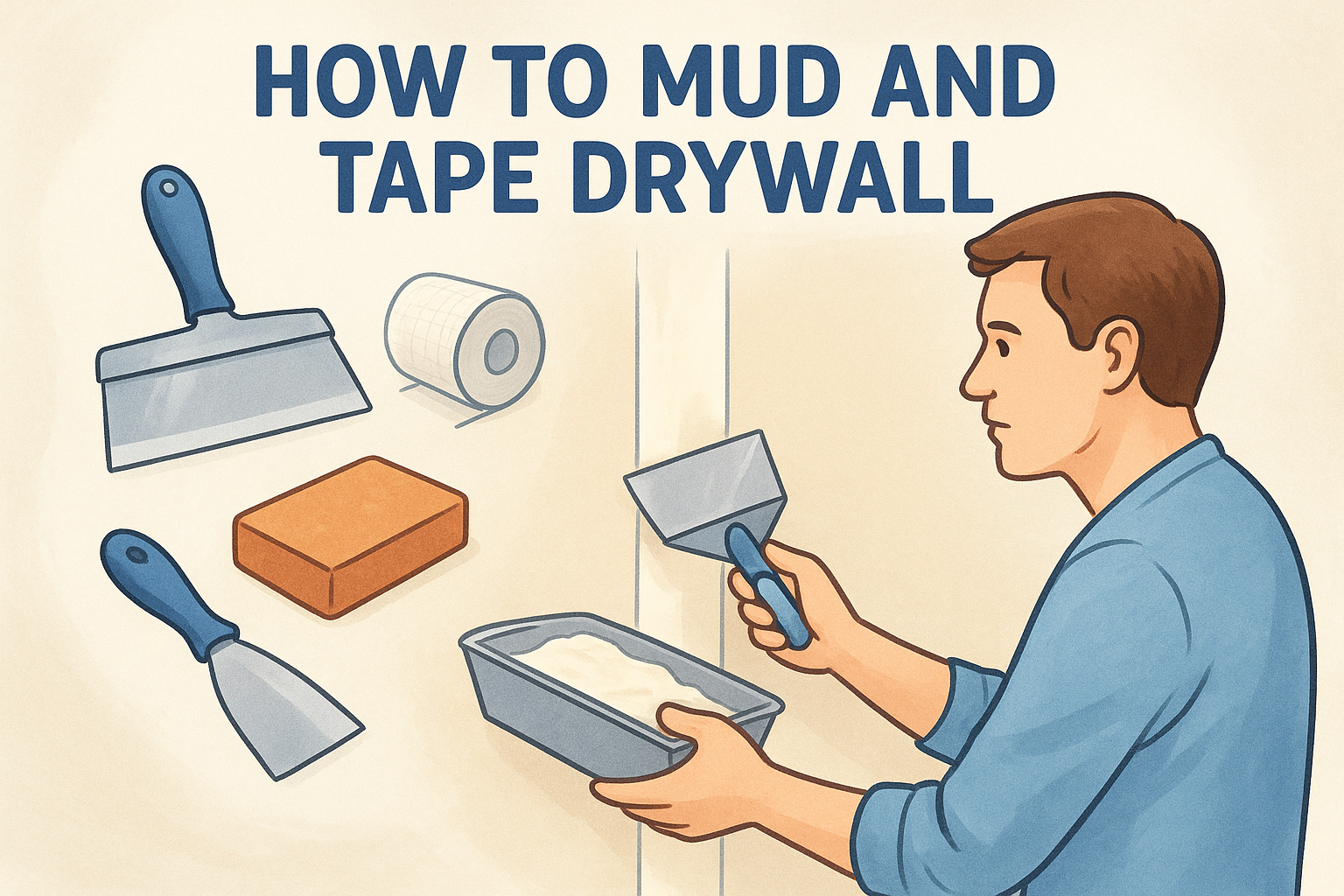
The finishing steps, taping, mudding, and sanding, are where most of the labor time lives on a drywall project.
Why drywall is the default choice for attached garages
If your garage shares a wall or ceiling with your living space, drywall is not optional . The California Building Code requires fire-rated wall assemblies on garage-to-house separations, and 5/8-inch Type X drywall is the standard way to meet that requirement. Plywood does not satisfy this code on its own, which means choosing plywood for that shared wall puts you in violation before the project is even finished. When you weigh drywall vs plywood for garage walls on an attached garage, code compliance alone pushes you firmly toward drywall for the walls that matter most.
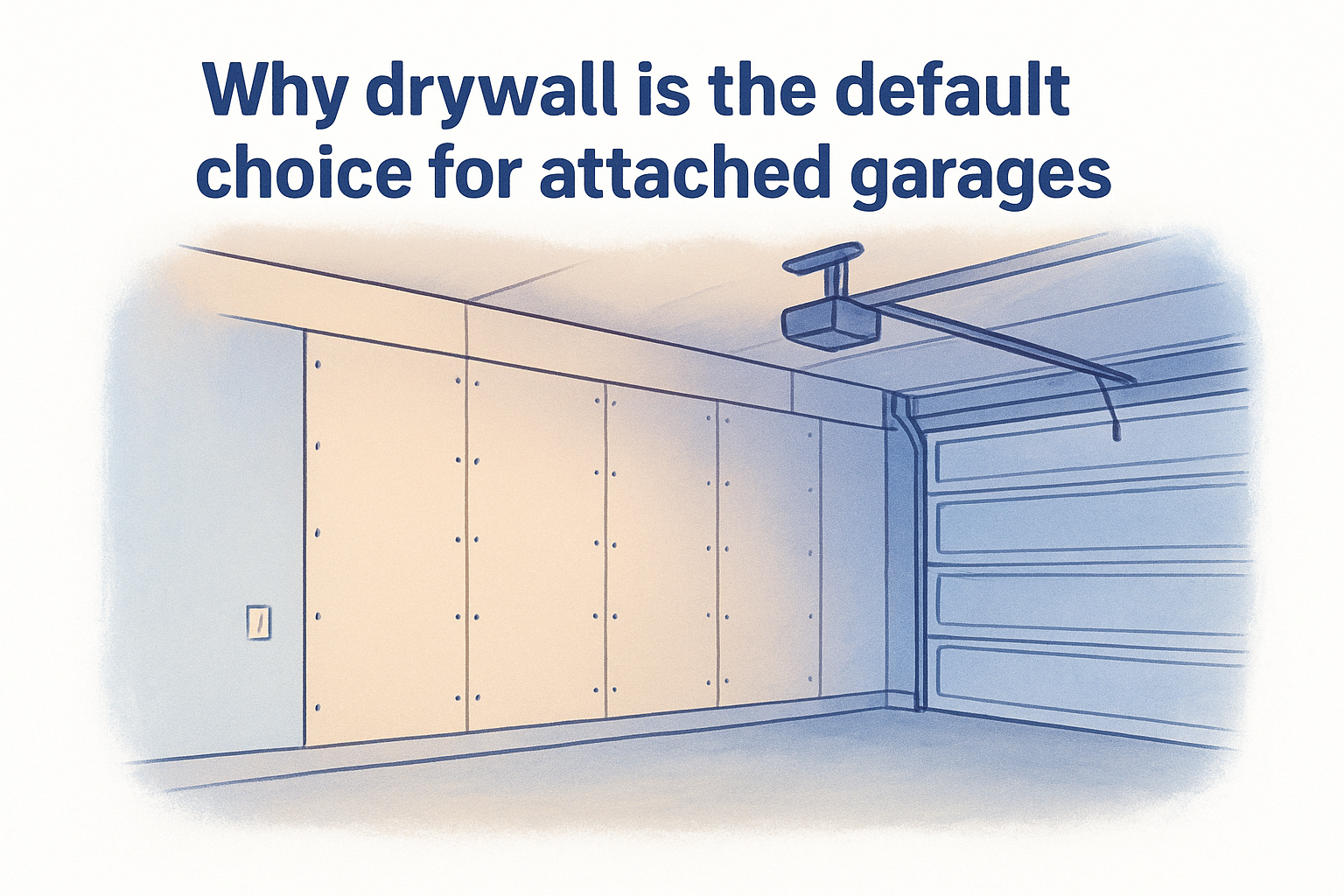
Standard 1/2-inch drywall works fine for the exterior-facing and non-shared walls of the same garage. Many homeowners use Type X on the shared wall and 1/2-inch drywall everywhere else to keep material costs reasonable without cutting corners on the fire separation.
What drywall doesn't handle well in a garage
Drywall is not impact-resistant . Back a bumper into it, drag a ladder along the surface, or let moisture sit against the base of the wall, and you'll see damage faster than you'd expect. Standard drywall absorbs moisture readily , which makes it vulnerable in garages without climate control or proper vapor barriers. Moisture-resistant drywall, sometimes called green board, performs better in humid conditions but still isn't a waterproof product.
Finishing drywall also requires specific skills and tools : corner bead, joint compound, sanding equipment, and at least two or three coats of mud before you paint. If you hire a contractor, this finishing work drives up the total cost compared to plywood, which you can paint or leave raw the same day it goes up.
Plywood and OSB for garage walls, explained
Plywood is a sheet material made from thin wood veneers glued together in alternating grain directions , which gives it strength across the entire panel rather than just along one axis. For garage walls, the most common thickness is 3/4 inch , though 1/2-inch plywood works for lighter-duty applications. Unlike drywall, plywood requires no taping, mudding, or sanding after installation. You screw it to the studs and the wall is functional the same day.
Where plywood outperforms drywall in a garage
The biggest advantage plywood offers in a drywall vs plywood for garage walls comparison is its ability to accept fasteners across its entire surface. You don't need to locate a stud every time you want to hang something. Screw a hook, bracket, or cleat into any point on the panel and it holds. That flexibility makes plywood the top choice for garages used as workshops, gyms, or storage-heavy spaces where you'll reorganize the wall layout as your needs change over time.
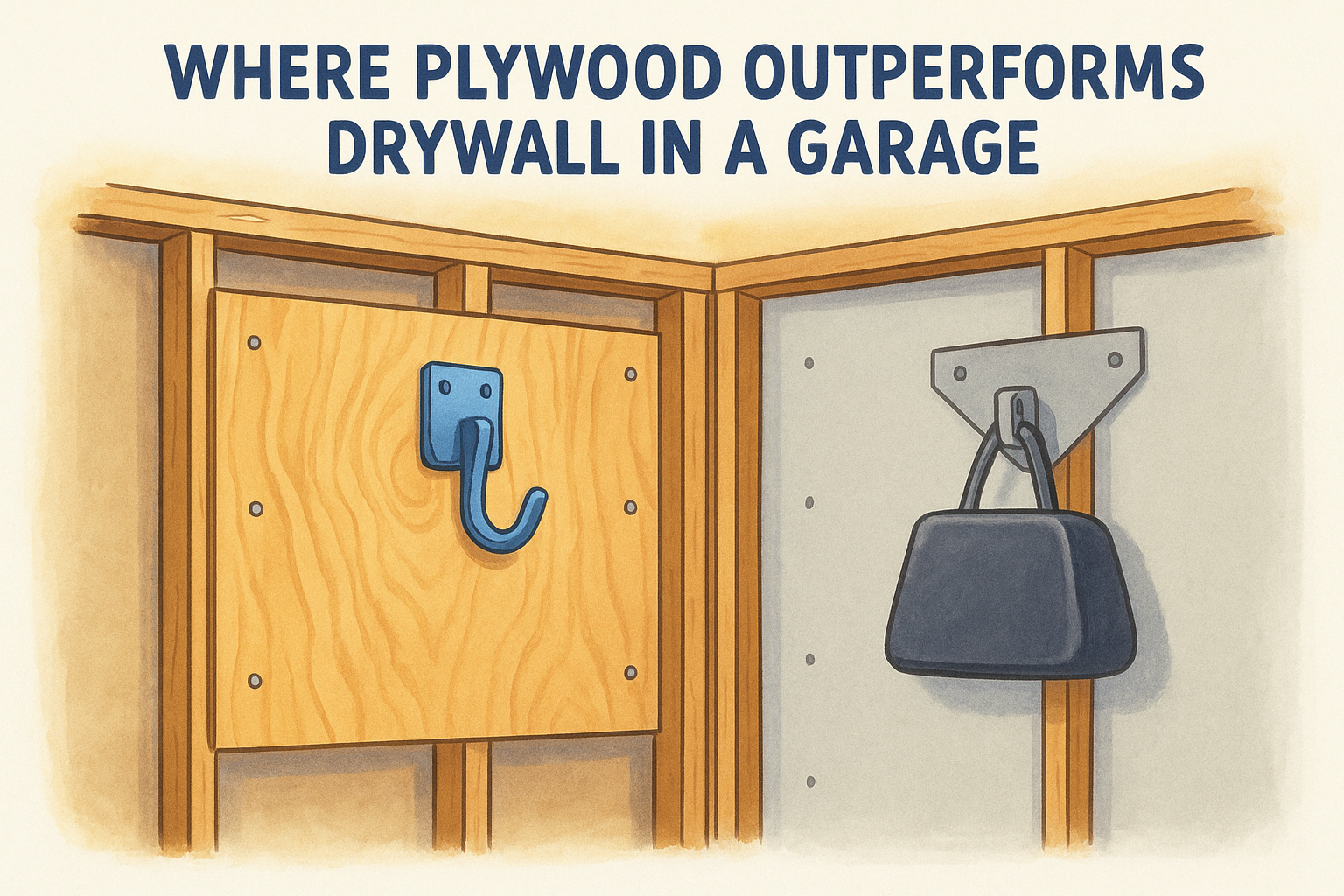
If mounting tools, shelving, and heavy equipment on your garage walls is a priority, plywood's ability to hold fasteners anywhere on the panel is a real advantage over drywall.
Plywood also handles impact and moisture far better than standard drywall in an unfinished garage. A plywood surface that takes a hit from a ladder or hand truck stays intact where drywall would crack or dent. In Sacramento Valley garages without climate control, where temperature swings and seasonal humidity are common, plywood won't deteriorate the way standard drywall does when moisture levels rise.
OSB as a budget alternative to plywood
Oriented strand board (OSB) is a lower-cost panel made from compressed wood strands and resin. It performs similarly to plywood for fastener holding and impact resistance, and it costs noticeably less per sheet. Many homeowners use OSB for detached garage walls where appearances matter less and keeping total project costs down is the priority .
The tradeoff is that OSB swells along its edges when it absorbs moisture , which causes visible seam separation over time in humid or uninsulated garages. If your garage stays dry and well-ventilated, OSB holds up fine. If moisture is a consistent issue in your space, spending a little more per sheet on plywood is the better long-term investment.
Drywall vs plywood for garage walls side-by-side
Putting both materials in the same frame makes the decision a lot clearer than reading about each one separately. The right pick in any drywall vs plywood for garage walls comparison almost always comes down to three things: how the garage gets used, what your local building code requires, and how much finishing work you're willing to pay for.
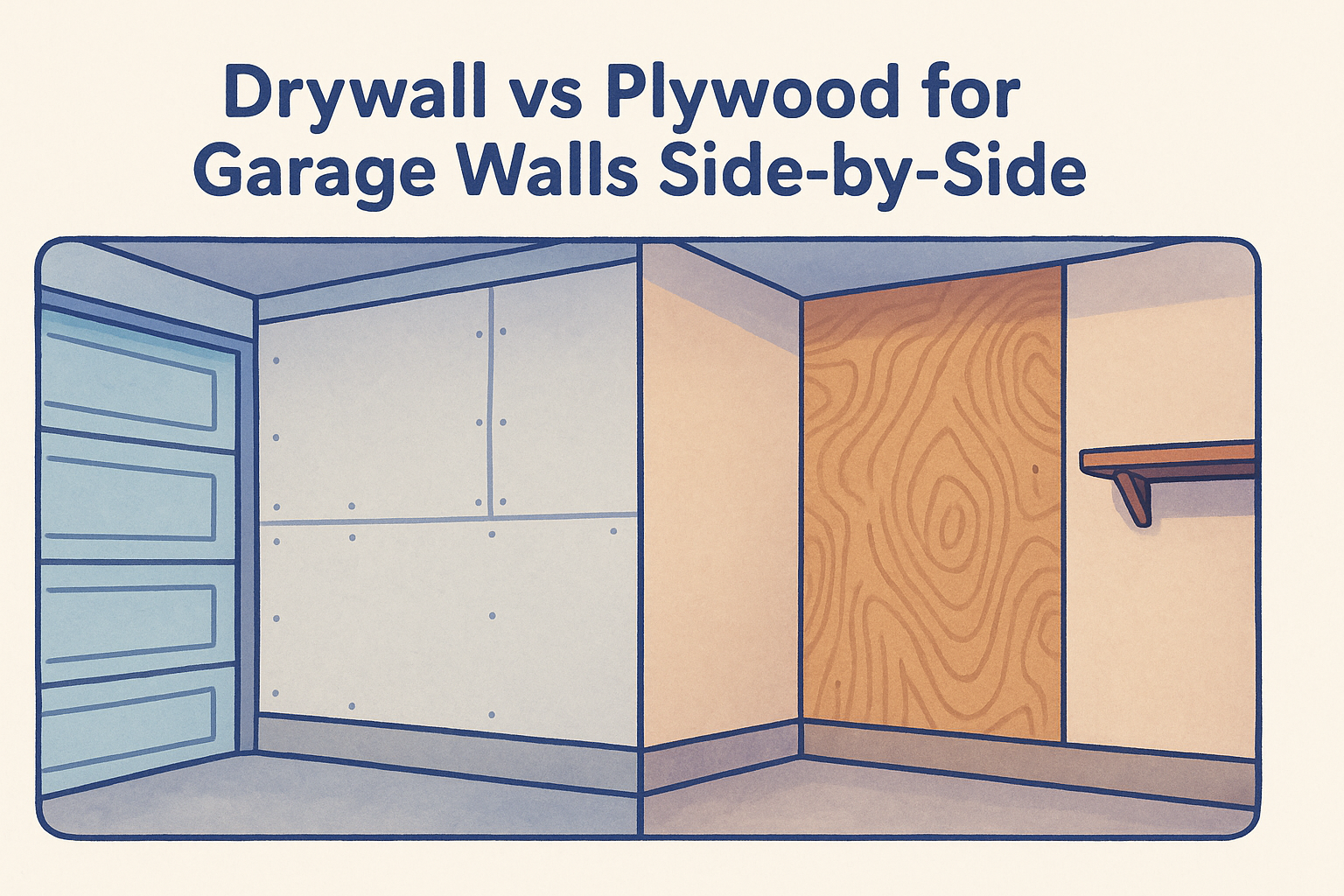
How the two materials compare on key factors
The table below covers the factors that matter most for a residential garage in the Sacramento Valley. Use it as a quick reference before diving into the details that follow.
| Factor | Drywall | Plywood |
|---|---|---|
| Fire rating | Meets code with 5/8" Type X | Does not meet fire separation code |
| Cost per sheet | Lower | Higher |
| Finishing required | Yes, tape, mud, sand, paint | No, paint optional |
| Fastener flexibility | Studs only | Anywhere on panel |
| Impact resistance | Low | High |
| Moisture resistance | Low (standard), moderate (green board) | Moderate to good |
| Appearance when finished | Clean, room-quality look | Industrial, functional |
| Repair ease | Patch and repaint | Full sheet replacement |
If you're comparing drywall and plywood purely on function, the garage's primary use almost always determines the winner before cost even enters the conversation.
Where each material clearly wins
Drywall wins on any wall that separates your garage from living space. There is no workaround for fire code, and plywood cannot sub in for Type X drywall on an attached garage wall. Beyond code, drywall also wins when finished appearance matters. A garage converted to a gym, office, or ADU space looks and feels more like the rest of your home with properly finished drywall on the walls.
Plywood wins in garages built around storage and work. If you plan to hang heavy shelving, build a wall-mounted tool system, or mount a workbench bracket wherever it fits best, plywood's full-panel fastener strength saves you time every time you reorganize the space. It also handles bumps, scrapes, and humidity swings without cracking or absorbing moisture the way standard drywall does. For a detached workshop garage, plywood often delivers more real-world value even though it costs more per sheet at the lumber yard.
Fire safety and garage wall code basics
Fire safety is where the drywall vs plywood for garage walls debate stops being purely a preference question. California and most Sacramento-area jurisdictions follow the California Building Code , which sets clear requirements for the wall and ceiling assemblies that separate an attached garage from the home's living space. Understanding these requirements before you buy materials keeps your project on track and prevents expensive tear-outs later.
What California code requires for attached garages
The California Residential Code requires a fire-rated separation between an attached garage and any habitable room in the house. That typically means 5/8-inch Type X drywall on the shared wall, and in many cases on the ceiling of the garage directly below a living space as well. Type X drywall contains glass fibers that slow combustion and give occupants more time to exit in a fire. No other common wall material, including plywood, meets this requirement without additional fire-resistant treatment.
If your garage shares any wall or ceiling with your living space, Type X drywall on those surfaces is a code requirement, not a suggestion.
Some local jurisdictions apply additional requirements on top of the state baseline. Sacramento County and several surrounding cities may require specific fastener spacing, taped joints, or continuous coverage with no gaps at penetrations for electrical or plumbing runs. Before you finalize your material list, pull the permit and talk to your local building department directly. A five-minute conversation with a plan checker can save you a failed inspection.
What happens when you skip the fire-rated wall
Skipping the correct drywall on a fire-separation wall doesn't just fail the inspection. It creates a real safety risk for everyone living in the house, since a garage fire can spread to the living space far faster without a rated barrier slowing it down. When you factor in that most garage fires start near fuel storage, electrical panels, or vehicle fluids , the shared wall is exactly the one you don't want to cut corners on.
From a practical standpoint, unpermitted or non-compliant work shows up during home sales, refinancing appraisals, and future permit pulls. Correcting a fire wall after the fact means removing all finish work back to the studs, installing the correct drywall, retaping, refinishing, and repainting. Doing it right the first time costs far less than fixing it under pressure two years later.
Best choice by garage type and how you use it
The drywall vs plywood for garage walls question gets much easier to answer once you define the type of garage you have and the work you expect those walls to handle. No single material wins across every use case , and the best contractors match the product to the situation rather than defaulting to one material for every job.
Attached garages and mixed-use spaces
If your garage connects directly to your home, drywall is the practical answer for every shared wall and ceiling . Code requires it, and there is no approved substitute that meets California's fire-separation standard without additional costly treatments. For the non-shared walls in the same attached garage, you still have flexibility. If you plan to use that garage purely for parking and general household storage, 1/2-inch standard drywall on the remaining walls keeps your costs down and gives you a consistent, finished look throughout the space.
An attached garage converted into a gym, home office, or ADU suite should use drywall on all four walls to match the finish quality of the rest of your home.
For these converted spaces, finishing quality matters more than fastener flexibility because the primary function is comfort and livability, not mounting heavy equipment. Drywall painted with a quality interior latex holds up well in a climate-controlled converted space and costs less per square foot once you account for the full project scope.
Detached workshops and storage-focused garages
A detached garage built around hands-on work is where plywood earns its higher price per sheet. When you're organizing a wall full of hand tools, hanging heavy shelving brackets, or repositioning your storage layout every few years, the ability to drive a fastener anywhere on the panel surface saves real time and effort. You are not hunting for studs every time your workflow changes.
For budget-focused detached builds , OSB gives you most of the same fastener benefits at a lower material cost. Pair it with a good primer and paint, and it handles a typical Sacramento Valley workshop without issues as long as your garage stays reasonably dry. If humidity or water intrusion is a known problem in your space, upgrading to 3/4-inch plywood is the smarter long-term call over OSB despite the added cost per sheet.
Installation and finishing tips that change results
Whether you've settled the drywall vs plywood for garage walls debate or you're still deciding, how you install and finish either material determines how long it lasts and how well it holds up to daily use. Cutting corners during installation creates problems that surface months later, often when the walls are already painted and the garage is fully organized.
Getting drywall right from the first sheet
Hanging drywall horizontally instead of vertically reduces the number of butt joints you'll need to tape and finish, which directly affects how smooth and seamless the final wall looks. Start from the top of the wall and work down, keeping all horizontal seams at a consistent height so you're not chasing mismatched joint lines across the room.
The quality of your tape and mud work determines the final appearance far more than which brand of drywall you buy.
Apply three coats of joint compound on every seam and corner, feathering each coat out wider than the last. Rushing this step and painting over visible ridges in the mud is the most common mistake homeowners make on a garage drywall project. After your final coat, sand with 120-grit paper before priming, and run your hand flat across every seam before you commit to a paint color. If you feel a ridge, it will be visible under paint.
Finishing plywood for long-term performance
Priming plywood before painting is a step many people skip, and it leads to blotchy, uneven paint coverage that needs two or three extra coats to look consistent. Plywood absorbs primer unevenly across the face veneer versus the exposed edge grain, so applying a shellac-based or oil-based primer first seals the wood and gives you a uniform base for your topcoat.
Fill any visible knots or surface voids in the plywood face with wood filler before priming. A smooth, filled surface holds paint longer and resists moisture better over time, particularly in Sacramento Valley garages where summer heat and seasonal humidity cause wood to expand and contract. Take the extra hour to prep the surface properly, and the finish coat will last significantly longer without peeling or cracking at the edges.
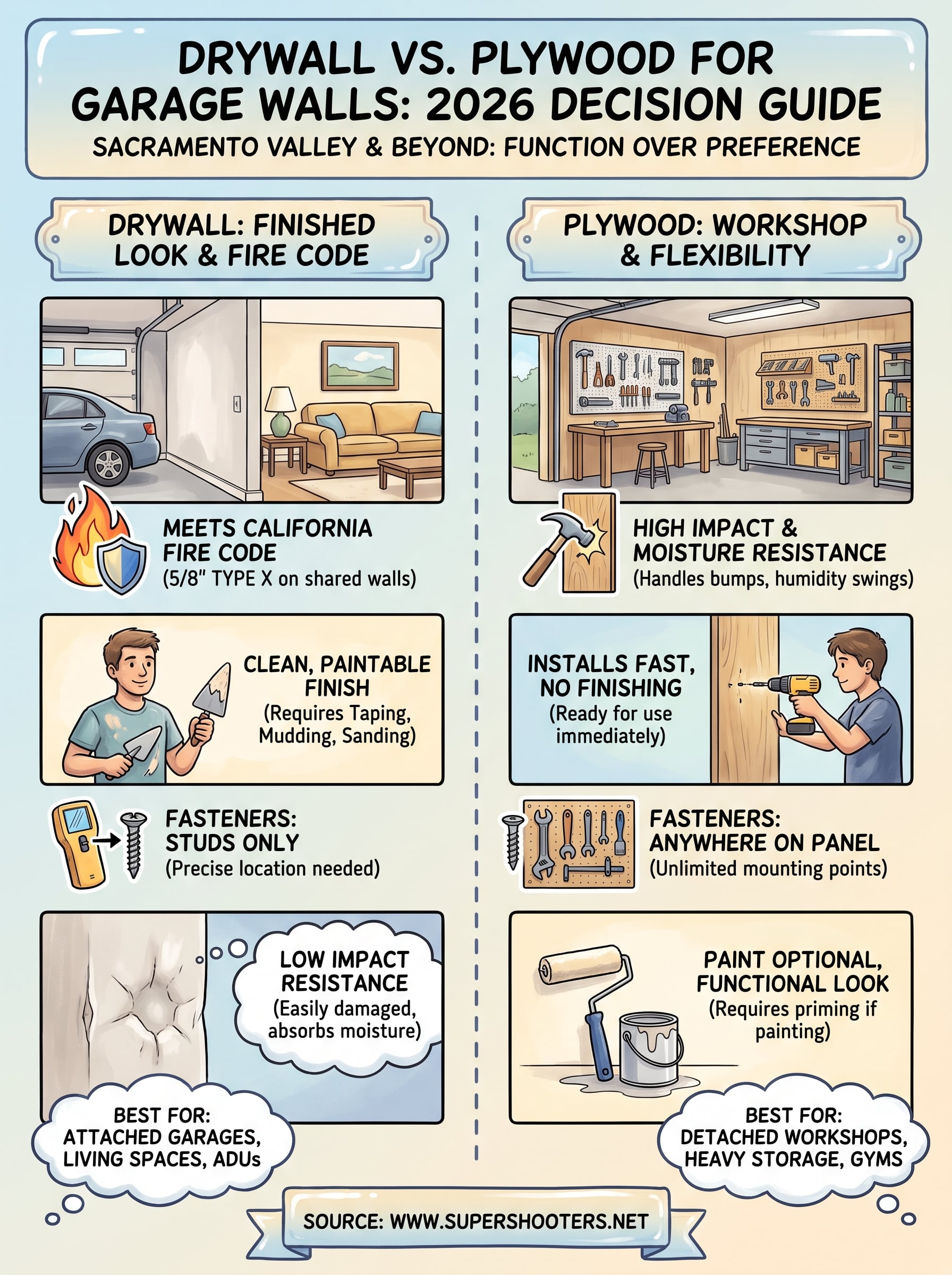
Final takeaway
The drywall vs plywood for garage walls decision comes down to two questions: what does your local code require, and how do you actually use the space? Attached garages with shared walls need 5/8-inch Type X drywall on those surfaces, full stop. No other common material meets California's fire-separation requirement, and skipping it creates both safety risks and costly corrections down the road.
For detached garages and non-shared walls, match the material to the work. Plywood serves workshop and heavy-storage setups better because it holds fasteners anywhere on the panel and shrugs off impact. Drywall serves finished, livable spaces better because it looks cleaner and costs less per sheet once labor is factored in. Pick based on function, install it correctly, and prep the surface properly before you paint.
If you want professional results on your garage walls in the Sacramento Valley, get a free estimate on drywall installation from Super Shooters today.
Recent Posts