June 2, 2026
Drywall Labor Cost Per Sheet: 2026 Rates For Hang & Finish
Whether you're finishing a garage, repairing water damage, or renovating an entire home, knowing the drywall labor cost per sheet keeps you from overpaying or underestimating your budget. Labor is typically the largest chunk of any drywall project, often more than the materials themselves, so getting a clear picture of current rates before you hire matters.
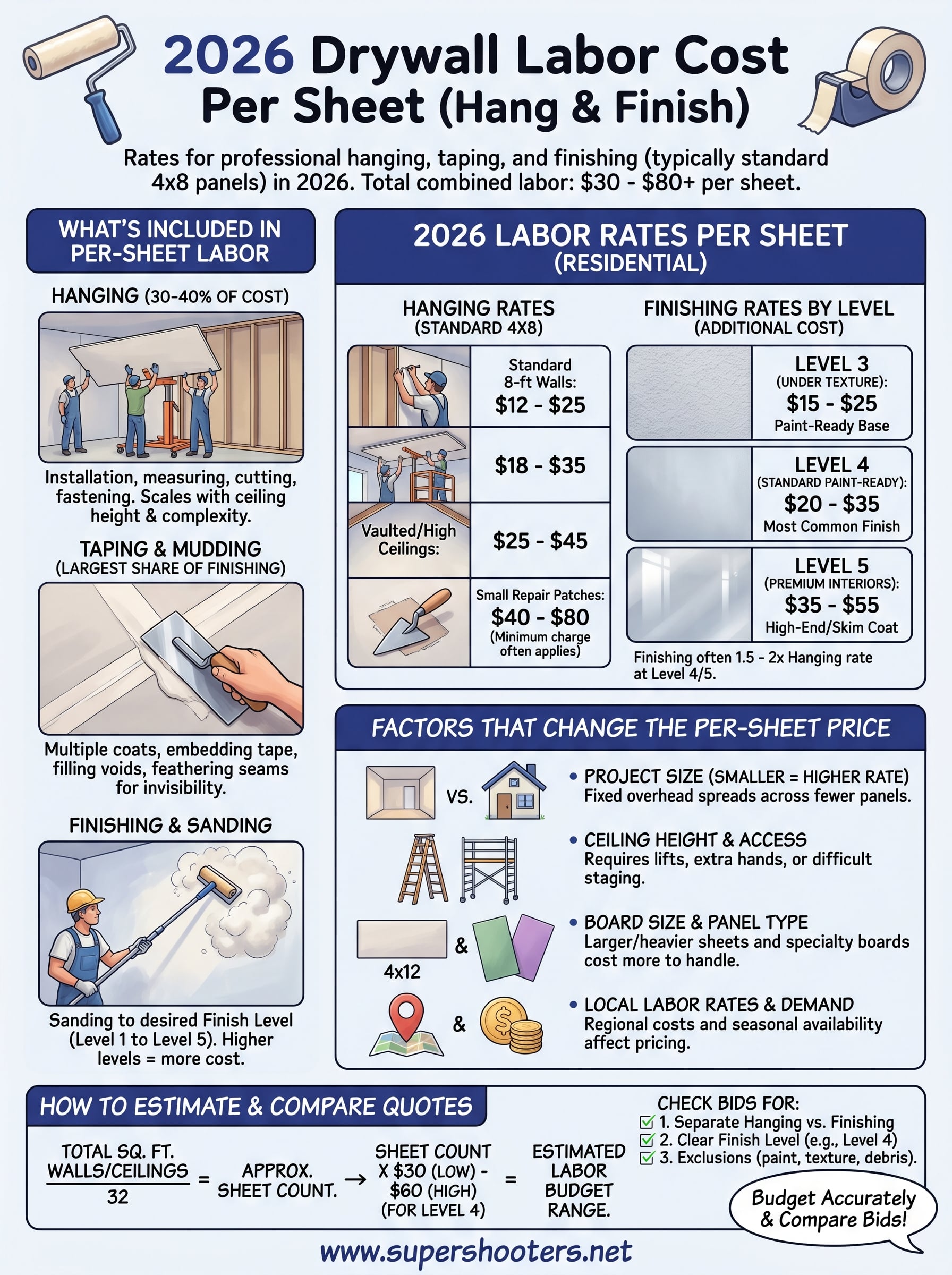
In 2026, most homeowners can expect to pay somewhere between $30 and $80 per sheet for professional hanging, taping, and finishing, though the actual number depends on factors like ceiling height, finish level, and your local market. Here in the Sacramento Valley, we've seen these prices firsthand. At Super Shooters, we've completed over 10,000 residential drywall projects across more than three decades, and we regularly walk homeowners through what drives costs up or down. That experience gives us a practical view of pricing that goes beyond generic national averages.
This guide breaks down exactly what you should expect to pay for drywall labor on a per-sheet basis in 2026. We'll cover the differences between hanging and finishing costs, explain what factors affect your final price, and help you spot the line between a fair bid and an inflated one . By the end, you'll have the numbers and context you need to budget accurately and have a real conversation with your contractor.
What drywall labor cost per sheet includes
When contractors quote a drywall labor cost per sheet , that number covers several distinct phases of work, not just nailing panels to studs. Understanding what's bundled into that rate (and what isn't) helps you compare bids accurately and avoid surprises when the invoice arrives. Most residential quotes roll hanging, taping, and at least a basic level of finishing into a single per-sheet figure, but the specifics vary by contractor and project scope.
Hanging the drywall
Hanging is the first phase and covers the physical installation of each drywall sheet onto wall studs or ceiling joists. A crew measures and cuts each panel to fit the space, then fastens it with screws or nails at the correct spacing. This sounds straightforward, but the labor involved scales quickly with ceiling height, unusual angles, and whether the job requires cutting around outlets, windows, or other obstacles . A standard 8-foot wall in a square room goes faster than a vaulted ceiling with multiple cutouts, and your contractor accounts for that difference when pricing per sheet.
The crew also spends considerable time staging and lifting panels into position. On ceilings especially, this requires specialized lifts or multiple workers holding sheets overhead while fastening, which adds real time to the job. Expect the hanging phase to account for roughly 30 to 40 percent of the total per-sheet labor cost on most residential projects.
Taping and mudding
Once the panels are up, the crew tapes every seam and applies joint compound, commonly called mud , over the tape and screw holes. This phase typically happens in multiple coats , with drying time between each application. The first coat embeds the tape and fills the deepest voids. Subsequent coats feather the edges out so the seam disappears under paint.
Taping and mudding is where most of the skill in drywall finishing lives. A rushed or inexperienced mud job will show up as visible ridges and cracks within months.
This phase is labor-intensive and time-sensitive because each coat needs adequate drying before the next one goes on. Rushing it leads to bubbling, cracking, and visible seams once the wall is painted. On a per-sheet basis, taping and mudding often accounts for the largest share of finishing labor costs .
Finishing and sanding
After the final coat of mud dries, the crew sands the surfaces smooth. Finish levels run from Level 1 (basic tape embed, no sanding, used in utility spaces) all the way up to Level 5 (skim-coated and sanded to a near-perfect surface, typically required for gloss paint or high-end finishes). The level your project requires directly affects the per-sheet labor rate because each step up adds time and material.
Most standard residential projects call for a Level 4 finish , which covers all joints, fasteners, and corner bead with smooth, paint-ready surfaces. Level 5 takes significantly longer and costs more per sheet because the crew applies a full skim coat over the entire surface before final sanding.
What's typically not included
Standard per-sheet labor quotes usually cover hanging, taping, and finishing only. The following items are almost always quoted separately or listed as exclusions:
- Priming and painting the finished surface
- Texture application such as orange peel, knockdown, or smooth skim coat
- Debris removal and drywall disposal fees
- Framing repairs or backing installation needed before hanging can begin
- Permits , if required by your local jurisdiction
Knowing these exclusions upfront helps you build a complete project budget rather than getting caught off guard when your contractor hands you an itemized invoice at the end.
2026 labor rates per sheet for hang and finish
Labor pricing for drywall varies by region, crew size, and project complexity, but the ranges below reflect what contractors are charging in 2026 across the Sacramento Valley and similar mid-sized U.S. markets. These figures cover residential work only . Commercial projects typically carry different rates due to code requirements and project scale.
Hanging rates
Hanging-only labor runs between $12 and $25 per sheet in 2026 for standard 4x8 panels on walls with 8-foot ceilings. Ceiling work costs more because it requires extra hands or a lift, typically pushing rates to $18 to $35 per sheet on ceilings alone. Projects with multiple cutouts, angled walls, or difficult access will land at the higher end of those ranges.
| Job Type | 2026 Hanging Rate Per Sheet |
|---|---|
| Standard 8-ft walls | $12 - $25 |
| Standard ceilings | $18 - $35 |
| Vaulted or high ceilings | $25 - $45 |
| Small repair patches | $40 - $80 (minimum charge often applies) |
Finishing rates by level
Finishing labor depends heavily on the level of finish your project requires. A Level 3 finish, suitable for texture application, runs $15 to $25 per sheet . A Level 4 finish, the standard for paint-ready walls, costs $20 to $35 per sheet . Level 5 finishes, required for high-gloss paint or high-end interiors, push finishing labor to $35 to $55 per sheet because of the additional skim coat and extended sanding time involved.
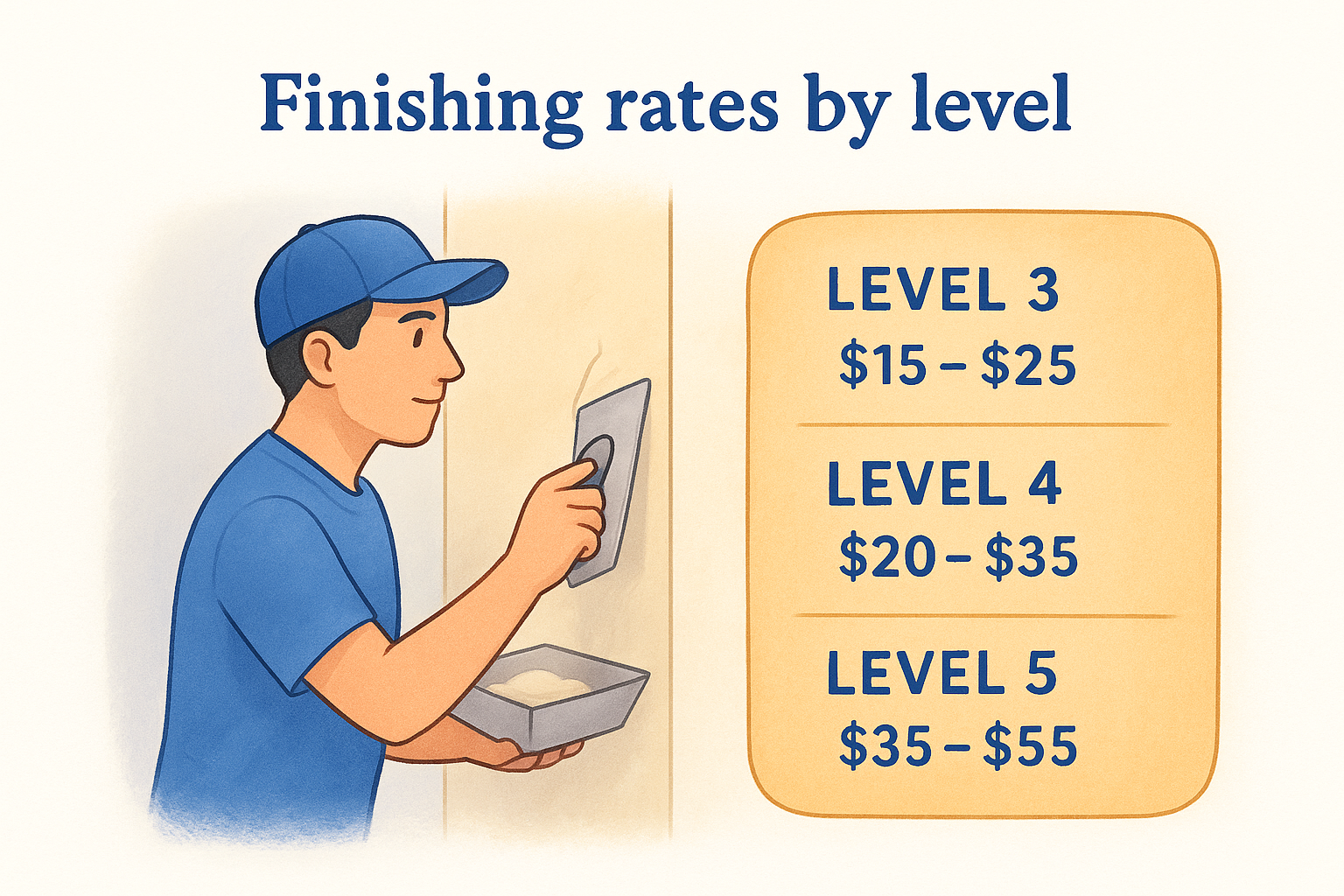
Finishing labor consistently costs more than hanging on a per-sheet basis, often running 1.5 to 2 times the hanging rate once you reach Level 4 or Level 5.
| Finish Level | Typical Use | 2026 Rate Per Sheet |
|---|---|---|
| Level 3 | Under texture | $15 - $25 |
| Level 4 | Standard paint-ready | $20 - $35 |
| Level 5 | Gloss paint, premium interiors | $35 - $55 |
Combined together, the total drywall labor cost per sheet for a typical Level 4 residential project lands between $30 and $60 . Projects with high ceilings, complex layouts, or a Level 5 finish requirement can push that combined rate past $80 per sheet. Use these ranges as a starting point when reviewing bids, keeping in mind that local labor markets and project-specific conditions will shift the final number in either direction.
Factors that change the per-sheet price
The ranges above give you a reliable starting point, but your actual drywall labor cost per sheet will move up or down based on the specific conditions of your project. Contractors build these variables into their bids, so understanding them helps you see why two quotes for the same square footage can look very different.
Project size
Larger jobs cost less per sheet because crews can work efficiently without constantly repositioning, re-measuring, or hauling materials in and out repeatedly. A full-home install might come in at $30 to $40 per sheet for combined hang and finish, while a single-room repair or small addition often runs $50 to $80 per sheet or more because setup time and minimum charges spread across fewer panels.
The smaller the job, the higher the per-sheet rate tends to run because fixed overhead costs spread across fewer panels.
Ceiling height and access
Standard 8-foot ceilings are the baseline for most per-sheet pricing. Once your ceilings climb above 9 or 10 feet, the rate goes up because crews need scaffolding, lifts, or extra workers to safely handle and fasten panels overhead. Vaulted ceilings, stairwell walls, and tight spaces like closets and hallways add similar complexity because the crew cannot move at a standard pace or use their typical lifting method.
Board size and panel type
Most pricing assumes standard 4x8 panels in 1/2-inch thickness. When your project calls for 4x12 panels, which reduce seams but are heavier and harder to maneuver, labor rates increase because handling larger sheets takes more time and care. Specialty boards such as moisture-resistant drywall for bathrooms or Type X fire-rated panels for garages often carry a slight labor premium as well, since cutting and fastening requirements differ from standard material.
Local labor rates
Regional wage differences affect what contractors charge regardless of project type. In the Sacramento Valley, labor rates generally track with California's higher cost of living, which means you'll typically pay more per sheet here than in a rural Midwest market. Seasonal demand also plays a role: spring and summer renovation rushes push rates up as crews stay booked, while slower winter months sometimes make contractors more flexible on pricing.
How to estimate your job and compare quotes
Getting an accurate estimate before you call contractors puts you in a stronger position to evaluate bids critically and catch pricing that doesn't add up. A rough estimate takes only a few minutes to put together, and it gives you a baseline number to hold every quote against, rather than accepting the first figure a contractor offers.
Calculate your sheet count first
Start by measuring the total square footage of wall and ceiling surface you need covered. Multiply the length of each wall by its height, add those figures together, then subtract the area taken up by windows and doors. Divide your total square footage by 32, which is the surface area of a standard 4x8 drywall sheet. That gives you your approximate sheet count .
Once you have a sheet count, apply the per-sheet labor ranges covered earlier in this guide. For a standard Level 4 finish , multiply your sheet count by $30 on the low end and $60 on the high end to get a realistic labor budget range before you start collecting quotes.
What to look for in a contractor's bid
A well-written bid should break down hanging labor separately from finishing labor and clearly state the finish level included in the price. It should also specify whether texture, priming, debris removal, or permits are included or excluded. Any bid that lists only a single lump-sum number without line-item detail makes it difficult to compare accurately against other quotes or verify that the drywall labor cost per sheet is reasonable for your project scope.
Ask every contractor to confirm the finish level in writing before you sign anything. A Level 3 and Level 4 quote can look identical on paper but produce very different results on your walls.
Red flags that signal a bad quote
Watch for bids that come in significantly below the low end of market rates without a clear explanation. Unusually low pricing often means a contractor plans to cut corners on finishing coats, use lower-grade materials, or add fees mid-project once the work is underway. On the other end, a quote that far exceeds the high end without documented justification, such as very high ceilings, specialty board requirements, or complex access conditions, deserves a direct follow-up question before you accept it.
Collecting at least three written bids for any project over a few rooms gives you enough data points to spot outliers in both directions and make a confident hiring decision.
Common questions about drywall labor pricing
Homeowners asking about drywall labor cost per sheet often have follow-up questions once they understand the base rates. The questions below come up repeatedly during estimates, and answering them directly helps you avoid misconceptions that lead to poor hiring decisions or budget miscalculations .
Is it cheaper to hire one contractor or a full crew?
Hiring a single contractor instead of a crew often looks cheaper on paper because the hourly rate is lower, but the math shifts when you factor in time. A solo installer working a full house will spend significantly more days on site, which extends the total labor hours and can actually cost more overall than a crew that finishes the same job in a fraction of the time. For large projects, a full crew almost always delivers a better per-sheet rate when you calculate total cost against total output.
For any project covering more than four rooms, get quotes from both solo contractors and small crews before assuming one option saves you money.
For smaller repairs covering only one or two rooms, a single experienced installer often makes more sense because a full crew has minimum charges that price the job out of proportion to the work involved.
Does the type of room affect labor rates?
Room type matters more than most homeowners expect. Bathrooms and laundry rooms require moisture-resistant board, which takes slightly more care to cut and fasten correctly. Garages often need Type X fire-rated panels along shared walls, and the additional fastening requirements under building codes add time to the install. Standard bedrooms and living rooms with straightforward layouts cost the least to hang and finish because crews move through them without interruption.
Kitchens add complexity because of the number of cutouts required around outlets, switches, plumbing, and range hoods, each of which slows the hanging phase and drives up the per-sheet rate for that specific room even if the rest of the house is straightforward.
Should you supply the drywall yourself to save money?
Supplying your own drywall panels can reduce material markup, but it introduces logistics that many homeowners underestimate. You become responsible for ordering the correct quantities , arranging delivery to the job site, and ensuring panels arrive undamaged. If your count is short, the project stalls while you wait for more material. Most contractors are willing to work with homeowner-supplied materials, but some charge a handling fee to account for inventory they no longer control.
Final takeaways
The drywall labor cost per sheet in 2026 runs between $30 and $60 for a typical Level 4 residential project, with ceiling work, large panels, and complex room layouts pushing that number higher. The biggest variable in your final bill is usually the finish level , not the hanging phase, so confirm the level in writing before any work begins.
Getting at least three itemized bids gives you enough data to separate fair pricing from inflated quotes. Check that each bid separates hanging from finishing, lists what is excluded, and states the finish level clearly . Small jobs cost more per sheet than large ones because fixed overhead spreads across fewer panels, so factor that into your expectations.
If your project involves new drywall installation in the Sacramento area and you want a straightforward, no-upfront-payment estimate from a crew with over 30 years of experience, get a free quote for drywall installation from Super Shooters.
Recent Posts