Share this article

May 28, 2026

Drywall Installation Steps: DIY Guide From Prep to Paint

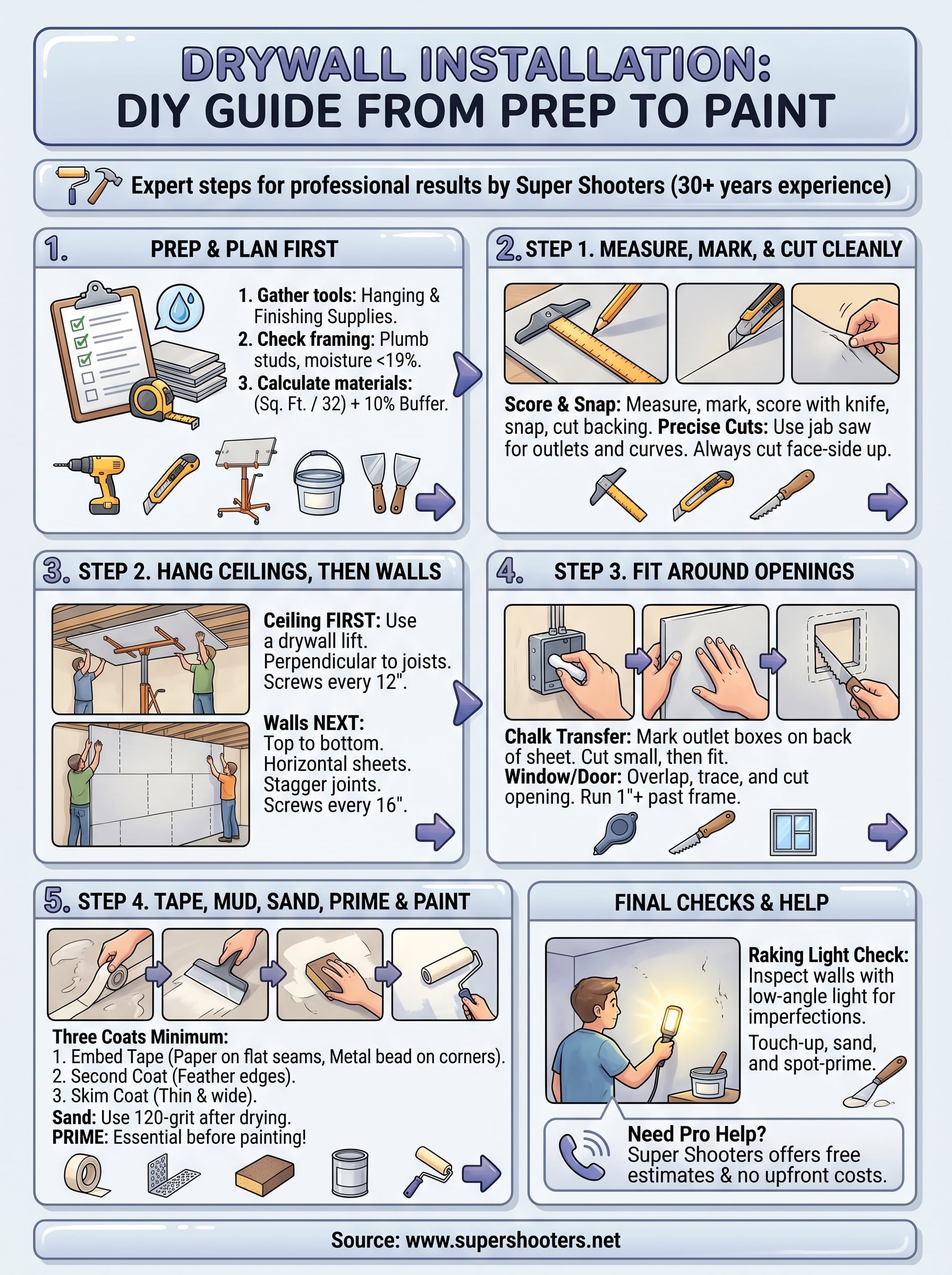
Hanging drywall is one of those projects that looks straightforward until you're standing in a room full of heavy sheets, wondering which way is up. The truth is, understanding the drywall installation steps before you pick up a single tool makes the difference between walls you're proud of and walls that haunt you. With the right preparation and technique, most homeowners can handle this work themselves , and save a significant chunk of their renovation budget in the process.

At Super Shooters, we've completed over 10,000 drywall and ceiling projects across the Sacramento Valley in our 30+ years of business. That experience has taught us exactly where DIY jobs go right, and where they go sideways. We built this guide to walk you through every stage, from measuring and cutting to mudding and sanding , so you can approach your project with real confidence.

Whether you're finishing a garage, remodeling a bedroom, or wrapping up an ADU, this step-by-step breakdown covers the tools, materials, and techniques you need. And if you hit a point where you'd rather hand it off to a pro , we're always a phone call away with free estimates and no upfront costs .

Plan and prep before you hang the first sheet

Good preparation is what separates a clean, professional finish from a project full of gaps, waste, and do-overs. Before you work through the actual drywall installation steps , take the time to assess your space, gather the right tools, and calculate your materials accurately. Skipping this stage costs you more time and money than any single mistake you can make on the job.

Gather your tools and materials

You'll need two categories of supplies: hanging tools for getting the sheets up, and finishing tools for taping and mudding later. Buying or renting the right equipment up front prevents mid-project trips to the hardware store that break your rhythm and add hours to a straightforward job.

Here's what to have on hand before you start:

Hanging tools and materials:

  • Drywall sheets (½ inch for walls, ⅝ inch for ceilings)
  • Drywall screws (1¼ inch for walls, 1⅝ inch for ceilings)
  • Screw gun or drill with a dimpler bit
  • Drywall lift (essential for ceilings, rentable at most hardware stores)
  • T-square and pencil
  • Utility knife with extra blades
  • Measuring tape
  • Safety glasses and a dust mask

Finishing tools and materials:

  • Joint compound (all-purpose works for most projects)
  • Drywall tape (paper tape for flat seams, mesh tape for patches)
  • Corner bead (metal or vinyl)
  • 6-inch, 10-inch, and 12-inch taping knives
  • Sanding sponges and 120-grit sandpaper
  • Primer formulated for new drywall

Check your framing and room conditions

Your drywall is only as solid as the framing behind it , so inspect your studs and joists before ordering a single sheet. Use a level to confirm everything is plumb and straight. Any stud that bows more than ¼ inch inward or outward will create a visible hump or gap in your finished wall that no amount of mud will fully hide.

Moisture is the single biggest threat to new drywall. If your framing shows any signs of dampness, track down and fix the source before you hang anything.

Check the wood moisture content with an inexpensive moisture meter. Framing should read below 19% before you proceed. In rooms like bathrooms or laundry areas, swap standard panels for moisture-resistant drywall (often called greenboard) to prevent mold and long-term deterioration.

Calculate how much drywall you need

Measure the total square footage of your walls and ceiling, then divide by 32 to get your sheet count based on standard 4x8 panels. Always add 10% to that number as a buffer for cuts and waste. For example, a 12x14 foot room with 8-foot ceilings has roughly 416 square feet of wall space plus 168 square feet of ceiling, totaling 584 square feet. That works out to about 19 sheets, so you'd order 21 to stay safe.

Plan your sheet layout before anything arrives on site. Drywall hangs perpendicular to the framing for maximum structural strength. On walls, orient each sheet so the long edge runs horizontal , which reduces the number of butt joints you'll need to tape and gives you a flatter, easier surface to finish.

Step 1. Measure, mark, and cut drywall panels cleanly

Accurate cuts are the foundation of every clean drywall installation. If your panels don't fit the framing precisely, you end up with gaps that need excessive mud to fill, or edges that don't land on a stud at all. Taking an extra two minutes to measure twice before you score the sheet saves you a wasted panel and a frustrating redo.

Score and snap for straight cuts

Most straight cuts in the drywall installation steps follow the same simple process: measure, mark, score, and snap. Use your T-square as a guide to draw a clean pencil line across the face of the sheet. Then drag your utility knife along that line with firm, consistent pressure. You only need to cut through the paper facing and about ¼ inch into the gypsum core for a clean break.

Once you've scored the line, stand the sheet on edge and push the back side away from you at the score. The panel will snap cleanly along the cut. Flip it around and run your knife along the paper backing to separate the two pieces. Keep your blades sharp throughout this process because a dull blade tears the paper and leaves a ragged edge that's harder to tape.

Always cut drywall face-side up when scoring so the clean paper edge ends up on the visible side of the wall.

Here's a quick reference for common cuts and the right approach:

Cut type Tool Technique
Straight cuts T-square + utility knife Score, snap, cut backing
Long rip cuts Chalk line + utility knife Snap line, score full length
Short notches Jab saw Cut both directions, pop out

Cut curves and outlet holes cleanly

Outlet boxes, light fixtures, and other openings require more precision than a straight score-and-snap . Measure the exact position of the box from the nearest edge of the sheet and transfer those measurements to the panel face. Use a jab saw or oscillating multi-tool to cut along your marked lines in controlled, short strokes. Work slowly at corners so you don't blow out the surrounding gypsum and create a larger hole than you need.

Step 2. Hang drywall on ceilings, then walls

The sequence matters in these drywall installation steps : always hang the ceiling before the walls . When you install the wall sheets afterward, their top edges press against the ceiling panels and close any small gaps. That contact gives you cleaner seams and fewer places for joint compound to crack over time.

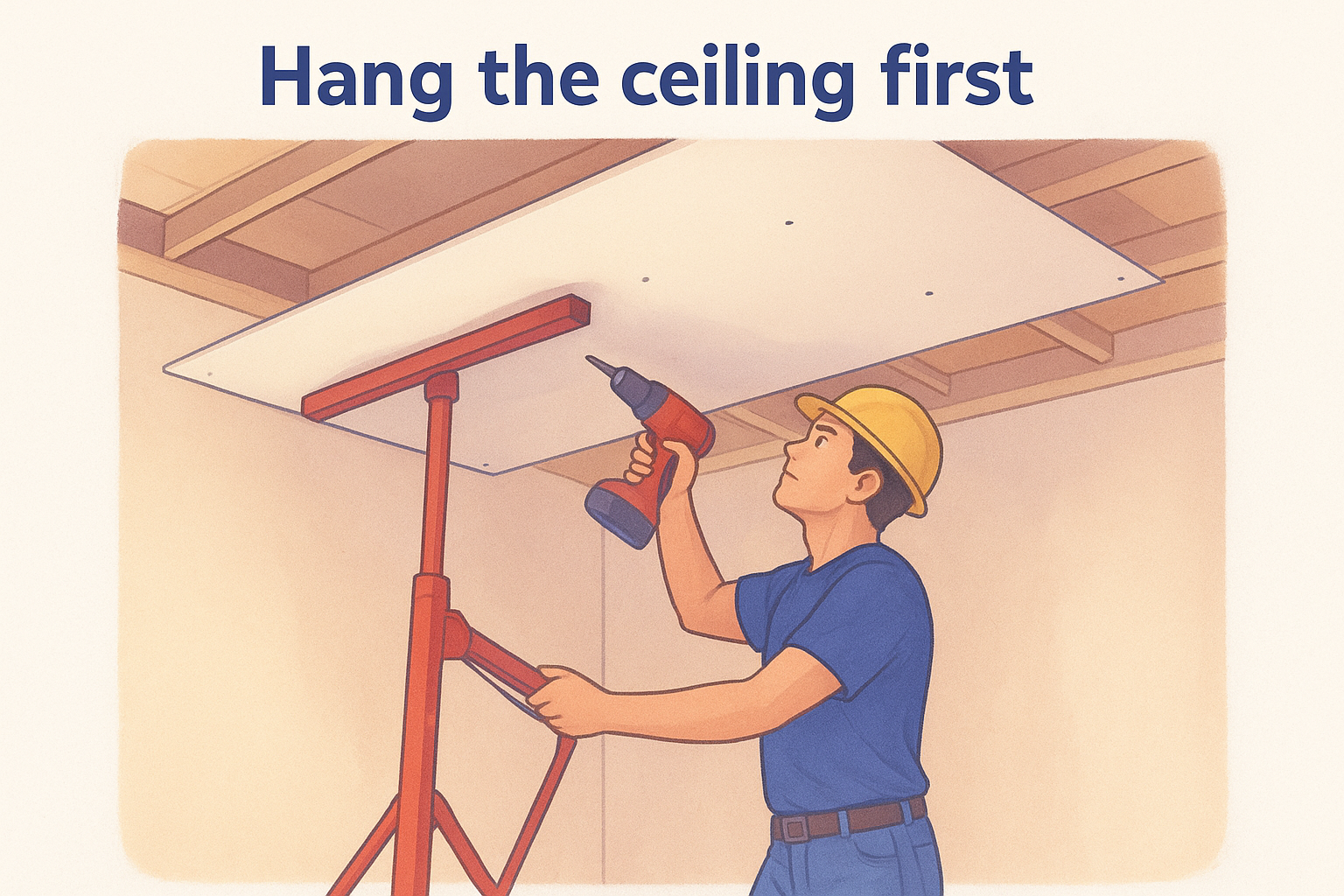
Hang the ceiling first

Ceiling work is the hardest part of any drywall job, and doing it alone is not realistic. Recruit at least one helper , or better yet, rent a drywall lift from your local hardware store. A lift holds each panel in position while you drive screws, which protects your neck and back, and keeps your fastener placement accurate from start to finish.

Rent a drywall lift for ceiling work. Trying to muscle sheets overhead by hand leads to crooked panels and stripped screws that won't hold.

Position each ceiling panel so its long edge runs perpendicular to the joists . Start near the center of the room and work outward when possible. Drive screws every 12 inches along each joist the panel crosses, keeping each fastener about 3/8 inch from the panel edge to avoid crumbling the gypsum core. Set each screw so the head sits just below the paper surface without tearing through it.

Fasten sheets to the walls

With the ceiling panels secured, move to your walls. Start at the top of each wall and work down , pressing the first sheet tight against the ceiling to close the gap at the top edge. Run sheets horizontally , staggering the vertical joints between rows so no two seams line up directly above one another. Staggered joints are stronger and far easier to finish cleanly.

Drive field screws every 16 inches along each stud, and every 8 inches along perimeter edges. Keep all fasteners between 3/8 and 1/2 inch from the panel edge. On interior corners, let one panel run fully into the corner and overlap the edge of the adjacent sheet, so the corner bead has a solid surface to sit against when you reach the finishing stage.

Step 3. Fit drywall around outlets, windows, and doors

Openings for outlets, switches, windows, and doors are where many DIY drywall installation steps break down. Cut too small and you force the panel, cracking the gypsum. Cut too large and you leave gaps that look sloppy and complicate your finish work. Accurate measurement before you cut is the only way to get clean openings that sit flush with the framing every time.

Mark and cut outlet and switch box openings

The most reliable method for outlet openings is the chalk transfer technique . Rub the face of the outlet box with chalk or the end of a pencil, then press the drywall panel firmly into position over the box so it leaves a mark on the back of the sheet. Pull the panel off and you'll have an exact outline of the box transferred directly to the drywall.

Use a jab saw for outlet cutouts, not a utility knife. A jab saw gives you the controlled, short strokes you need to stay on your line without cracking the surrounding panel.

Cut along the inside edge of your marked outline so the box sits flush with the finished wall surface. Standard outlet boxes are designed to sit at finished wall depth, so if your cut is accurate, the cover plate will cover any minor gap around the perimeter.

Opening type Best cutting tool Key detail
Outlet/switch box Jab saw Cut inside the line
Recessed light Hole saw or jab saw Measure center point precisely
Window or door Utility knife + jab saw Score face, then cut edges

Handle window and door openings

Window and door openings require a slightly different approach. Hang the full sheet first and let it overlap the rough opening, then trace and cut the opening from the back side using the framing edge as your guide. This method keeps your sheet aligned to the studs before you remove any material.

Run the drywall a minimum of 1 inch past the window or door frame edge before cutting so the edge lands cleanly on the trimmer stud. That overlap gives your screws a solid anchor and leaves the edge of the panel fully supported when you tape and finish the corner later.

Step 4. Tape, mud, sand, then prime and paint

Finishing is where the drywall installation steps shift from physical labor to patience and skill. Every seam, screw dimple, and inside corner needs at least three coats of joint compound before you touch sandpaper. Rushing this stage is the most common reason DIY walls look amateurish once painted, so give each coat full time to dry completely before applying the next one.

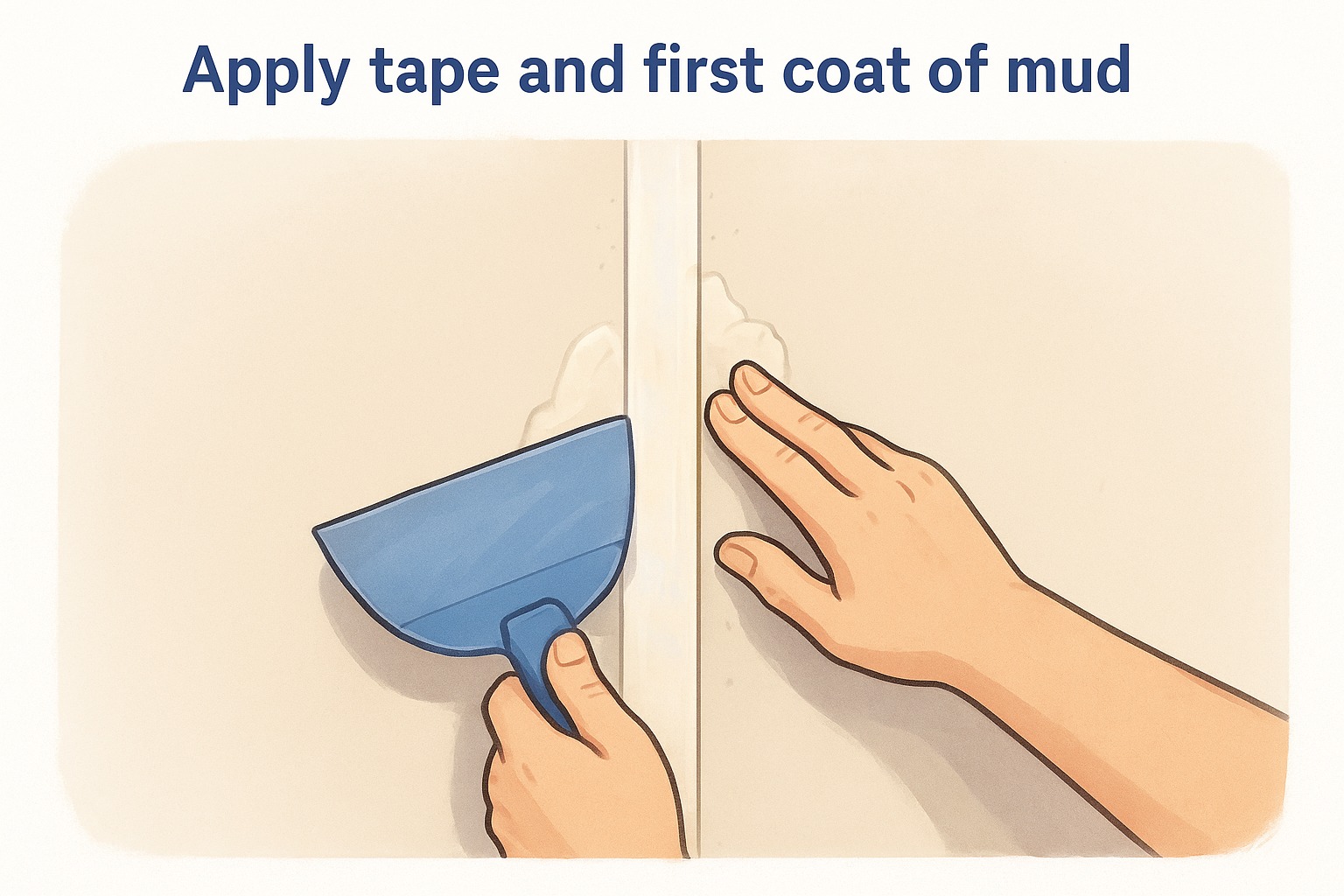
Apply tape and first coat of mud

Start by spreading a thin base coat of all-purpose joint compound over every seam using your 6-inch taping knife. Press paper tape firmly into the wet mud along flat seams, centering it over the joint, then drag your knife across the tape to embed it and push out any air bubbles. For inside corners, fold pre-creased paper tape in half and press it into the corner. On outside corners, nail or crimp metal corner bead into place before you apply any compound.

Never skip paper tape on flat seams. Mesh tape works well for small patches but tends to crack along long seams under normal wall movement.

Once the tape coat dries fully (typically 24 hours), apply your second coat with a 10-inch knife, feathering the compound several inches past both edges of the tape to blend the seam gradually into the surrounding surface. Let that dry completely, then apply a third skim coat using your 12-inch knife, spreading the compound even wider and thinner. Fill every screw dimple with the same three-coat process.

Sand, prime, and paint for a smooth finish

After the final coat dries, sand the entire surface with 120-grit sandpaper using long, even strokes. Work under good lighting so you catch any ridges or thin spots before you prime. Wipe away the dust with a lightly damp cloth , not a wet one, to avoid raising the drywall paper fibers.

Apply a coat of drywall primer before any paint goes on. New drywall absorbs paint unevenly, and skipping primer leaves blotchy, uneven coverage that a second coat of paint rarely fixes. Once the primer dries completely, your walls are ready for finish color.

Final checks and help

Before you call any room finished, walk through it with a bright work light held at a low angle against each wall. Raking light catches ridges, low spots, and screw pops that flat overhead lighting completely hides. Mark any problem areas with a pencil circle and apply a thin touch-up coat of joint compound. Let it dry, sand lightly, and spot-prime before you repaint that section.

Running through all the drywall installation steps in the right order keeps the work manageable, but some projects involve conditions that make DIY less practical. Ceilings in large open rooms, fire-rated assemblies, or walls that need specific moisture ratings all require more than standard technique. If your project falls into that category, or you simply want the job done fast and guaranteed, our team at Super Shooters is ready to help. Get a free estimate from our Sacramento drywall installation service page and we'll take it from there.

Recent Posts

By cinchweb June 2, 2026
See what you'll pay for hanging and finishing in 2026. Learn the drywall labor cost per sheet to help you budget your project and find a fair quote.
By cinchweb June 1, 2026
Get smooth walls with these pro drywall finishing tips. Master mud consistency, tape application, and sanding to achieve a flawless, professional finish.
By cinchweb May 31, 2026
Estimate your water damage drywall repair cost with our 2026 guide. Compare labor rates, square foot pricing, and learn when to repair vs. replace panels.
By cinchweb May 31, 2026
Is your ceiling bowing? Learn how to fix a sagging ceiling by identifying water damage, securing loose fasteners, and spotting structural red flags.
By cinchweb May 31, 2026
Learn what causes ceiling cracks and how to spot structural red flags. Find out if your home has simple cosmetic issues or damage that needs expert repair.
By cinchweb May 28, 2026
Fix your home with this guide to drywall repair after water damage. Learn to dry wall cavities, replace panels, and match textures for a seamless finish.
By cinchweb May 26, 2026
Calculate the cost to drywall a room in 2026. This guide breaks down square foot rates, labor factors, and material costs to help you budget for your project.
By cinchweb May 25, 2026
Learn how to repair plaster walls by stabilizing loose areas, fixing cracks with mesh tape, and matching textures for a finish that makes damage invisible.
By cinchweb May 25, 2026
Learn how to calculate drywall needed for your project. Our guide covers measuring, subtracting openings, and adding waste for an accurate sheet count.
Show More