
Share this article

May 12, 2026

How To Drywall A Garage: Steps, Tools, Insulation & Cost

Most garages come with bare studs, exposed insulation, or concrete block walls that collect dust and look unfinished. Learning how to drywall a garage transforms that space into something functional, whether you want a clean workshop, extra storage, or a room that meets code for a future conversion. It's one of the most practical upgrades you can make to your home, and the process is more straightforward than most people expect.

That said, hanging and finishing drywall takes real effort. You'll need the right materials, a solid plan for insulation, and enough patience to tape and mud your seams correctly. Skip a step or cut corners, and you'll end up with cracks, visible joints, or moisture problems down the road. This guide walks you through every phase of the project , from measuring and framing to finishing and cost estimates, so you can decide whether to tackle it yourself or bring in a professional crew .

At Super Shooters, we've completed over 10,000 drywall and finishing projects across the Sacramento Valley in our 30+ years of business. Garage drywall is one of the most common calls we get from homeowners. Everything in this guide comes from hands-on experience our team brings to job sites every day. Let's get into it.

What you need: tools, materials, code, cost

Before you touch a sheet of drywall, get a clear picture of what the job requires and what it will cost you. Getting organized upfront saves you from multiple hardware store runs and avoids the mistakes that come from guessing. Here's what you need to know before you start learning how to drywall a garage the right way.

Tools and materials

You don't need a truck full of specialty gear, but a few key tools make a serious difference in how fast the job goes and how clean the finish looks. Rent a drywall lift if you're doing the ceiling solo - it holds panels while you fasten them and saves both your back and your patience. For everything else, gather a utility knife, T-square, measuring tape, drill or screw gun , drywall screws, mud pan, 6-inch and 10-inch taping knives, a pole sander, and safety glasses.

Here's a quick list of the materials you'll need to buy:

  • Drywall panels (1/2-inch for walls not adjoining living space, 5/8-inch Type X for shared walls and ceilings)
  • Joint compound (pre-mixed or powder form)
  • Paper or mesh drywall tape
  • Corner bead for outside corners
  • Drywall primer and finish paint
  • Insulation batts (if not already installed)
  • Vapor barrier (in humid climates or unheated garages)

For a standard two-car garage (roughly 20 x 20 feet), plan on 50 to 60 sheets of drywall to cover walls and ceiling. Add 10% for waste from cuts and mistakes.

Code requirements for garage drywall

Fire-rated drywall is required by most building codes between an attached garage and any living area of your home. The International Residential Code specifies 1/2-inch drywall on garage walls that don't adjoin living space and 5/8-inch Type X on any wall or ceiling shared with the house. Skipping this isn't just a code violation - it's a genuine fire hazard.

Check with your local building department before you start. Failing an inspection after the drywall is up costs far more in time and money than a quick phone call upfront.

Your local authority may also have rules around insulation R-values, vapor barriers, or permits . Some areas require a permit for garage finishing work. Pull the permit if required - unpermitted work can create problems when you sell your home.

What it costs

The cost to drywall a garage depends on size, panel type, and whether you DIY or hire a crew. Here's a realistic breakdown for a two-car garage:

Item DIY Cost Professional Cost
Drywall panels and materials $400 - $900 $400 - $900
Tool rental (lift, sander) $50 - $150 Included
Labor (hanging, taping, finishing) $0 $1,100 - $3,100
Total $450 - $1,050 $1,500 - $4,000

DIY cuts the number significantly, but factor in the learning curve on getting clean seams and the time you'll spend correcting early mistakes.

Step 1. Plan the layout and prep the garage

Good planning prevents most of the frustrating mid-project problems. Before you hang a single sheet, measure every wall and the ceiling , then sketch a simple layout on graph paper. You'll use this to figure out exactly how many panels you need and where your cuts will fall, which helps you minimize seams in visible areas and reduce wasted material.

Measure and sketch the layout

Start with the ceiling, since it's the hardest surface to work on and gets drywalled first. Measure the total square footage of each surface, then divide by 32 (the area of a standard 4x8 sheet) to get your panel count. Add 10% for cuts and mistakes. A 20x20 two-car garage has roughly 400 square feet of ceiling, which means you'll need at least 14 sheets for that surface alone before accounting for waste.

Use this planning template before you place your material order:

Surface Length (ft) Height/Width (ft) Sq Footage Sheets Needed (+10%)
Ceiling
Wall 1
Wall 2
Wall 3
Wall 4
Total

Mark window and door openings on your sketch and subtract their square footage from the total. You'll still cut partial sheets to fit around those frames, so don't remove them from your order entirely.

Clear and prep the space

This is where learning how to drywall a garage properly begins in practice. Remove everything from the garage - vehicles, shelves, storage bins, and wall-mounted items. You need open floor space to cut panels and maneuver a drywall lift without obstacles slowing you down.

Check your framing condition before anything goes up. Look for bowed, twisted, or damaged studs. Any stud that sits more than 1/4 inch proud of the wall plane will create a visible hump in your finished surface. Sister a new stud alongside any problem framing and secure it before you start hanging.

Skipping the framing inspection is the single most common reason homeowners end up with wavy walls after the drywall is up.

Step 2. Install insulation and manage moisture

Insulation and moisture control are two areas where many DIYers rush ahead to get to the drywall. That's a mistake. Poor insulation drives up energy costs and makes the garage uncomfortable year-round, while unmanaged moisture causes mold growth behind your panels before you even notice a problem. Anyone serious about learning how to drywall a garage correctly needs to treat this step with the same care as hanging the panels themselves.

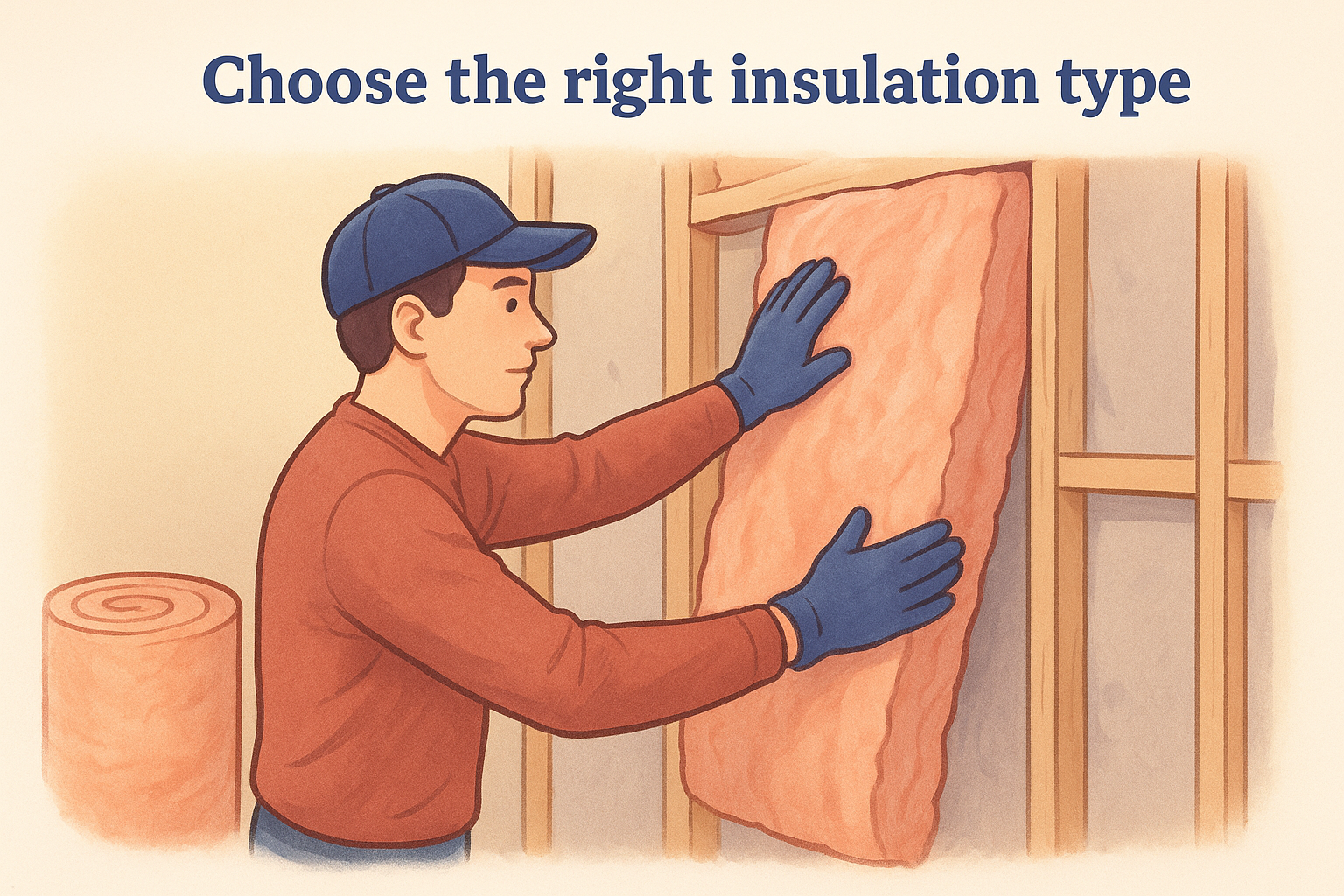
Choose the right insulation type

The most common choice for garage walls is fiberglass batt insulation cut to fit between studs. For a 2x4 framed wall, use R-13 or R-15 batts. For a 2x6 framed wall, go with R-19 or R-21. The ceiling deserves attention too - aim for R-38 if you plan to heat the garage or if it sits above a conditioned living space.

Here's a quick reference for common garage insulation options:

Insulation Type R-Value Range Best For Approx. Cost (per sq ft)
Fiberglass batts R-11 to R-21 Standard stud walls $0.30 - $0.60
Rigid foam board R-3.8 to R-6.5 per inch Concrete block walls $0.25 - $0.50
Spray foam R-3.5 to R-7 per inch Air sealing gaps and edges $1.00 - $2.00

Press batts snugly into each stud bay without compressing them. Compressed insulation loses R-value fast , so fit it flush with the stud face rather than forcing extra material into a tight cavity. Staple the facing tabs to the studs on every batt to keep things in place before the drywall goes up.

Control moisture before the drywall goes up

Garages attached to homes in humid climates need a vapor barrier between the insulation and the drywall. Use 6-mil polyethylene sheeting stapled to the studs, lapping seams by at least 6 inches and sealing them with housewrap tape . In drier climates like Sacramento, vapor barriers are less critical on all walls, but still worth adding on any exterior wall that faces direct weather.

If you skip moisture control and trap water vapor behind new drywall, you'll face mold remediation costs that far exceed what a roll of poly sheeting costs today.

Step 3. Hang drywall on walls, ceiling, and around doors

With insulation in place and framing confirmed, you're ready for the most physically demanding part of learning how to drywall a garage: getting the panels up. Work ceiling to walls and always fasten panels perpendicular to the framing members, with panel ends landing on the center of a joist or stud so both sheets share that edge for a solid seam.

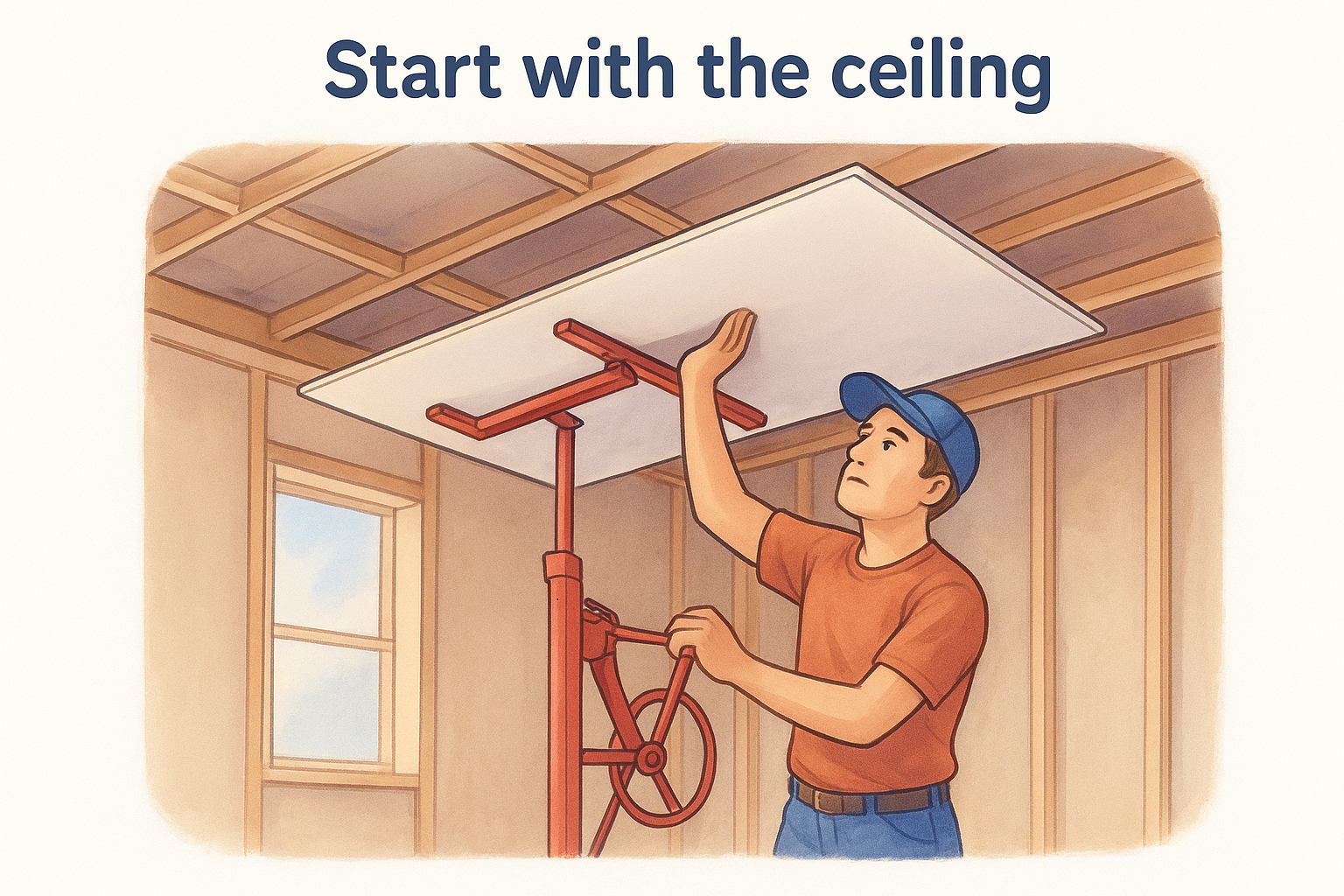
Start with the ceiling

Hanging ceiling panels solo is brutal without the right equipment. Rent a drywall lift and load each panel face-down before cranking it flush against the joists. Drive 1-5/8-inch drywall screws every 12 inches along each joist, keeping fasteners at least 1/2 inch from the panel edge to avoid crumbling the core near seams.

Follow this sequence for each ceiling panel:

  1. Load the panel onto the lift face-down
  2. Crank it snug against the joists
  3. Drive two screws immediately to hold position before releasing the lift handle
  4. Complete the full fastening pattern across every joist the panel crosses
  5. Leave a 1/8-inch gap between adjacent panels to allow for expansion

Never force panels tight against each other - that small gap prevents buckling when humidity causes the panels to shift.

Hang the walls and work around openings

Start wall panels at the top course and press each sheet tight to the ceiling panels above. Use a foot lifter to hold the bottom panel in place while you drive screws. Space fasteners every 16 inches in the field and every 12 inches along edges where two panels share a stud.

Doors and windows require careful measuring before each panel goes up. Mark every opening on the panel face using measurements taken directly from the rough frame, then score and snap the cutout with a utility knife. Test-fit the panel before you commit to fastening it - a cut that's off by half an inch creates a gap that takes extra mud to close and tends to show through the final finish.

Step 4. Tape, mud, sand, texture, and paint

The finishing phase is what separates a clean result from one that looks uneven and rushed. Learning how to drywall a garage is straightforward up to this point, but taping, mudding, and sanding require real patience. Plan on three separate coats of joint compound with full drying time between each one, and do not rush the sanding step.

Tape and apply joint compound

Start by embedding paper tape over every seam using a thin first coat of joint compound. Press the tape into the mud with your 6-inch taping knife , smoothing out any bubbles or wrinkles as you go. Fill all screw dimples with this same first coat.

Always let each coat dry completely before applying the next one - mud that looks dry on the surface can still be wet underneath, and sanding too early tears the tape loose.

Apply two additional coats of compound , widening each coat slightly with your 10-inch knife. The second coat feathers the edges and builds a smooth transition. The third coat is your finish coat and should be thin enough to sand back quickly without heavy effort. Use pre-mixed compound for all three coats on a typical garage job.

Sand, texture, and paint

Sand between coats with 120-grit paper and do your final sanding with 150-grit on a pole sander. Work in strong side-angle lighting - a work light held low across the wall surface reveals ridges and high spots that flat overhead lighting completely hides. Wipe the dust off with a dry cloth before you touch the primer.

Prime the entire drywalled surface before texturing or painting. Unprimed joint compound absorbs paint unevenly and creates dull patches called flashing. Roll on a drywall-specific primer and let it dry fully. Then apply your texture - orange peel and knockdown are the two most common choices for garages. Once the texture sets, roll on two coats of finish paint and the job is complete.

Wrap up and decide DIY vs pro help

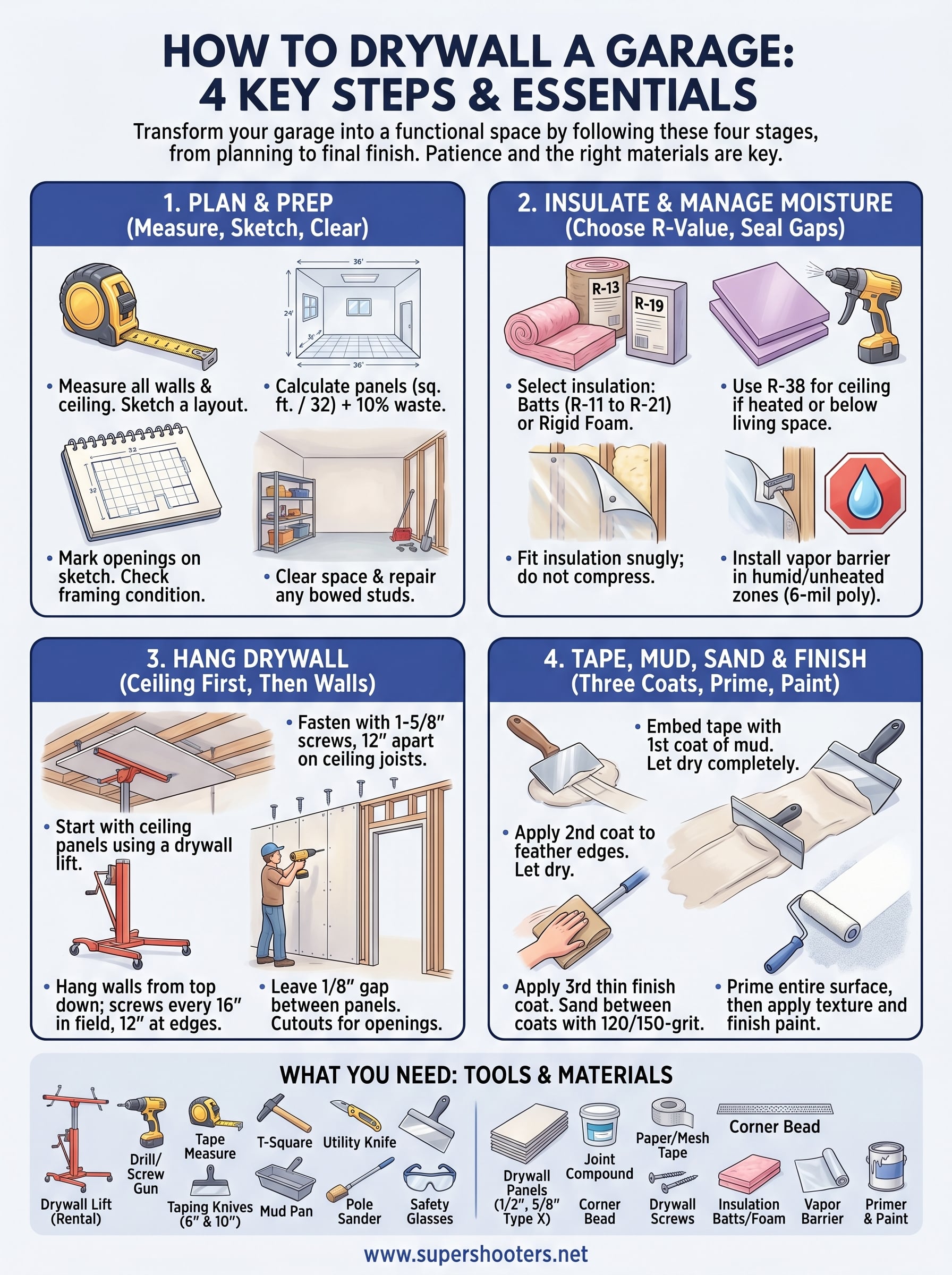
You now have everything you need to understand how to drywall a garage from start to finish. The process breaks down into four manageable phases: planning and prep, insulation, hanging panels, and finishing your surface with tape, mud, and paint. Doing it yourself saves real money , but it demands time, physical effort, and a willingness to correct mistakes along the way. Give yourself at least two full weekends for a standard two-car garage, and plan for a third if the finishing work needs extra passes to look clean.

If the ceiling work, fire-code requirements, or finishing quality feel outside your comfort zone, hiring a professional crew is the smarter call. Experienced contractors work faster, carry the right equipment, and deliver results that hold up to a building inspection without the guesswork. For Sacramento Valley homeowners who want the job done right, contact Super Shooters for a free in-home estimate and see what professional garage drywall looks like when done properly.

Recent Posts

By cinchweb May 12, 2026
Learn what to do after popcorn ceiling removal. Fix drywall damage, apply a smooth skim coat, and get a professional paint finish with these easy steps.
By cinchweb May 10, 2026
Identify and repair 6 common types of drywall damage. From water stains to cracks, learn how to fix your walls fast and get professional, lasting results.
By cinchweb May 9, 2026
Learn how to fix cracks in plaster walls. Assess the damage, secure loose areas with plaster washers, and apply compound for a seamless, lasting repair.
By cinchweb May 9, 2026
Learn how to texture drywall walls with our guide to orange peel and knockdown finishes. Master mud consistency, tool selection, and expert techniques.
By cinchweb May 7, 2026
Learn how to repair water damaged drywall with our guide. Fix leaks, dry framing, and follow steps to patch and finish walls or ceilings for a seamless look.
By cinchweb May 7, 2026
Learn how to finish drywall with this step-by-step guide. Master professional techniques for taping, mudding, and sanding to get smooth, paint-ready walls.
By cinchweb May 5, 2026
Compare orange peel vs knockdown texture to find the best finish for your home. We break down the costs, cleaning ease, and repair tips for each style.
By cinchweb May 4, 2026
Learn how to patch a hole in the ceiling with our guide for every size. Fix dings, use mesh patches, or replace drywall for a seamless, professional finish.
By cinchweb May 4, 2026
Learn how to smooth textured walls to get a flat, modern finish. Our guide covers asbestos safety, skim coating, and tools for professional results.
Show More