July 14, 2026
Popcorn Ceiling Removal Cost Per Square Foot: DIY vs. Pro
You've looked up popcorn ceiling removal cost per square foot because you want a real number before you commit to a quote or a weekend of scraping. Fair enough. Prices online swing wildly, from a couple dollars a square foot to double-digit numbers, and none of that helps you plan an actual budget for your living room or a 1,500 square foot house.
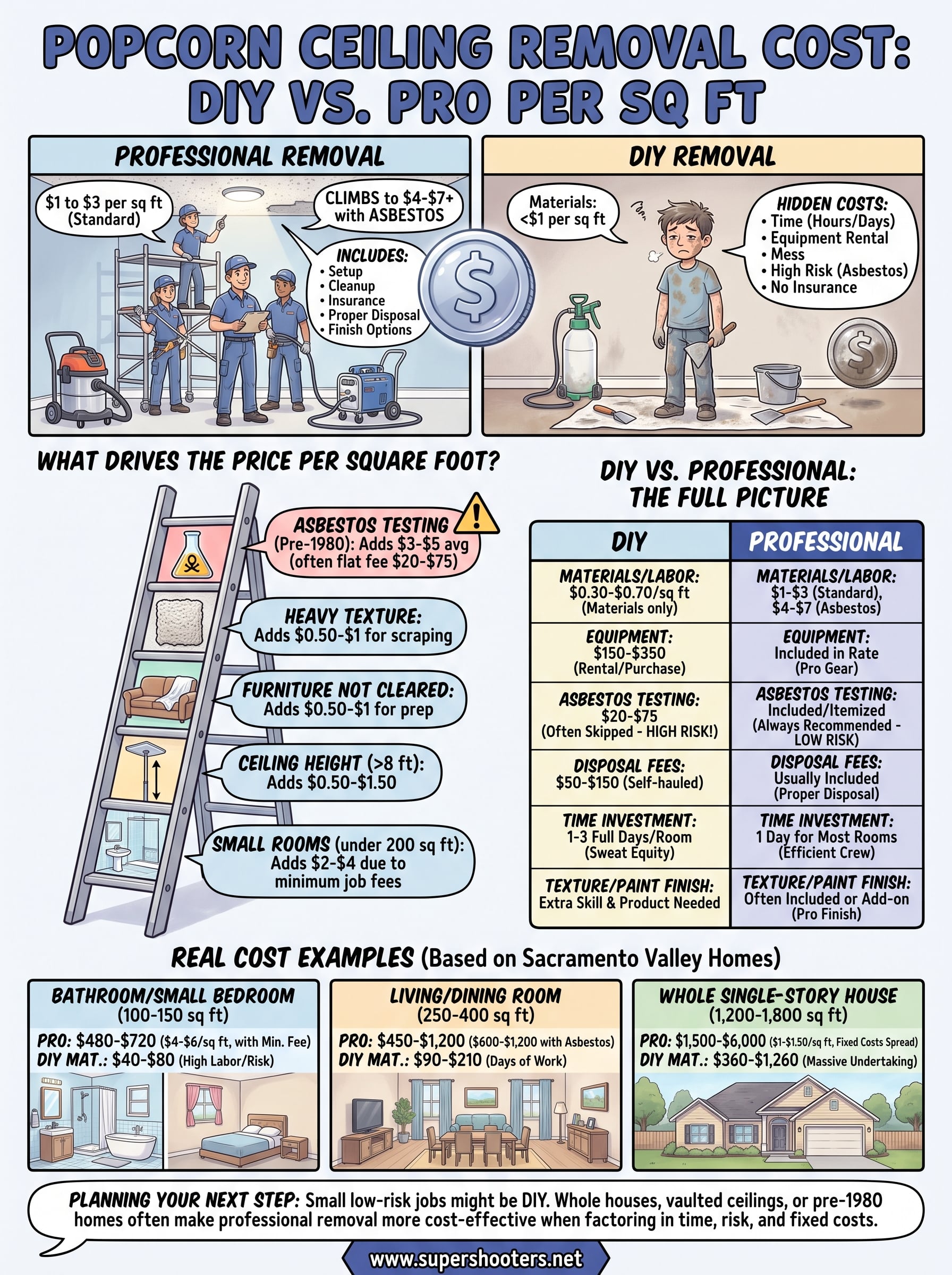
Here's the short answer: professional removal typically runs $1 to $3 per square foot for standard ceilings, climbing to $4 to $7 or more when asbestos testing or abatement enters the picture. DIY can drop that to under a dollar per square foot in materials, but it costs you in time, mess, and risk if the texture turns out to contain asbestos, which is common in homes built before 1980.
Below, we break down exactly what drives the price up or down, compare true DIY costs against hiring a licensed contractor, and walk through when paying more for professional removal actually saves you money. We've handled thousands of these ceilings across Sacramento Valley homes, so the numbers reflect what jobs actually cost, not guesswork.
Why the cost per square foot matters for your budget
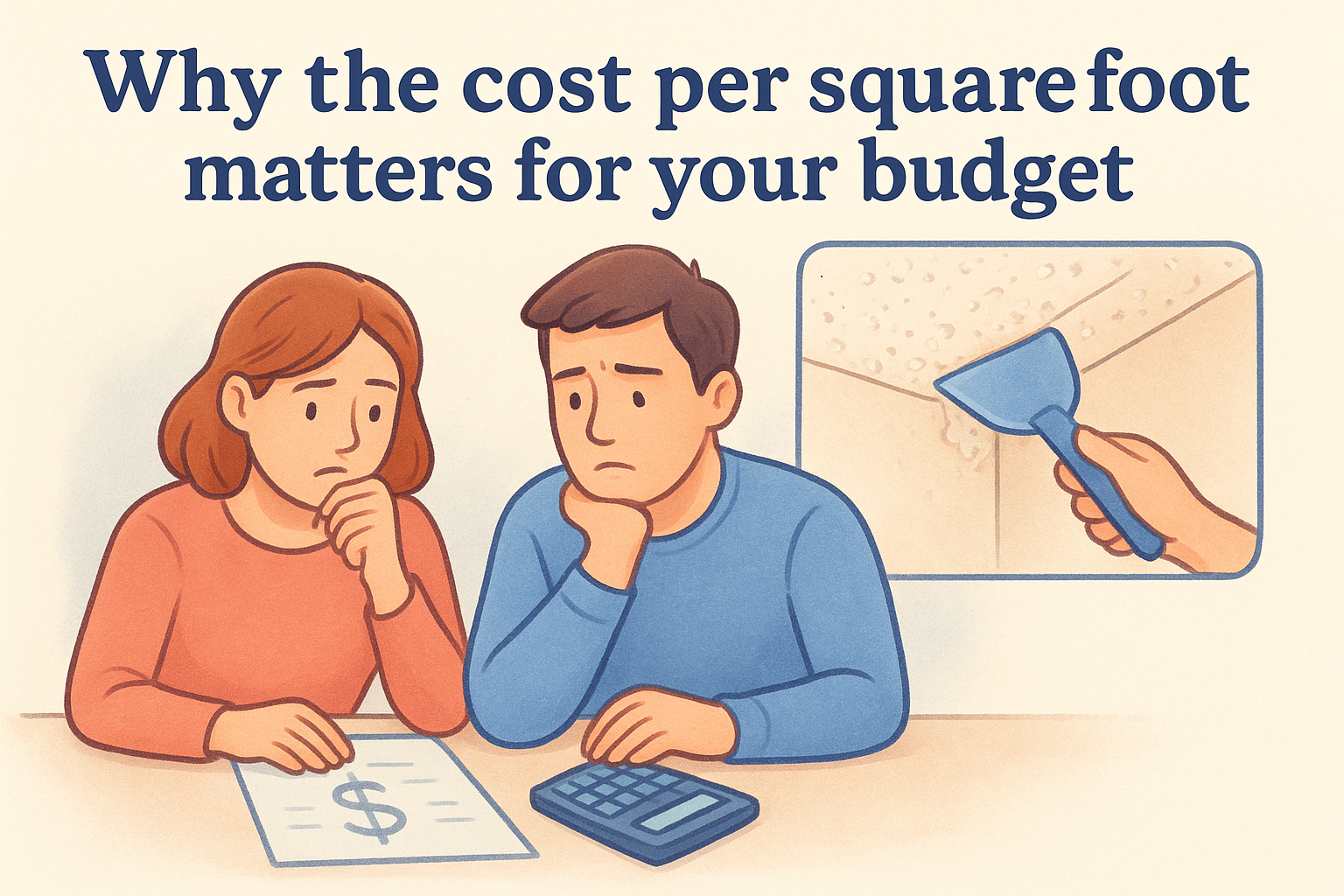
Most homeowners assume price scales in a straight line: double the ceiling, double the bill. It doesn't work that way with popcorn ceiling removal , and that's exactly why understanding the per-square-foot number matters before you sign a contract. A contractor's minimum job fee, the cost of setup and cleanup, and the fixed price of asbestos testing all get spread across your square footage. A tiny bathroom ceiling might cost $8 a square foot once you factor in a $250 minimum charge, while a 2,000 square foot single-story home might land closer to $1.50 a square foot because those same fixed costs get absorbed across a much bigger area.
Small rooms cost more per square foot than whole houses
Contractors don't drive out, set up drop cloths, mask off floors and vents, and haul away debris for less than a certain amount, no matter how small the room. That minimum job cost is why a single 100 square foot bedroom ceiling can run $4 to $6 per square foot, even though the same crew would charge $1.50 to $2.50 per square foot on a whole-house job. If you're only removing popcorn texture in one room, ask your contractor directly whether they have a minimum charge, because that number changes your effective rate more than anything else on the estimate.
The smaller the job, the higher your true cost per square foot, because fixed costs like setup, testing, and cleanup don't shrink with the room.
What pushes your price per square foot higher
Several variables swing the price beyond simple square footage, and most homeowners don't find out about them until the estimate lands in their inbox. Ceiling height matters because anything above 8 feet needs scaffolding or extended equipment, which slows the crew down. Furniture and belongings left in the room add labor hours for covering and moving items. Textured ceilings with heavier stipple or thick popcorn take longer to scrape than a light, thin application. And if the home was built before 1980, asbestos testing almost always gets added to the quote, since older acoustic ceiling texture frequently contains asbestos fibers that require lab confirmation before anyone touches the surface. The Environmental Protection Agency notes that popcorn ceilings installed before the 1980s ban on asbestos-containing materials are common candidates for this testing, and skipping it isn't a shortcut worth taking. You can read more about asbestos in older homes directly from the EPA's asbestos page.
| Factor | Typical effect on cost per sq ft |
|---|---|
| Room under 200 sq ft | Adds $2-$4 due to minimum job fees |
| Ceiling above 8 feet | Adds $0.50-$1.50 for equipment and time |
| Furniture not cleared | Adds $0.50-$1 for extra prep labor |
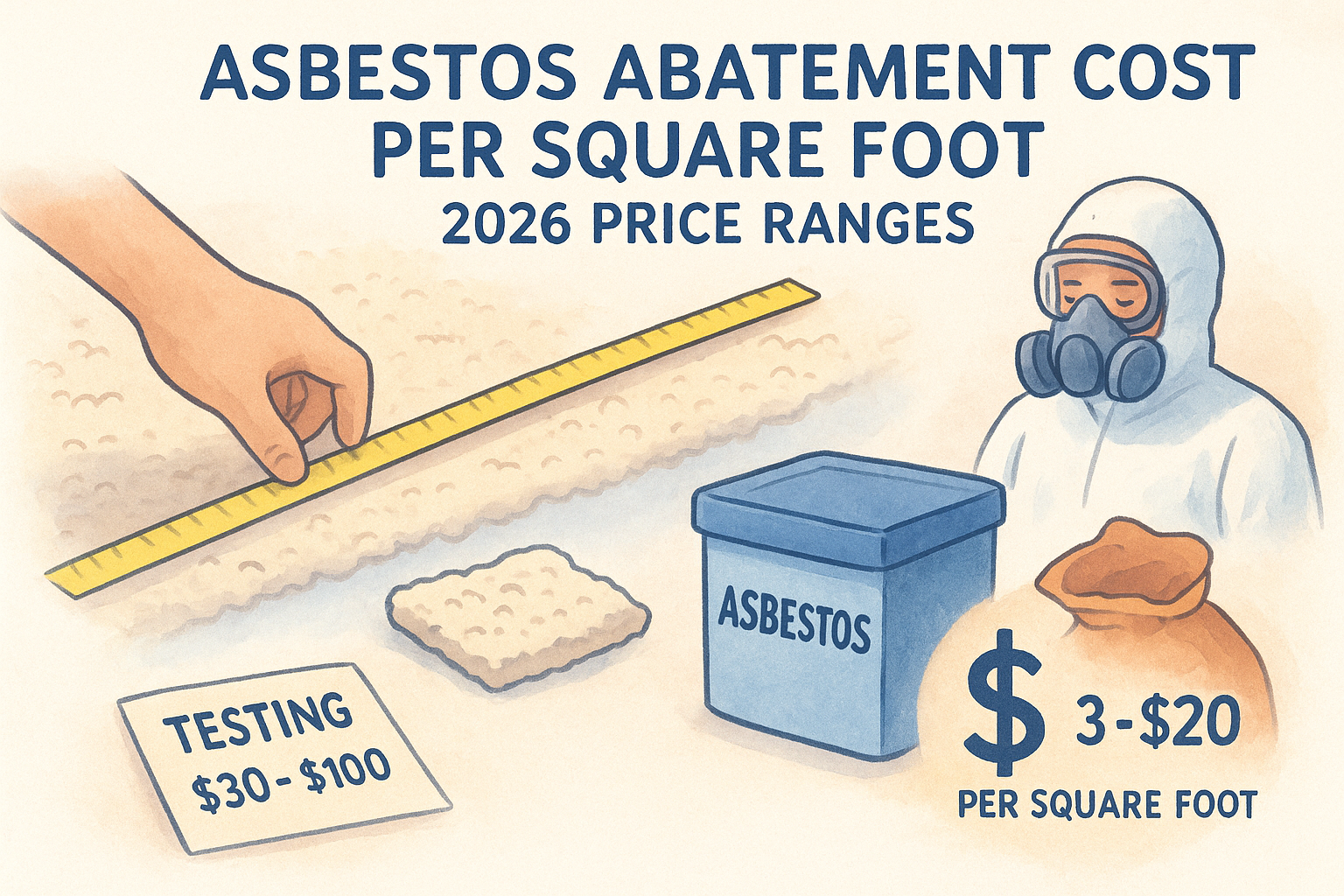
| Asbestos testing required | Adds $3-$5 average, often a flat lab fee |
| Heavy or thick texture | Adds $0.50-$1 for extra scraping time |
Comparing quotes without getting fooled
Quotes rarely present the same variables the same way, which is why two bids for the same house can land $2,000 apart and still both be reasonable. One contractor might roll asbestos testing into their base price per square foot, while another lists it as a separate line item that only shows up if the sample comes back positive. Some companies quote a flat project price instead of a rate per square foot, which hides how they're actually calculating the number. Before you compare bids side by side, ask each contractor for three specifics:
- The exact square footage they measured and how they measured it
- Whether asbestos testing is included or billed separately
- Whether the price includes texture matching and repainting after removal
Getting those three answers in writing turns a confusing stack of estimates into an apples-to-apples comparison, and it protects you from a low headline number that balloons once the real scope of work shows up on invoice day.
How to calculate your total popcorn ceiling removal cost
Getting an accurate number for your own home means working through three steps in order: measuring square footage correctly, applying the right rate for your situation, and layering fixed costs on top. Skip any one of these and your estimate will be off by hundreds of dollars, which is exactly why so many homeowners feel blindsided when the final invoice doesn't match the number they had in their head.
Measure your ceiling square footage correctly
Start by measuring the length and width of each room you're treating, then multiply those two numbers together. A 12-foot by 15-foot bedroom gives you 180 square feet. Don't subtract for closets, light fixtures, or vents. Contractors typically charge for the full ceiling plane because covering and scraping around those obstacles takes time too. If you're pricing out a whole house, add up every room separately rather than using total floor square footage from your property listing, since that figure usually includes exterior walls and sometimes garage space that won't need texture removal.
Apply the per-square-foot rate to your scenario
Once you know your square footage, multiply it by the rate that matches your job type. Here's the basic formula:
Total cost = Square footage x Rate per sq ft + Fixed costs
For a straightforward job with no asbestos concerns, plug in $1 to $3 per square foot for professional removal . If your home was built before 1980, add the asbestos testing fee separately rather than folding it into the rate, since testing is a flat cost regardless of room size. A 500 square foot living room and hallway combo, for example, comes out to $500 to $1,500 before testing, and $530 to $1,530 after a typical $30 sample fee.
Multiply square footage by your rate, then add fixed costs like testing and disposal, because skipping either step guarantees an inaccurate budget.
Add the fixed costs on top
Fixed costs are the line items that don't scale with square footage, and they're where most DIY budget estimates fall apart. Here's what typically gets added after the base calculation:
- Asbestos testing: $20 to $75 for lab analysis of a sample
- Debris disposal fees: $50 to $150 depending on volume and local dump rates
- Furniture moving or protective covering: $100 to $300 if you're hiring labor for this step
- Texture matching and repainting: $0.50 to $1.50 per square foot if you want the ceiling finished, not just scraped bare
Run through this same math for every room you're treating, then total the results. That gives you a real project cost instead of a single per-square-foot number that ignores how your specific home is laid out. If you're getting quotes from licensed contractors , ask them to show their math the same way, room by room with fixed costs itemized, so you can verify the number instead of taking a bottom-line figure on faith.
DIY vs. professional removal: comparing the price per square foot
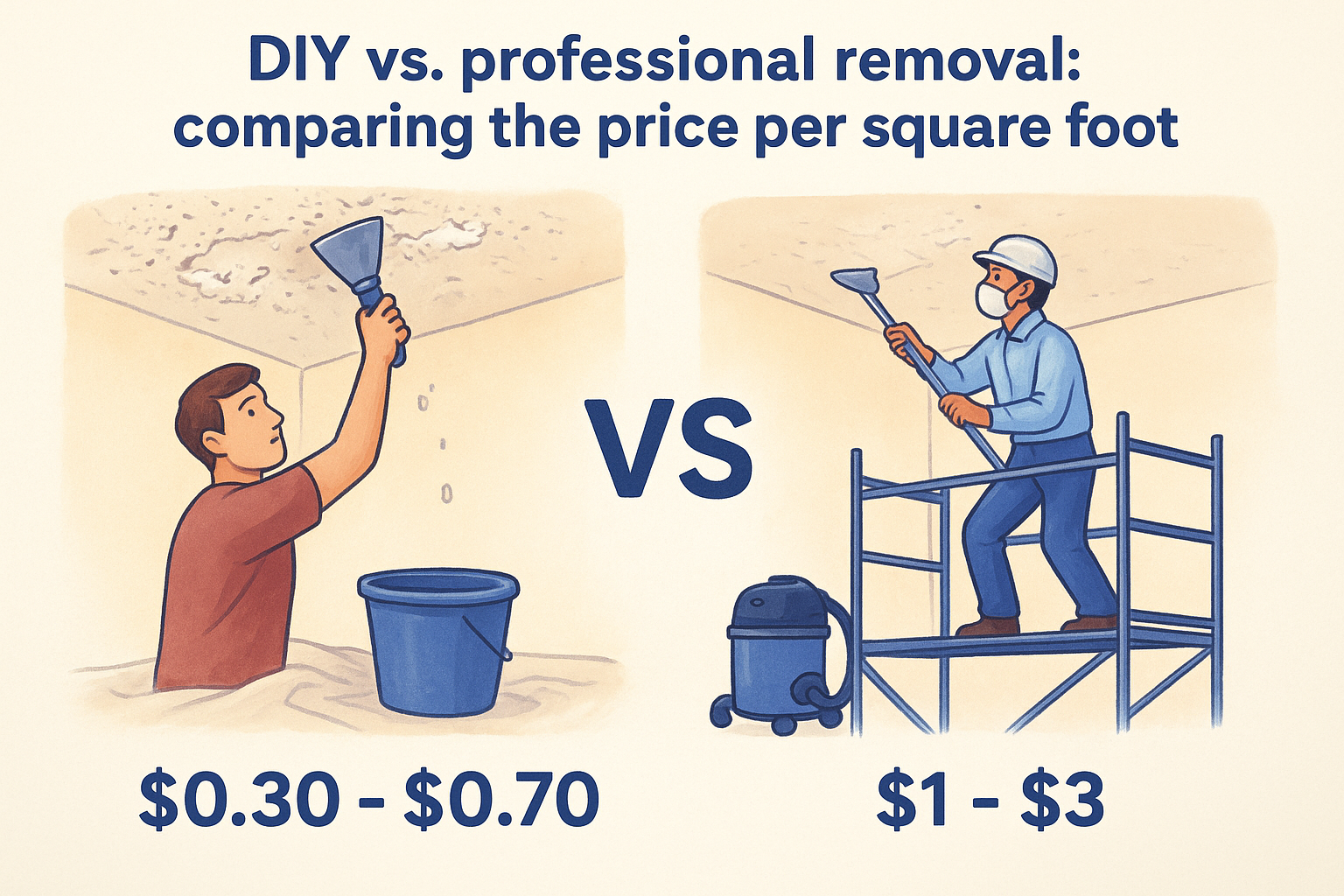
On paper, DIY popcorn ceiling removal looks like the obvious money-saver. In practice, the math only works out if your ceiling has no asbestos, you have the physical stamina for hours of overhead scraping, and you value your weekend at close to zero. Materials for a DIY job, a garden sprayer, drop cloths, a wide scraper, and joint compound for patching, typically run $0.30 to $0.70 per square foot. That's a real number, but it's only part of the story once you account for what a professional crew brings that a homeowner usually can't replicate alone.
What you're actually paying for with a pro
Equipment rental narrows the gap faster than most people expect. Scaffolding or a proper extension pole system for vaulted ceilings can add $50 to $150 to a DIY weekend, and a wet/dry vacuum rated for drywall dust runs another $100 to $200 if you don't already own one. Professional crews carry that gear as part of their overhead, which is baked into their $1 to $3 per square foot rate. They also carry insurance, which matters the moment a ladder slips or a light fixture gets damaged during removal.
Paying $1 to $3 more per square foot for a licensed crew buys you insurance, proper disposal, and a texture-matched finish, not just faster scraping.
Side-by-side cost comparison
Here's how the two approaches stack up once every cost gets accounted for, not just the headline material price:
| Cost factor | DIY | Professional |
|---|---|---|
| Materials/labor rate per sq ft | $0.30-$0.70 | $1-$3 (standard), $4-$7 (with asbestos) |
| Equipment (one-time) | $150-$350 | Included in rate |
| Asbestos testing | $20-$75, but often skipped | Included or itemized, always recommended |
| Disposal fees | $50-$150, self-hauled | Usually included |
| Time investment | 1-3 full days per average room | 1 day for most rooms |
| Texture/paint finish | Extra skill and product needed | Often included or offered as add-on |
| Risk if asbestos present | High, no containment protocol | Low, licensed abatement procedures |
Where DIY actually makes sense
Small, low-risk jobs are where scraping it yourself pays off. A single closet ceiling, a small laundry room, or a home built after 1980 with a documented negative asbestos test are reasonable DIY candidates. You'll spend a weekend and under $100 in materials for a room that size, and the risk of hidden asbestos is minimal since post-1980 construction rarely used the older formulations. The Environmental Protection Agency's asbestos guidance confirms that risk drops sharply for homes built after the ban, which is the single biggest factor in deciding whether DIY is worth the labor.
Beyond that scope, the math flips. Whole-house jobs, vaulted ceilings, or any home built before 1980 push the real cost of DIY, including your time, equipment, and the risk of disturbing asbestos fibers without containment, above what a licensed contractor charges for the same square footage. That's the point where the per-square-foot savings on paper stop translating into actual savings in your driveway.
Real cost examples by ceiling size and room type
Numbers stick better than formulas, so here are actual project ranges pulled from typical Sacramento Valley homes. These examples assume a home built before 1980 unless noted, since that's the majority of houses still carrying popcorn texture, and they include a standard asbestos testing fee where it applies. Use these as a sanity check against any quote you receive, not as an exact match, since your specific layout, ceiling height, and texture thickness will shift the final number up or down.
Bathroom or small bedroom (100-150 sq ft)
A small bathroom or single bedroom is where the per-square-foot rate looks the most painful, purely because of minimum job fees. A 120 square foot bathroom ceiling with a negative asbestos test typically runs $480 to $720 for professional removal, working out to $4 to $6 per square foot once the contractor's minimum charge gets factored in. Add asbestos testing and a positive result requiring abatement, and that same room can jump to $700 to $900 total. DIY materials for a room this size land around $40 to $80, but that ignores the hours of overhead scraping in a cramped space with limited room to maneuver.
Living room or dining room (250-400 sq ft)
Rooms in this range start showing the real advantage of spreading fixed costs across more square footage. A 300 square foot living room runs $450 to $900 professionally, or $600 to $1,200 if asbestos abatement is required. Vaulted ceilings in this room type push costs higher still, since scaffolding and extended reach tools add labor time regardless of square footage. DIY materials here fall between $90 and $210, which sounds appealing until you account for two to three full days of work overhead, plus disposal for a much larger volume of scraped debris.
Whole single-story house (1,200-1,800 sq ft)
Whole-house jobs are where the per-square-foot rate drops closest to that $1 to $1.50 range, since the contractor's setup and minimum charges get absorbed across every room. A 1,500 square foot single-story home typically runs $1,500 to $3,000 for standard removal, or $4,500 to $6,000 if asbestos abatement is confirmed across multiple rooms. This is also where hiring a licensed contractor pays off most clearly, since the labor savings from doing one large continuous job outweigh what you'd spend tackling it room by room over several weekends.
A whole-house job often costs less per square foot than a single small room, because fixed fees get spread across far more ceiling area.
| Room type | Approx. sq ft | Professional cost range | DIY material cost |
|---|---|---|---|
| Bathroom | 100-150 | $480-$720 | $40-$80 |
| Bedroom | 150-200 | $600-$1,000 | $60-$120 |
| Living/dining room | 250-400 | $450-$1,200 | $90-$210 |
| Whole single-story house | 1,200-1,800 | $1,500-$6,000 | $360-$1,260 |
Without abatement in the mix, these figures track closely with published cost estimates from sources like HomeAdvisor's national cost data, though local labor rates in the Sacramento Valley tend to sit near the middle of most national ranges rather than the high end.
Planning your next step
Your cost per square foot ultimately comes down to three questions: how big is the job, does your home predate 1980, and how much is your own time worth. Small rooms cost more per foot, whole houses cost less, and asbestos testing changes the math faster than anything else on the list. Run the formulas above against your own square footage before you accept any bid, and you'll walk into that conversation knowing whether $1,200 or $4,500 is the honest number for your house.
If your ceiling was installed before 1980 or you'd rather skip the guesswork entirely, get a free estimate from a crew that's measured thousands of these jobs across the Sacramento Valley. Request your quote through our popcorn ceiling removal page and get a real, itemized number instead of a range.
Recent Posts