
August 13, 2026
How to Choose the Right Drywall Repair Contractor
That crack over your doorway or the fist-sized hole in the hallway isn't going away on its own, and patching it yourself with a tub of spackle usually leaves a lumpy reminder every time you walk by. Finding a reliable drywall repair contractor matters more than most homeowners realize, because a bad patch job shows up under paint, especially with textured ceilings or walls that have their own pattern to match.
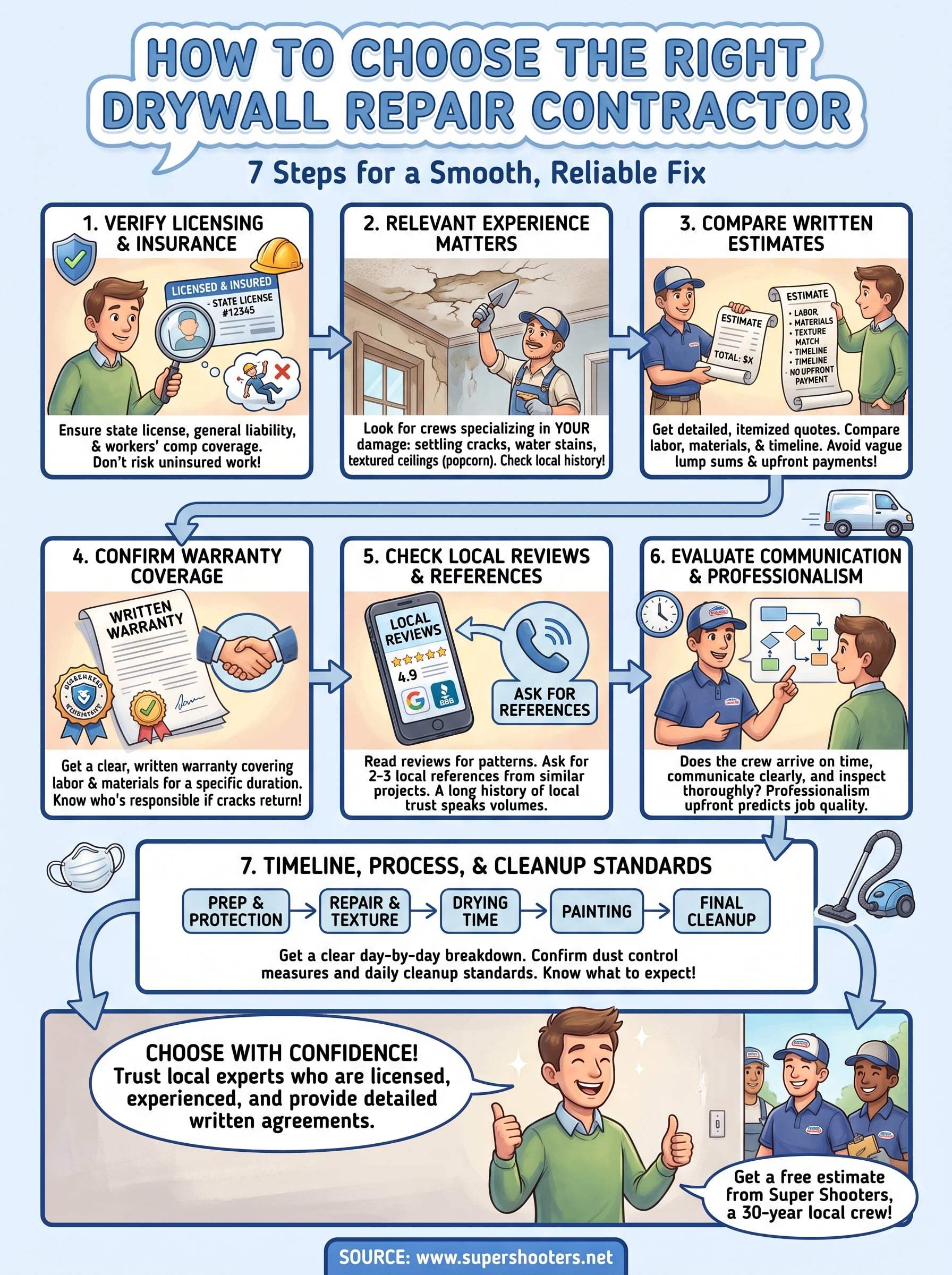
So how do you actually pick the right person for the job? It comes down to checking a handful of specifics: licensing and insurance , real experience with your type of damage (water stains, settling cracks, popcorn ceiling remnants), and a written estimate that spells out cost and timeline before any work starts. A contractor who won't put things in writing or hedges on a warranty is telling you something.
Below, we walk through the exact criteria to compare, the questions to ask during a free consultation, and the red flags that signal you should call the next name on your list. If you're in the Sacramento Valley area, you'll also see how local, long-established crews stack up against one-off handyman services when it's your walls on the line.
1. Verify licensing, insurance, and certifications
Before you talk price or timeline, ask for proof that the company is legally allowed to do the work and covered if something goes wrong. A licensed contractor carries a state license number you can look up, general liability insurance, and workers' comp for anyone stepping into your home. Skip this step and you're the one holding the bag if a worker gets hurt on a ladder in your living room or a botched repair damages a ceiling joist.
What to look for
Ask for the contractor's license number and check it against your state's contractor licensing board database. In California, that means confirming the license through the Contractors State License Board. A legitimate company will hand over this number without hesitation, often printing it right on their trucks and estimates. Also confirm they carry current general liability insurance and, if they have employees, workers' compensation coverage. If the job involves an older home with a textured ceiling, ask whether they're trained to handle asbestos-containing materials , since popcorn ceilings installed before the 1980s sometimes contain it and require specific abatement procedures rather than standard sanding and removal.
A contractor who can't produce a license number and insurance certificate on request shouldn't be inside your home.
Why it matters
Uninsured work puts your homeowner's policy and your wallet at risk. If a worker falls or a pipe gets nicked during a repair, you could end up covering medical bills or water damage out of pocket. Licensing also signals that the contractor has passed baseline competency requirements and is accountable to a regulatory body if the work goes wrong. This step matters even more with asbestos abatement , where improper handling can expose your household to airborne fibers with long-term health consequences.
Questions to ask
- Can you provide your license number and a copy of your insurance certificate?
- Are your workers covered under workers' compensation?
- Have you tested for or handled asbestos-containing ceiling materials before?
- What happens if damage occurs to my home during the repair?
- Is your license active and in good standing right now?
2. Look for relevant experience and specialization
Not every drywall crew handles the same range of problems. Some outfits focus on new construction, hanging sheets in fresh builds where every wall is square and there's no existing texture to match. Others specialize in repair work on older homes , where you're dealing with settling cracks, water stains, and ceilings textured decades ago in a pattern nobody makes anymore. Before hiring, figure out which category your project falls into and pick a contractor whose daily work matches it.
What to look for
Ask how long the company has operated in your area and how many repair jobs they've completed, not just installations. A crew with 30 years of history and thousands of completed projects has seen almost every kind of damage a house can throw at them. Also check whether they handle specialty situations like ADU drywall completion , garage finishing, or plaster repair on top of standard patching.
Ten years fixing new-construction seams doesn't prepare a crew for matching a 1970s popcorn texture.
Why it matters
A contractor who mostly hangs drywall in new subdivisions may struggle to blend texture on a 40-year-old ceiling or diagnose whether a crack signals foundation movement. Specialized experience means fewer surprises and a better texture match.
Questions to ask
- How many repair jobs like mine have you completed?
- Have you worked on homes built before 1980?
- Do you handle texture matching, or just flat patching?
- Can you show photos of similar past repairs?
3. Compare estimates and pricing structures
A quick phone quote tells you almost nothing. A written estimate should break down labor, materials, and any anticipated extras like texture matching or asbestos testing, so you can compare contractors on an apples-to-apples basis instead of guessing at a lump sum.
What to look for
Request at least two or three estimates before you commit. Look at how each one itemizes cost, not just the bottom line.
| Estimate detail | Why it matters |
|---|---|
| Labor vs. materials breakdown | Shows where your money actually goes |
| Texture/paint matching included? | Prevents surprise add-on charges |
| Payment schedule | Reputable crews don't demand full payment upfront |
| Timeline estimate | Flags rushed or vague scheduling |
Many established Sacramento Valley contractors, including Super Shooters, require no upfront payment , collecting only once the work is finished to your satisfaction.
If a contractor wants full payment before touching a wall, walk away.
Why it matters
Vague pricing invites change orders halfway through the job. A detailed estimate protects you from surprise charges and gives you leverage if the final bill doesn't match what was promised.
Questions to ask
- Is this estimate free, and does it require any deposit?
- What's included versus billed as an extra?
- When is payment due, and is any portion required upfront?
- How long is this quote valid?
4. Check warranty and guarantee coverage
Ask what happens if the patch cracks again in six months or the texture starts peeling at the edges. A warranty separates contractors who stand behind their work from ones who disappear after collecting the final check. Repairs on drywall aren't like replacing a light fixture, movement in the house, humidity, or a bad batch of mud can cause a fix to fail down the road, and you want to know who's responsible when that happens.
What to look for
Find out exactly what's covered, for how long, and whether the warranty transfers if you sell the house. Super Shooters backs its repairs with a Super Shield warranty , which covers workmanship issues that show up after the crew leaves. Get the terms in writing rather than a verbal promise, and check whether the warranty covers just labor or materials too.
A verbal promise of a warranty isn't worth much once the crew has left your driveway.
Why it matters
Without written guarantee coverage, you're stuck paying twice if a repair fails, once for the original job and again for whoever fixes it. A solid warranty also tells you the contractor trusts their own workmanship enough to put it in writing, which says more about quality than any sales pitch.
Questions to ask
- What exactly does your warranty cover, and for how long?
- Is the warranty written into the contract?
- Does it cover materials, labor, or both?
- What's the process if something needs to be redone under warranty?
5. Read local reviews and ask for references
Online star ratings only tell part of the story. Before hiring, dig into what past customers actually said about the crew that showed up at their house, not just the marketing copy on the company's own site. A contractor with thousands of completed projects and decades of reviews from real Sacramento Valley homeowners gives you a much clearer picture than one with a handful of five-star ratings posted last month.
What to look for
Check reviews on Google and the Better Business Bureau, and look for patterns rather than one-off complaints. Ask the contractor directly for two or three local references you can call, ideally from jobs similar to yours, like a popcorn ceiling removal or a water-damaged wall repair.
A contractor with thirty years of local references has nothing to hide.
Why it matters
Reviews and references reveal how a crew handles problems, not just how clean their finished work looks in a photo. A company that's been trusted by homeowners across Roseville, Folsom, and Elk Grove for decades has built a reputation that's harder to fake than a rushed batch of online reviews.
Questions to ask
- Can you give me contact information for two or three recent customers?
- Do you have reviews specific to my type of repair?
- How do you respond when a customer isn't satisfied?
- Are your references from projects in my area?
6. Evaluate communication and professionalism
How a contractor talks to you before signing anything usually predicts how they'll treat you once the job starts. Pay attention to whether they show up on time for the estimate, answer your calls promptly, and explain the repair process in plain language instead of vague reassurances. A drywall repair contractor who takes your questions seriously during the free consultation is more likely to keep you informed while your walls are opened up.
What to look for
Notice whether the estimator actually inspects the damage up close, checking for water stains, settling, or texture type, rather than eyeballing it from across the room. Watch how they dress, whether they wear shoe covers or lay down drop cloths during the walkthrough, and whether they arrive in a branded vehicle. Small details like these often reflect how the crew will treat your home during the actual repair.
How a contractor treats your living room during a free estimate is how they'll treat it during the job.
Why it matters
Poor communication during the estimate phase almost always carries over into the project itself, leading to missed appointments, unclear scheduling, and frustration when questions go unanswered. Professionalism upfront signals a crew that respects your time and your home.
Questions to ask
- Who will be my main point of contact during the project?
- How quickly do you typically respond to calls or texts?
- Will the same crew that gave the estimate do the actual work?
- How do you handle unexpected issues discovered mid-repair?
7. Confirm timeline, process, and cleanup standards
Before a crew starts cutting into your wall, get a clear picture of how long the job takes and what your house looks like while it's underway. A drywall repair contractor who can walk you through each step, cutting out damaged material, taping, mudding, texturing, and painting, without hedging on timing usually runs a tighter operation than one who says "we'll get to it."
What to look for
Ask for a day-by-day breakdown, especially if the job involves drying time between mud coats or texture matching that needs to cure before painting. Find out how they handle dust control, since drywall sanding creates fine particles that spread through vents if nobody bothers to seal off the work area. Check whether daily cleanup is included or left as an afterthought.
A contractor who can't tell you how long the job takes probably hasn't planned it out.
Why it matters
Open-ended timelines turn a two-day patch into a two-week headache, especially if you're living in the house during the repair. Dust containment matters just as much: a careless crew can leave gypsum dust coating furniture and floors throughout the house, not just the room being worked on.
Questions to ask
- What's the estimated start-to-finish timeline for this project?
- How do you contain dust during sanding?
- Will you clean up daily, or only at the end?
- What happens if you find additional damage once the wall is opened?
Choosing a contractor with confidence
Hiring the right crew for a cracked ceiling or a water-stained wall doesn't require guesswork. Run through the same checklist every time: confirm the license and insurance , ask about specific repair experience, get a written estimate, and nail down warranty terms before anyone picks up a trowel. Skip any of these steps and you're rolling the dice with your own walls.
Good contractors expect these questions and answer them without hesitation. If a company gets defensive about showing a license number or won't put a warranty in writing, that's your answer right there. Trust the ones who talk you through their process like they've done it thousands of times, because they have.
If you're in the Sacramento Valley and dealing with cracks, holes, or damaged texture, get a free drywall repair estimate from Super Shooters and see how a 30-year local crew handles it.