November 5, 2026
Best Paint for Popcorn Ceiling: 4 Picks and How to Apply
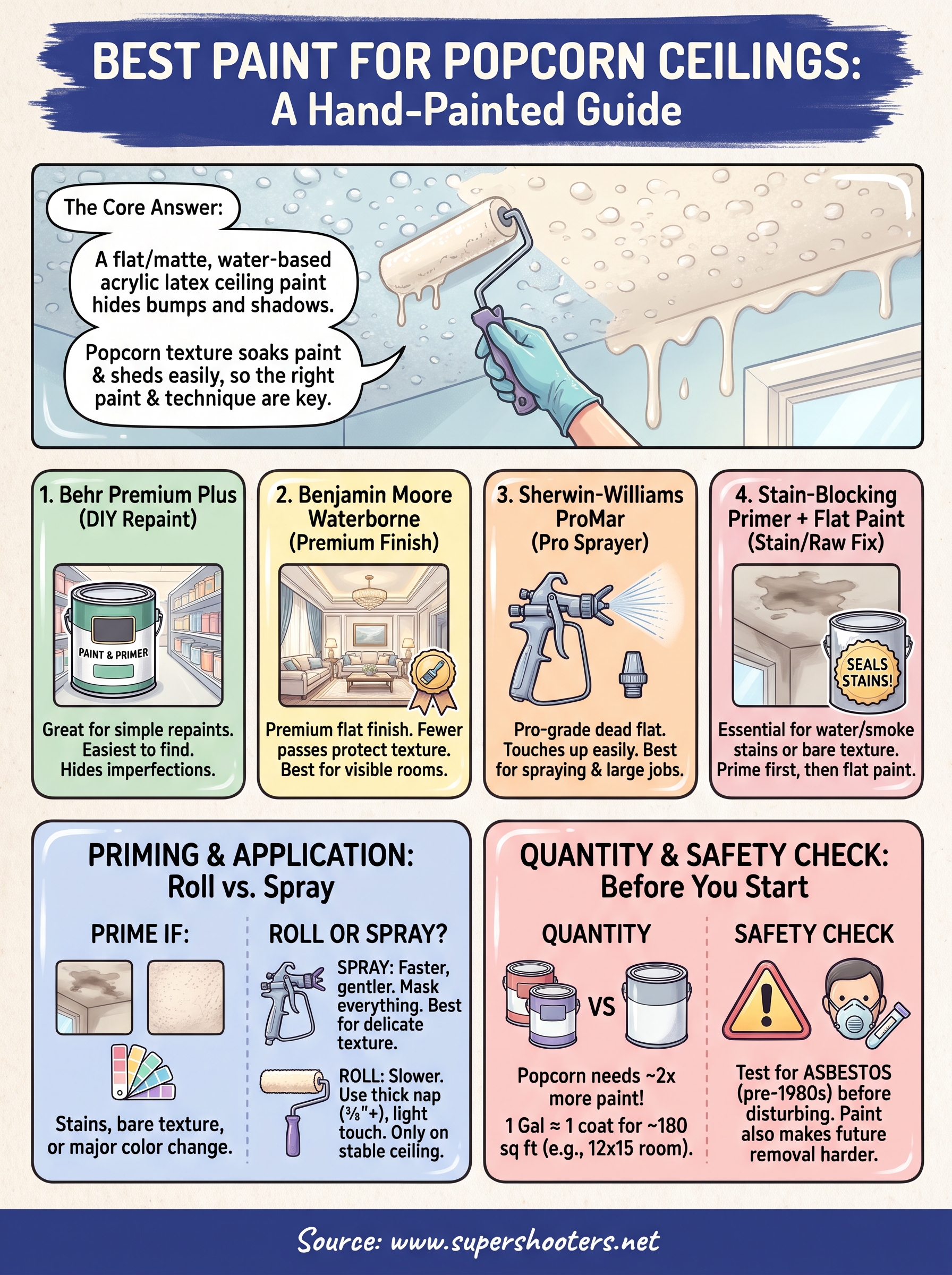
The best paint for popcorn ceiling is a flat or matte, water-based acrylic latex ceiling paint, applied in thin coats over a sound ceiling. Behr Premium Plus Ceiling Paint suits you if you want a paint and primer you can grab at a home center. Benjamin Moore Waterborne Ceiling Paint fits if you want a premium finish in a visible room. Sherwin-Williams ProMar suits you if you plan to spray. A stain-blocking primer under flat paint is the right call for stained or never-painted ceilings.
The problem is that popcorn texture behaves differently from a smooth ceiling. It soaks up paint, it can shed if you press a roller too hard, and the wrong sheen makes every bump and shadow stand out. This article gives you four picks, then covers priming, roller versus sprayer, how much paint to buy, and the asbestos check you should do first.
Super Shooters has worked on popcorn ceilings in Sacramento Valley homes for over 30 years. We see how these ceilings hold up under paint, and we know when painting is worth it and when it is not.
1. Behr Premium Plus Ceiling Paint
Behr Premium Plus Ceiling Paint is a flat acrylic-latex paint and primer made for ceilings, and it is the easiest pick to find. Home Depot lists a 5-gallon version in the white shade BWC-11 "Fresh Popcorn". The name describes the color, not a texture-specific formula.
How it performs on popcorn
The flat sheen hides the shadows and bumps that a glossier finish would highlight on texture. The product listing describes the formula as designed for previously painted or primed interior surfaces. Treat it as a repaint product, not a fix for raw texture.
Treat "paint and primer" as a repaint product, and prime bare or stained texture separately.
Who it suits and what to check
Choose it when your ceiling already carries a coat of paint and you want a one-product job from a home center. Before you buy:
- Confirm the can says flat and interior.
- Buy enough for two coats (the quantity example below shows how).
- Check the white in daylight, because ceiling whites vary from can to can.
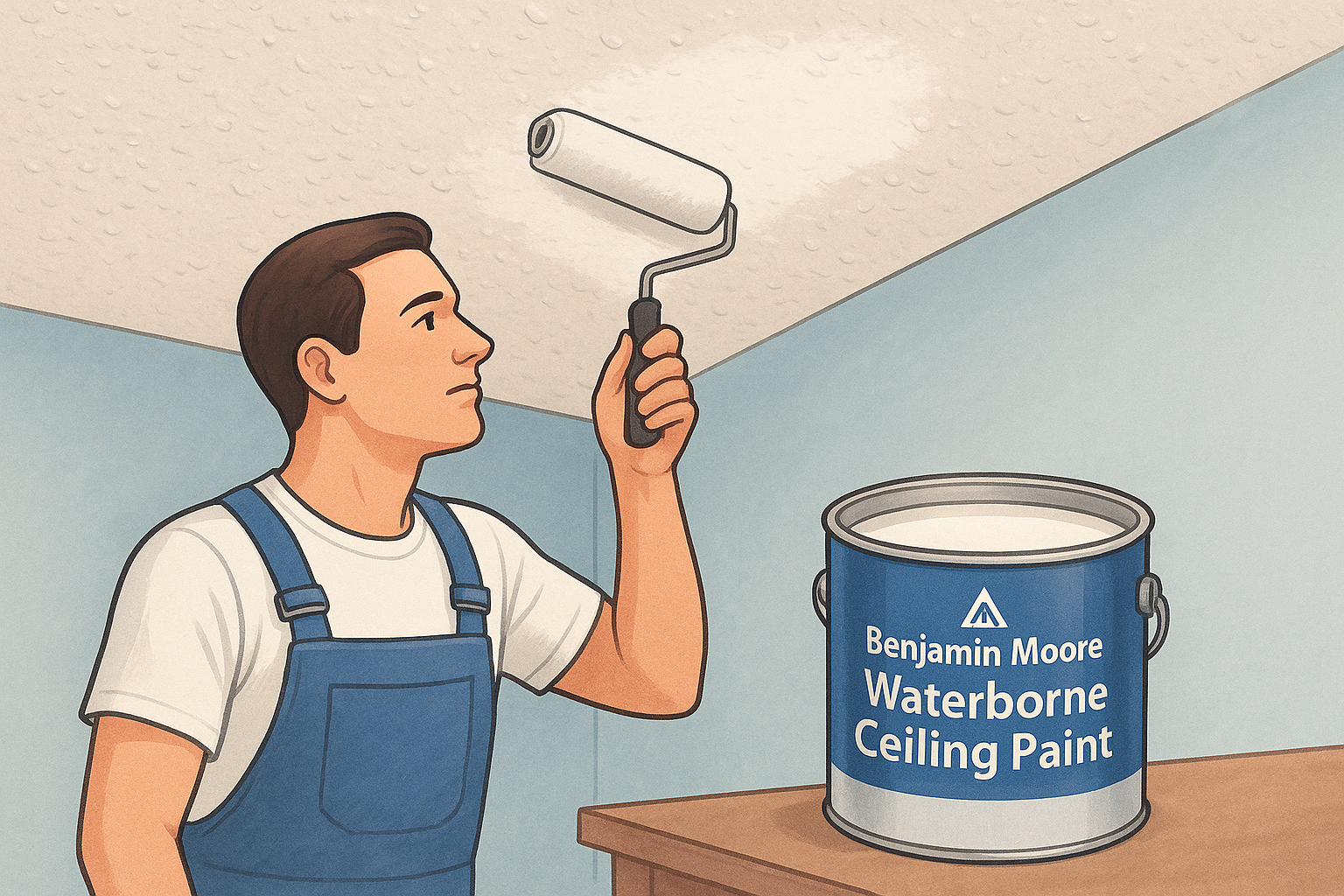
2. Benjamin Moore Waterborne Ceiling Paint
Benjamin Moore Waterborne Ceiling Paint is a premium flat ceiling paint. Painters recommend it when you want a high-quality finish over an uneven surface.
How it performs on popcorn
Painters point to it for covering surface imperfections . On popcorn, that matters for a practical reason. Fewer passes mean less roller pressure on texture that can loosen.
On popcorn, good coverage in fewer passes protects the texture as much as it improves the look.
Who it suits and what to check
It fits a living room, kitchen, or open-plan space where the ceiling is always in view and you will pay more for a cleaner result. Keep these points in mind:
- Ask the retailer for the current ceiling formula and have them tint it if needed.
- It does not replace a stain-blocking primer on water stains or smoke.
- Premium paint cannot rescue crumbling texture, so fix loose patches first.
3. Sherwin-Williams ProMar flat ceiling paint
Sherwin-Williams ProMar flat ceiling paint is the pro-grade pick. Painters who spray ceilings favor it because it dries dead flat and touches up easily .
How it performs on popcorn
A dead-flat finish makes patches and brush-cut edges disappear. That helps on popcorn, where touch-ups are hard to blend. It sprays well because ceiling-grade flat paint is designed for contractor application, but follow the label and your sprayer manual on thinning.
A dead-flat finish is the quiet advantage on popcorn, because patches and touch-ups vanish.
Who it suits and what to check
This is the choice if you are renting or buying an airless sprayer or painting several rooms. Before you commit:
- Product lines get renamed, so ask the store for its current ProMar flat ceiling product.
- Ask whether your sprayer needs a particular tip size or any thinning.
- Skip it if you are only doing one small room by roller, since a home-center paint is simpler.
4. Stain-blocking primer plus flat ceiling paint
A stain-blocking primer under any flat ceiling paint is the right pick when the ceiling has water stains, smoke, or grease, or has never been painted. Brands such as KILZ and Zinsser both sell stain-blocking primers.
How it performs on popcorn
Primer seals stains so they do not bleed through your topcoat. It also gives the ceiling an even surface , which prevents patchy sheen. Oil-based and shellac-based blockers are strongest against water stains and smoke but have strong fumes. Water-based blockers are easier to work with.
A stain you only paint over will come back through, so fix the source and seal it.
Who it suits and what to check
Use this combination for kitchens with grease, smoky rooms, ceilings under an old leak, and raw, never-painted popcorn . Keep these in mind:
- Repair the leak before you prime.
- Prime the whole ceiling, not just the stain, to avoid visible patches.
- Ventilate well and wear a respirator with solvent-based primers.
Priming, rolling, and spraying your popcorn ceiling
You only need primer when the ceiling has stains, bare texture, or a major color change. Otherwise one flat coat of ceiling paint is the starting point. Spray if you can, roll if you must , and test for asbestos before you touch an older ceiling.
Do you need to prime a popcorn ceiling?
You can paint over a popcorn ceiling without priming when it is already painted, clean, and stable. Prime in these cases:
- The ceiling has water, smoke, or grease stains.
- The texture has never been painted.
- You are covering a dark color with white.
- The texture sheds dust when you rub it lightly.
Unpainted popcorn is the risky case, because water-based paint can soften loose texture . Spray a thin first coat rather than rolling it.
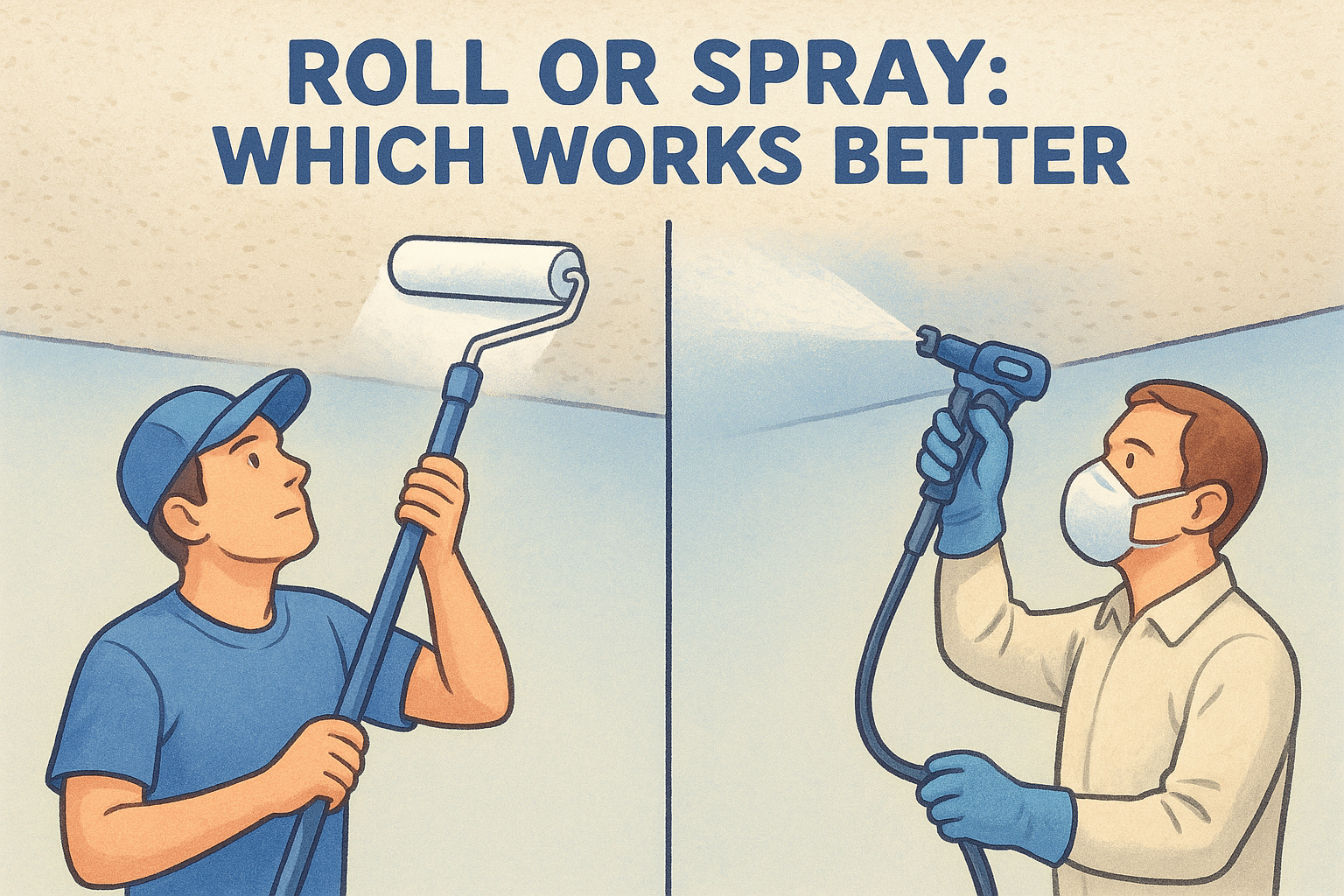
Roll or spray: which works better
A sprayer is faster and gentler on the texture, but you must mask everything. A roller works fine on a stable, painted ceiling and answers the question of painting without a sprayer.
| Factor | Roller | Airless sprayer |
|---|---|---|
| Speed | Slow, texture traps paint | Fastest |
| Texture risk | Pressure can pull texture loose | No contact with the ceiling |
| Mess | Drips and spatter | Heavy overspray, so mask walls and floors |
| Equipment | Thick-nap roller and extension pole | Sprayer to buy or rent |
Use a sprayer when the texture is delicate, and a thick-nap roller with a light touch when it is stable.
With a roller, choose a thick nap of about 3/4 inch or more . Roll in one direction without pressing and skip repeated back-and-forth passes.
How much paint to buy
Popcorn texture uses far more paint than a smooth ceiling. Labels commonly state roughly 350 to 400 square feet per gallon on smooth surfaces, so assume about half that on texture. For a 12 by 15 foot room (180 square feet), one coat takes about one gallon and two coats take about two. Buy extra rather than stretching a can.
Check for asbestos before you paint
Popcorn texture in homes built before the 1980s may contain asbestos, and you cannot tell by looking. Test before you scrape, sand, or press hard with a roller. The EPA's asbestos guidance says material in good condition is best left undisturbed.
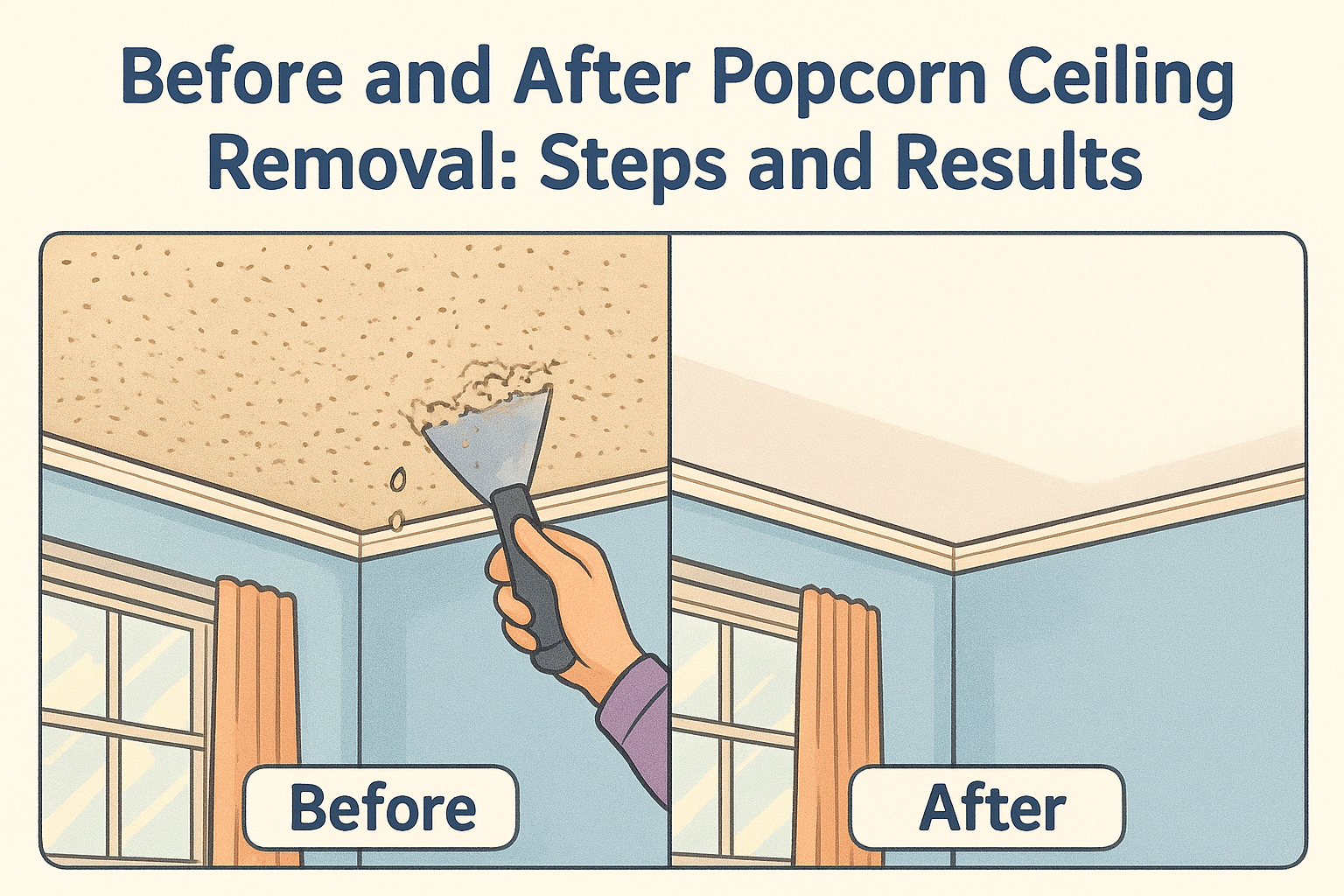
Painting is also close to a one-way decision. Paint seals the texture and makes later removal harder . Super Shooters handles asbestos-containing ceilings, so it is worth testing first if removal might be in your future.
Choosing your paint and your next step
Flat or matte acrylic latex is the answer for almost every popcorn ceiling. Behr suits a simple repaint, Benjamin Moore suits a premium finish, Sherwin-Williams ProMar suits spraying, and a stain-blocking primer handles stains and raw texture. Spray when you can, roll lightly when you cannot, and test older ceilings before you disturb them.
Paint is a good fix for a stable ceiling. If the texture is stained, shedding, or simply dated, a smooth ceiling is a better long-term result. We offer free in-home estimates and take no payment until the job is complete. You can see how it works on our popcorn ceiling removal page.