
Share this article

November 6, 2026

How to Find the Right Drywall and Ceiling Repair Near Me

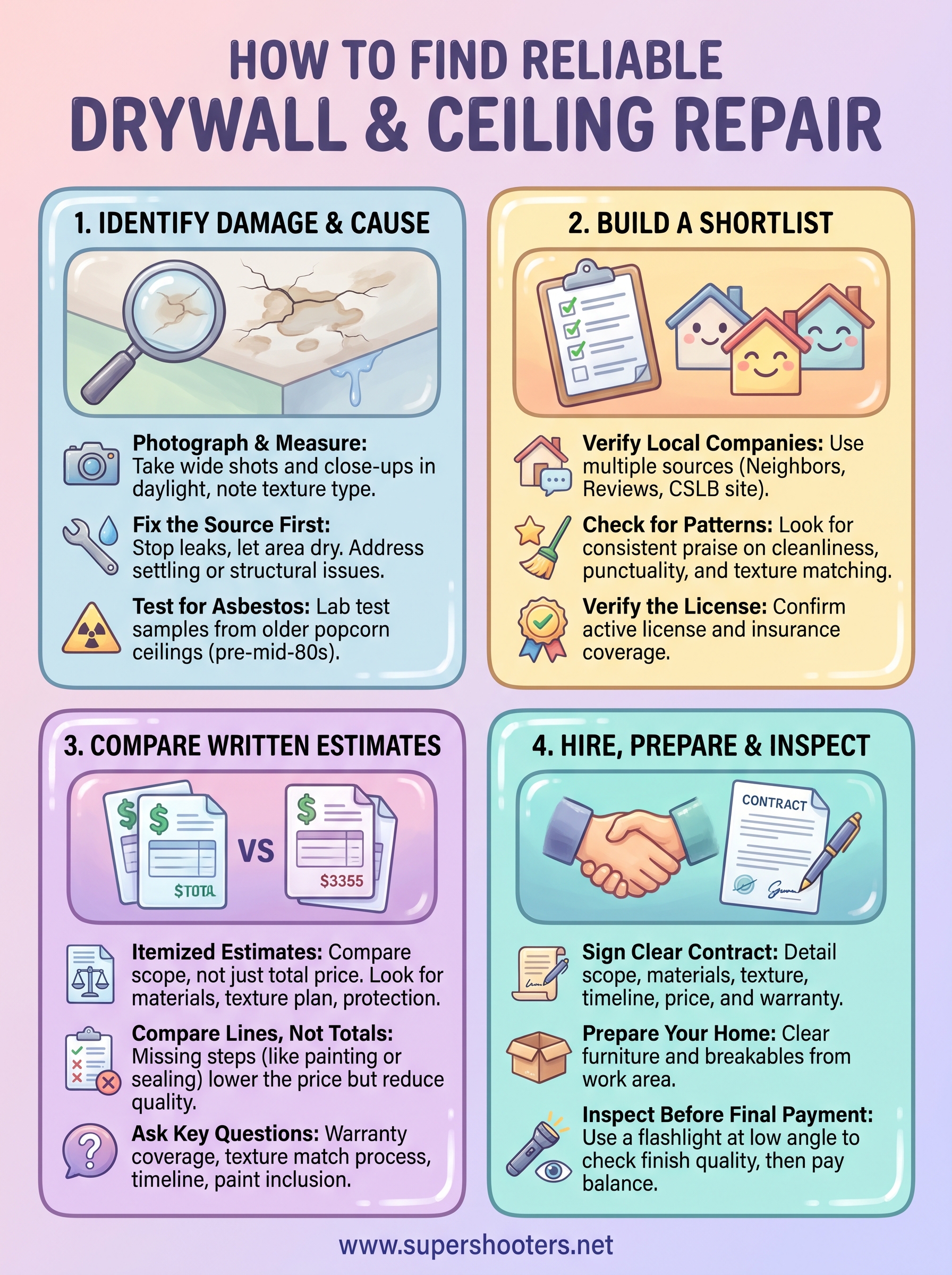
If you are searching for drywall and ceiling repair near me , the short answer is to work in four steps. Identify the damage and its cause , build a shortlist of licensed local companies, compare itemized written estimates, and hire the one with a clear scope, a warranty, and no large upfront payment. That sequence avoids the two most common mistakes: paying for a patch that fails, and hiring someone you cannot reach later.

The problem is that search results make this hard. You get directories, lead-selling sites, roofers who also patch, and handymen with a handful of reviews, all mixed together. Ceiling work is also hard to price from a distance, because a brown stain can be a cosmetic fix or a leak that has soaked the insulation above it.

This guide walks through the process in order. It comes from Super Shooters, a licensed drywall and acoustic ceiling contractor that has served homeowners across the Sacramento Valley for over 30 years. The checks below are the ones we would run ourselves if we were hiring.

Who to call for drywall and ceiling problems

Call a drywall contractor for most wall and ceiling damage, a handyman for one small patch, and a plumber or roofer first when water is involved. Getting this first call right saves you a second visit.

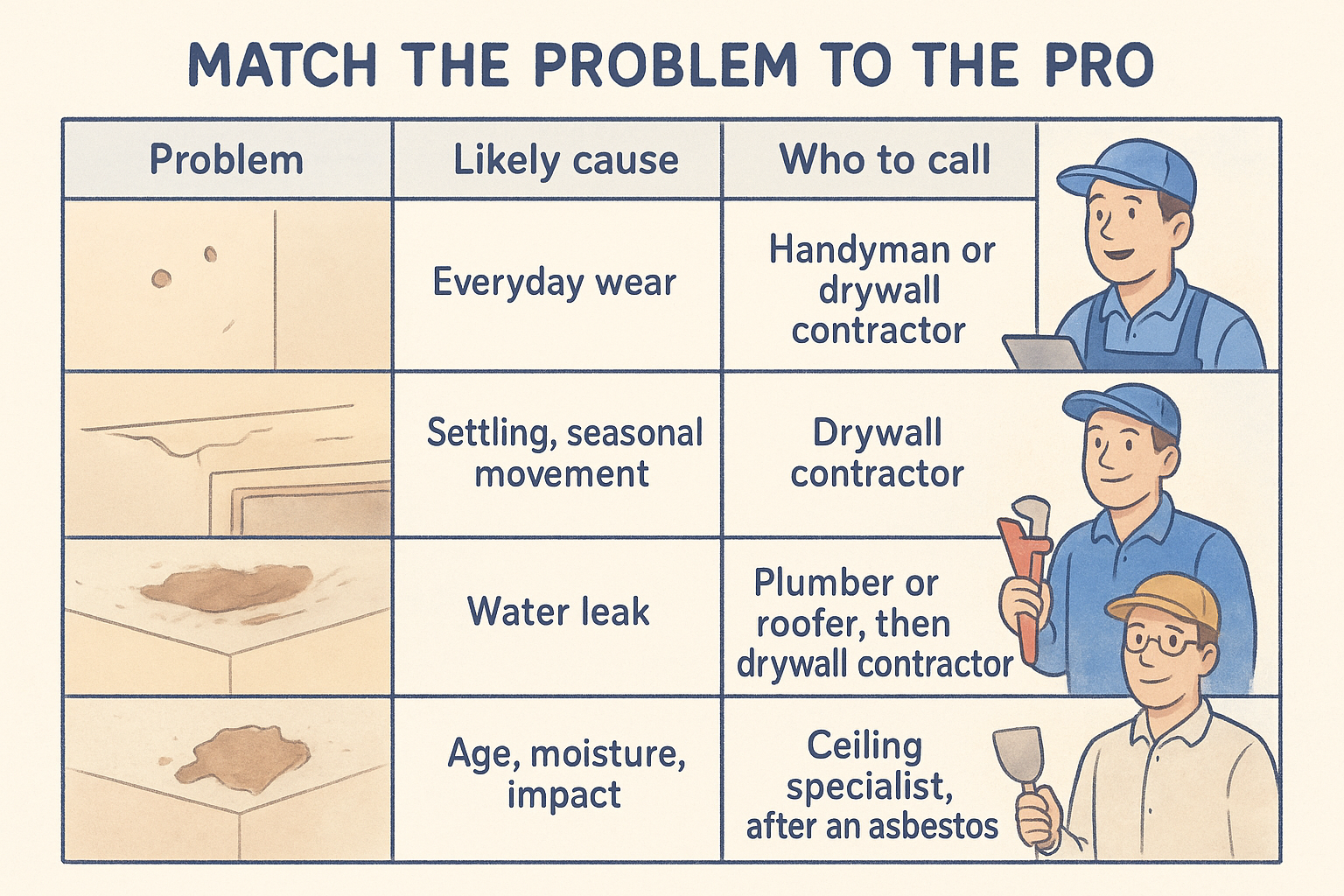
Match the problem to the pro

Use this table to decide which trade you need before you start comparing companies.

Problem Likely cause Who to call first
Small holes, dents, nail pops Everyday wear Handyman or drywall contractor
Cracks at seams or above doors Settling, seasonal movement Drywall contractor
Stain, sag, or bubbling ceiling Water leak Plumber or roofer, then drywall contractor
Damaged popcorn ceiling Age, moisture, impact Ceiling specialist, after an asbestos test
Cracked plaster walls Aging, movement Contractor with plaster experience

Handyman or drywall contractor

A handyman suits a single small patch, and he often bills by the hour. A drywall contractor suits anything involving texture matching, ceilings, water damage, or more than one room . Contractors usually price per job after seeing the damage, so an hourly rate matters less than the scope in the quote.

Finishing is what separates the two. Hanging and taping board is easy to learn. Blending a patch into a knockdown or popcorn ceiling so it vanishes under paint takes years of practice.

Hire for the finish, not the patch, because the visible result is the part you live with.

Step 1. Document the damage and find the cause

Before you call anyone, photograph the damage, measure it, and work out what caused it. A company that quotes without knowing the cause is guessing, and a repair over an active problem will fail.

Photograph and measure

Take wide shots and close-ups in daylight. Measure each patch and the room's ceiling height. Note the texture type , such as popcorn, knockdown, orange peel, or smooth, because matching it drives both the cost and the quality of the result. Send these photos when you contact companies. Many can give a rough range from them, but a firm price needs a visit.

Fix the source first

A ring-shaped stain, a drip, or a soft sagging spot means moisture. Stop the leak and let the area dry before anyone patches it. Diagonal cracks running from door and window corners, especially ones that widen, point to settlement. Hairline cracks along taped seams are usually harmless movement. Screw pops that return after repairs are often a framing or fastening issue, not a joint compound issue.

Test older popcorn ceilings for asbestos

Acoustic texture in homes built before the mid-1980s may contain asbestos. Do not scrape, sand, or drill into it until a lab has tested a sample, as the EPA's asbestos guidance explains. A tested ceiling changes who you can hire, because disturbing asbestos-containing texture is not a job for a handyman.

Name the cause before you name a price, because a repair over a live leak is wasted money.

Step 2. Build a shortlist of local companies

Shortlist three to five companies that you can verify, using a mix of sources instead of the first map result. When you search for ceiling drywall repair companies near me, you are looking at an ad-driven list, so treat it as a starting point.

Where to look

  • Google Maps results filtered to a high rating, with review counts in the dozens or more.
  • Neighbors and local community groups , where people name who did their ceiling and how it held up.
  • Your insurance adjuster or property manager , if the damage is a claim.
  • Company websites that show real before-and-after photos of finished repairs, not stock images.

Skip pages that list many companies without naming any single one. Those are lead-selling sites, and your request may go to whoever pays for it.

Read reviews for patterns

One bad review means little. Look for repeats. Praise for clean work areas, on-time arrival, and invisible texture matches is a good sign. Complaints about no-shows, patches that crack again, or surprise charges are the ones to weigh. Notice how the owner replies to criticism, since a calm, specific answer says a lot.

Verify the license

In California, drywall contractors work under a state license, and you can check any license number for free on the Contractors State License Board site. Confirm that the license is active, matches the business name, and carries workers' compensation coverage if the company has employees. Super Shooters, for example, is licensed under No. 1077675, and you should expect any company to hand you its number without hesitation.

A license number you cannot verify is a reason to remove a company from the list.

Step 3. Compare written estimates side by side

Get at least three itemized written estimates from an in-person visit, then compare scope before you compare price. Free in-home estimates are standard for reputable drywall contractors, so you should not pay to be quoted.

What a good estimate contains

Line item What to look for
Scope Each repair listed by room and size
Materials Board, joint compound, primer, paint
Texture Type named, plus how it will be matched
Protection and cleanup Plastic sheeting, dust control, debris removal
Timeline Start date and number of working days
Payment schedule Deposit amount, balance due at completion
Warranty What is covered and for how long

Why prices differ

Prices vary with the size and number of repairs, ceiling height, depth of damage, texture type, and whether paint is included . Patching a hole is cheaper than replacing a wet section of board. No honest contractor can quote a firm total from a photo, which is why a visit matters.

Here is a worked comparison. Three bids come in for a water-stained ceiling section. Bid A cuts out the wet board, replaces it, textures, primes, and paints. Bid B says only "patch ceiling" and costs noticeably less. The gap is the missing steps, and Bid B will likely leave a visible stain or ring. Compare lines, not totals.

Ask these questions

  1. Is the license active, and can I see proof of insurance?
  2. How will you match my existing texture?
  3. Is paint included, and who supplies it?
  4. How many days will the work take?
  5. What does your warranty cover?

On deposits, be wary of any request for a large payment upfront. Super Shooters, for instance, asks for no payment until the job is complete, and includes its Super Shield warranty with its work.

Compare the lines of each estimate, because the cheapest total is usually the one with the missing steps.

Step 4. Hire, prepare, and inspect the work

Put the chosen estimate into a signed contract, prepare the rooms, and inspect the result before you pay the final balance. This is where a good hire turns into a good outcome.

Sign a clear contract

The contract should repeat the estimate: scope, materials, texture, start date, price, and warranty terms . Ask for changes in writing, since verbal add-ons are the usual source of billing disputes. If water was involved, add a line that the contractor will check the area is dry before closing it up.

Prepare your home

Clear furniture from the work area, and remove breakables and glass-top furniture from rooms where ceiling work happens, since vibration and dust travel. Cover or move anything you cannot lift. A professional crew will still protect floors and furnishings with plastic, but a clear room makes the work faster and cleaner. Expect ceiling jobs to take days, not hours. Acoustic ceiling removal in an average home runs one to two days, sometimes three for a large house.

Inspect before the final payment

Do a walkthrough in good light. Turn off the room lights and hold a flashlight at a low angle across the surface, which shows ridges, seams, and uneven texture. Look at paint coverage and edges, and run your hand across the repair. Point out anything off in writing, and pay the balance once it is fixed. Keep your contract and warranty papers together in case a crack returns.

Pay the final balance only after you have inspected the work in raking light.

Your next step toward a clean, lasting repair

The process is simple once you see it in order. Find the cause, shortlist licensed companies you can verify, compare itemized estimates line by line, and inspect the work before you pay. A contractor that welcomes each of those checks is usually the one worth hiring.

If you are in Sacramento, Roseville, Folsom, Elk Grove, or nearby, you can request a free drywall repair estimate and put these questions to us directly.

Recent Posts

By cinchweb • November 9, 2026
Learn how to paint a drywall patch in four steps: check, prime, paint, and blend, plus fixes for flashing and texture mismatch.
By cinchweb • November 9, 2026
Learn how to sand a drywall patch with the right grit, light feathering strokes, and a check that catches ridges before you prime and paint.

By cinchweb • November 9, 2026
Drywall mud drying time runs 24 hours per coat for most compounds. See times by type, temperature and humidity, plus when to sand, prime and paint.

By cinchweb • November 5, 2026
Find the best paint for popcorn ceiling: 4 picks, plus when to prime and whether to roll or spray, so you can finish the job yourself.
By cinchweb • November 5, 2026
Learn how to remove stubborn wallpaper with a steamer or fabric softener mix, then score, scrape, and clean off the glue without damaging your walls.
By cinchweb • November 5, 2026
Learn how to fix drywall screw pops for good: find the cause, reset the fasteners, patch in three coats, and stop them from coming back.
By cinchweb • November 2, 2026
Handyman drywall repair near me: learn when a handyman fits, how to vet one, what repairs cost, and how to check the finish. Sacramento homeowner guide.
By cinchweb • November 1, 2026
See what before and after popcorn ceiling removal really looks like, then follow four steps to scrape, skim, and finish a smooth ceiling yourself.

By cinchweb • October 31, 2026
Hire a popcorn ceiling removal professional the right way: test for asbestos, vet licenses, compare bids line by line, and prep your home.

Show More