Share this article

November 9, 2026

Drywall Mud Drying Time by Type, Temperature, and Humidity

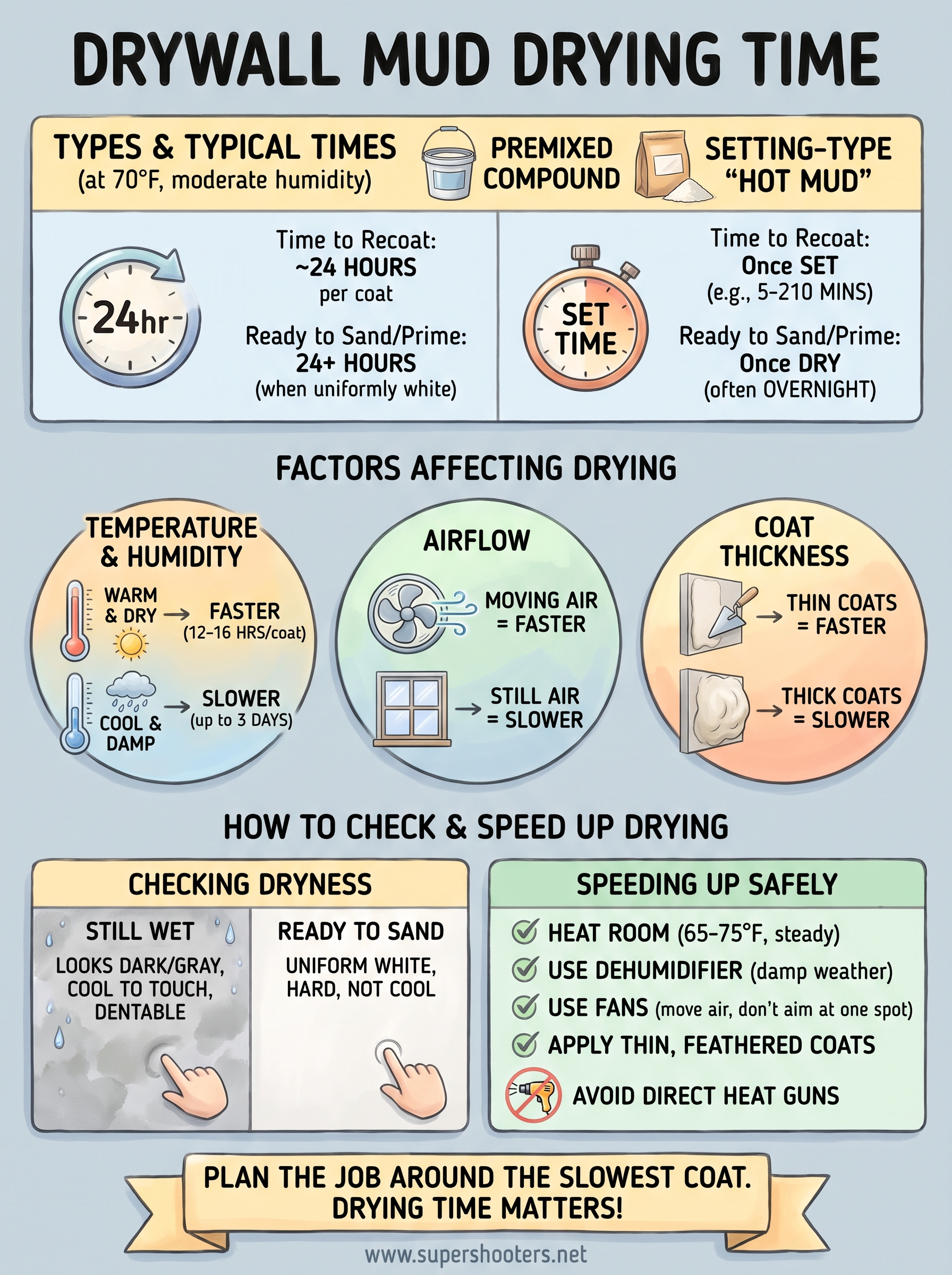
Drywall mud drying time is about 24 hours per coat for standard premixed joint compound at 70°F and moderate humidity. Setting-type "hot mud" hardens chemically in 5 to 210 minutes, depending on the product, but you should still let it dry before priming. Cold air, damp air, and thick coats can stretch drying to two or three days.

"Drying" means the compound has lost its water, stopped shrinking, and hardened enough to take the next coat, sanding, primer, or paint. Mud can look dry on the surface while it is still damp underneath. That gap between how it looks and how it is causes most finishing failures.

This article gives you drying times by compound type and by room conditions. It also shows how to check that mud is truly dry, how to schedule a full job, and how to speed things up safely. We have finished drywall in Sacramento Valley homes for over 30 years, so the advice comes from real job schedules, not theory.

Why drywall mud drying time matters

Drying time matters because every later step traps whatever moisture is still in the mud. Sanding, priming, and painting too early create defects that show up days or weeks later, and the only fix is to redo the work.

What goes wrong when you rush

Recoating damp mud causes cracking and bubbling as the trapped water escapes through the new layer. Sanding damp mud is just as bad. It gums up the sandpaper, tears the paper face of the drywall, and leaves a rough surface that needs more mud.

Painting over damp compound causes flashing , which means dull or shiny patches where the sheen differs from the wall around it. Primer can also peel or blister over wet joints. These flaws are obvious under raking light, such as a window or a lamp near the wall.

Why waiting costs less than redoing

A standard taped joint needs three coats. At 24 hours per coat, that is about three days of waiting. One extra day is free. Redoing a cracked or blistered joint costs a day of scraping, re-taping, and re-coating, and then another round of drying.

Mud that is dry on top but damp underneath is the most common reason a finished wall fails.

How long each type of drywall mud takes to dry

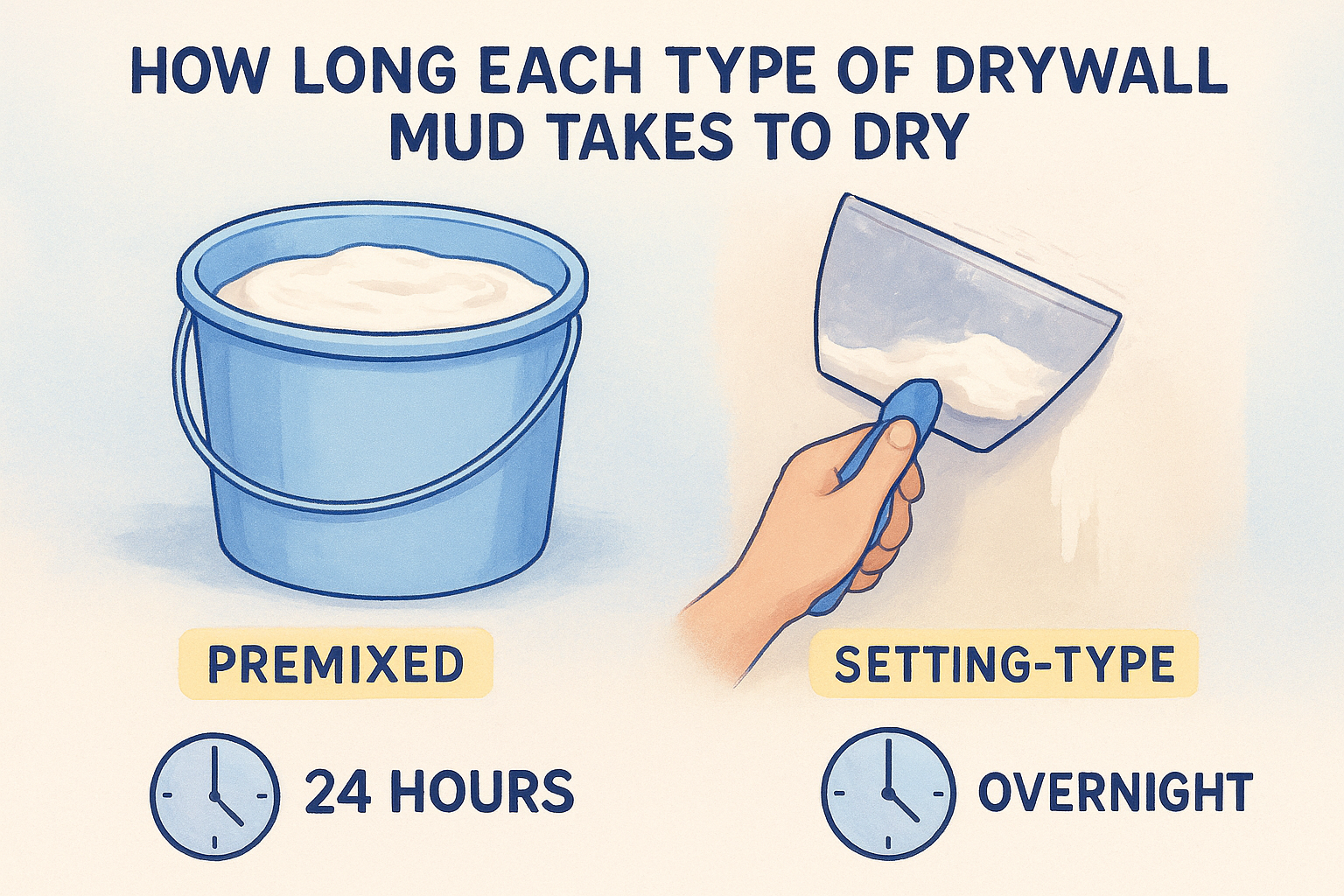
Premixed compounds take about 24 hours per coat. Setting-type compounds harden in the minutes printed on the bag, then still need time to dry out before priming. The table puts the main types side by side.

Compound type Time before next coat Ready to sand and prime
Premixed all-purpose About 24 hours (12 to 16 hours for thin coats in warm, dry air) After 24 hours or more, once uniformly white
Premixed lightweight About 24 hours About 24 hours, sands easily
Premixed topping About 24 hours About 24 hours
Setting-type (5, 20, 45, 90, 210 minute) Once it has set, about the rated time Usually overnight, once fully dry

Always check the label of your specific product. Manufacturers differ, and a fast-drying premixed formula can beat these numbers.

Premixed compounds

Premixed mud, often sold in a bucket or box, dries by evaporation. That makes it sensitive to the room . Manufacturer guidance, including USG's, puts drying at about 24 hours at 70°F and 70% humidity, and slower when it is cooler or more humid.

Thin coats dry faster than thick ones. Lightweight compound sands more easily than all-purpose, but a deep fill can shrink more and need a second pass.

Setting-type compounds

Setting-type mud comes as a powder that you mix with water. It hardens by a chemical reaction, not by evaporation. The number on the bag is the set time, not the dry time . So 20 minute mud, a common search, sets in roughly 20 minutes. You can recoat once it has hardened.

Hot mud is the right choice for deep fills, first coats on tape, and tight schedules. It is also harder to sand once cured, so keep finish passes smooth. Let it dry fully, usually overnight, before you prime.

The number on a bag of hot mud is the set time, not the dry time.

How temperature and humidity change drying time

Warm, dry, moving air dries mud fastest. Cool, damp, still air dries it slowest. Temperature and humidity can double or triple the time a coat needs.

Typical drying times by conditions

Room conditions Typical drying time per coat
Warm and dry (about 75 to 80°F, low humidity) 12 to 16 hours for thin coats
Standard (70°F, 70% humidity) About 24 hours
Cool or humid (about 60°F or damp air) 36 to 72 hours
Thick fills in cool air Up to 3 days

These ranges are practical estimates, not lab numbers. Use them to plan, then confirm with the dryness checks in the next section.

If your mud is still wet after 24 hours, the cause is usually one of three things: a cool room, damp air, or a coat that was thicker than you thought. Keep the room at 55°F or warmer , and follow the minimum on your product's label.

Seasons in the Sacramento Valley

Summer heat and very dry air can dry the surface of thick coats faster than the inside, which invites cracks. Winter brings the opposite problem. Tule fog and rain keep indoor humidity high, and unheated rooms like garages stay cold.

After rain, keep windows closed and run a dehumidifier, because outdoor air is often damper than the room.

Plan around the room's conditions, not the clock, because the same coat can take 12 hours or 3 days.

How to tell drywall mud is dry before you sand or paint

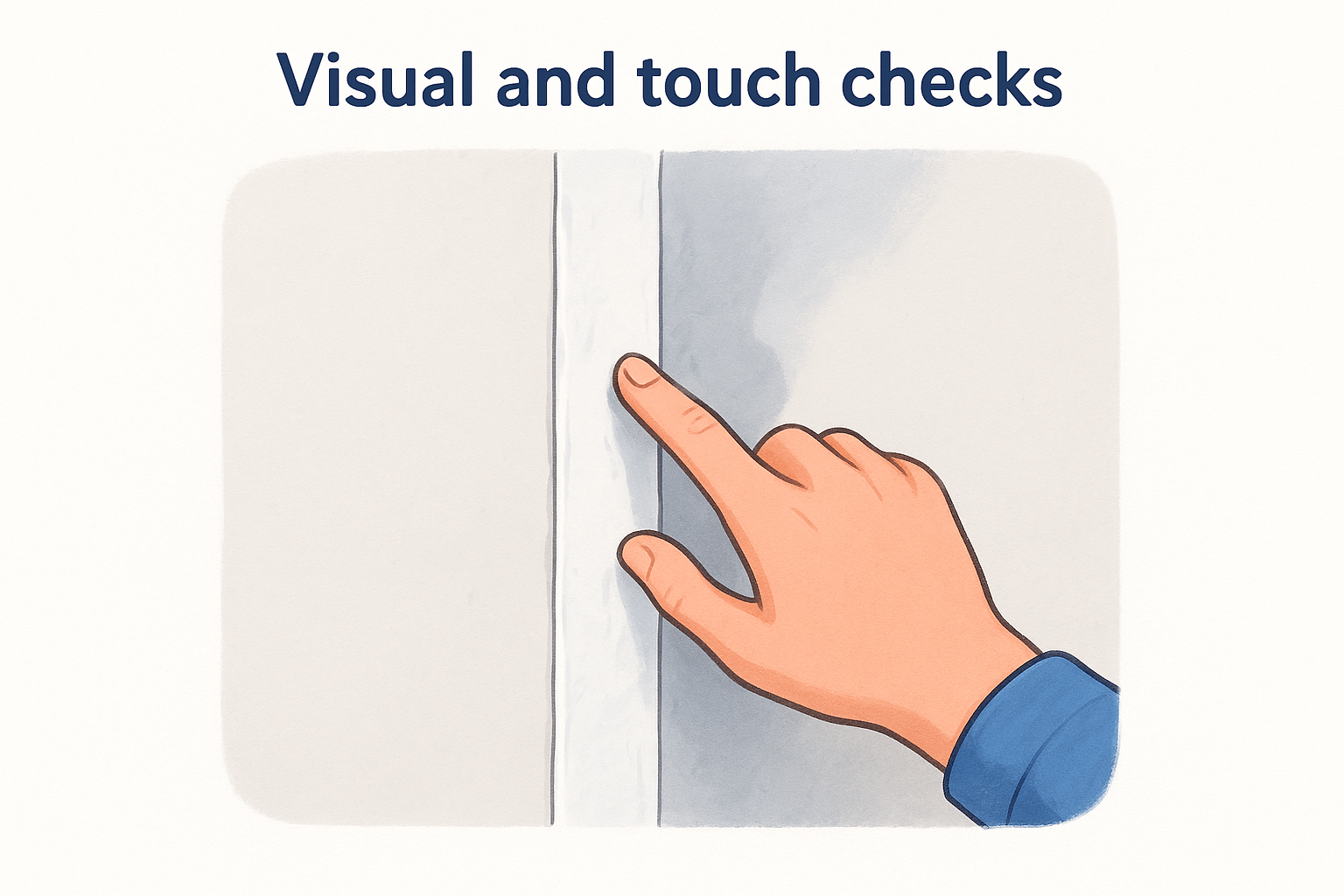
Dry mud is uniformly white or light in color, hard, and not cool to the touch. If any gray or darker patches remain, the mud is still wet.

Visual and touch checks

Color is the most reliable sign. Damp compound looks gray or darker, and dry compound turns a flat, even white. Check the thickest spots last, since inside corners, fills, and taped seams hold water longest.

Then touch the area with the back of your hand. Damp mud feels cool. Dry mud matches the wall around it. A fingernail should not leave a dent.

When to sand, prime, and paint

Here is the sequence for a taped joint at about 70°F with standard premixed compound:

  1. Day 1: tape and embedding coat.
  2. Day 2: fill coat, once the first is fully dry.
  3. Day 3: finish coat.
  4. Day 4: sand, dust the wall, and prime.
  5. After the primer dries: paint.

Sand only after the final coat passes the color and touch checks. Prime before painting, and prime skim coats too, because bare mud absorbs paint unevenly.

In a cool, humid room with 36 to 48 hours per coat, the same three coats take about 4 to 6 days. Build that into your schedule before you promise a finish date.

Sand only when the mud is dry all the way through, not when it merely looks dry.

How to make drywall mud dry faster

You speed up drying by controlling the room and by how you apply the mud. Heat, moving air, low humidity, and thin coats all help. Direct heat on the wall does not.

Room fixes

  • Heat the room to 65 to 75°F and keep it steady day and night.
  • Run a dehumidifier in damp weather or in closed rooms like garages.
  • Move air across the room with a fan, but do not point it at one joint.
  • Open windows only when the outdoor air is drier than the air inside.
  • Never aim a heat gun or space heater at the mud. Fast surface drying causes cracks and bubbles.

Technique fixes

Apply thin, feathered coats and scrape off ridges before they dry. Thick coats are the main reason mud misses the 24-hour mark. For deep fills and first coats on tape, use setting-type mud, and finish with premixed topping compound.

Big repairs and water-damaged walls dry unevenly, and the timing gets harder to judge. That is when many homeowners hand the job to a pro.

Control the room and keep coats thin, and you can cut a day or more off the schedule without risking cracks.

Plan the job around the slowest coat

Most drywall mud needs about 24 hours per coat, setting-type mud sets in minutes but still needs to dry before priming, and cool or damp rooms can double the wait. Check color and touch before every sanding, priming, or painting step. If the mud is gray, cool, or dented by a fingernail, wait.

If you would rather skip the waiting game, our team handles drywall repair and patching across the Sacramento Valley, with free in-home quotes and payment due only after the job is done.

Recent Posts

By cinchweb • November 9, 2026
Learn how to paint a drywall patch in four steps: check, prime, paint, and blend, plus fixes for flashing and texture mismatch.
By cinchweb • November 9, 2026
Learn how to sand a drywall patch with the right grit, light feathering strokes, and a check that catches ridges before you prime and paint.
By cinchweb • November 6, 2026
Find drywall and ceiling repair near me with a 4-step plan: diagnose the damage, verify licenses, compare written estimates, and inspect the finished work.
By cinchweb • November 5, 2026
Find the best paint for popcorn ceiling: 4 picks, plus when to prime and whether to roll or spray, so you can finish the job yourself.
By cinchweb • November 5, 2026
Learn how to remove stubborn wallpaper with a steamer or fabric softener mix, then score, scrape, and clean off the glue without damaging your walls.
By cinchweb • November 5, 2026
Learn how to fix drywall screw pops for good: find the cause, reset the fasteners, patch in three coats, and stop them from coming back.
By cinchweb • November 2, 2026
Handyman drywall repair near me: learn when a handyman fits, how to vet one, what repairs cost, and how to check the finish. Sacramento homeowner guide.
By cinchweb • November 1, 2026
See what before and after popcorn ceiling removal really looks like, then follow four steps to scrape, skim, and finish a smooth ceiling yourself.

By cinchweb • October 31, 2026
Hire a popcorn ceiling removal professional the right way: test for asbestos, vet licenses, compare bids line by line, and prep your home.

Show More