Share this article

October 23, 2026

Labor Cost for Drywall Installation: What You Should Pay

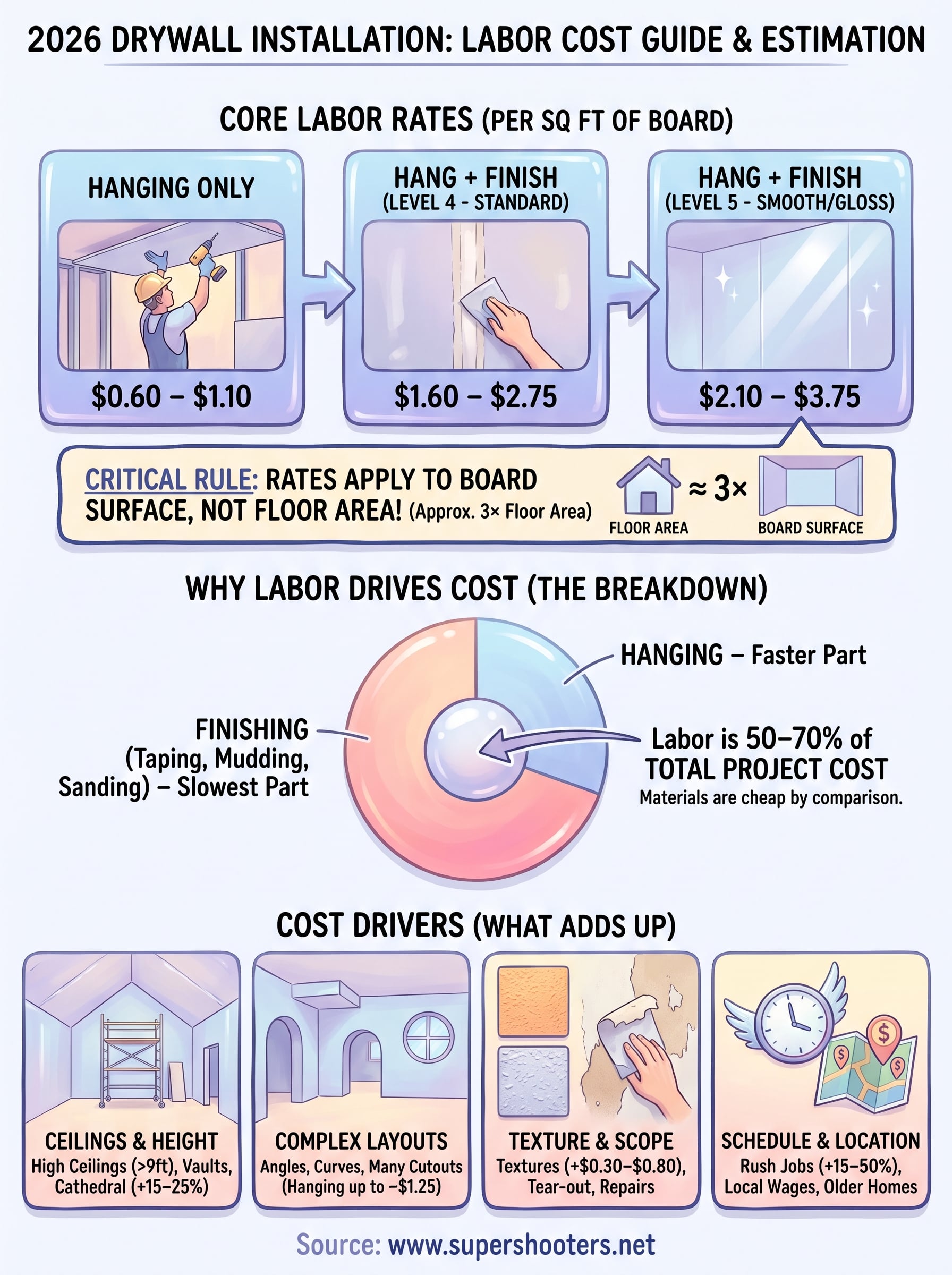
The labor cost for drywall installation is what a crew charges to hang, tape, mud, and sand the board, separate from the price of the sheets. In 2026, published pricing puts hanging and finishing at about $1.60 to $3.75 per square foot of board . A standard Level 4 residential finish runs $1.60 to $2.75, and hanging alone runs about $0.60 to $1.10.

Most budgets go wrong on one detail: which square footage the rate applies to. A contractor prices the wall and ceiling surface, which is roughly three times your floor area. A rate multiplied by floor space gives a total that is far too low. At Super Shooters Acoustic Removal & Drywall, we have hung and finished drywall in Sacramento Valley homes for over 30 years, and we offer free in-home estimates.

This guide covers what the labor price includes, rates by phase and finish level, and how to work out your own total for a room or a whole house. It also covers what moves the price and how to read a contractor's quote.

Why labor drives your drywall installation cost

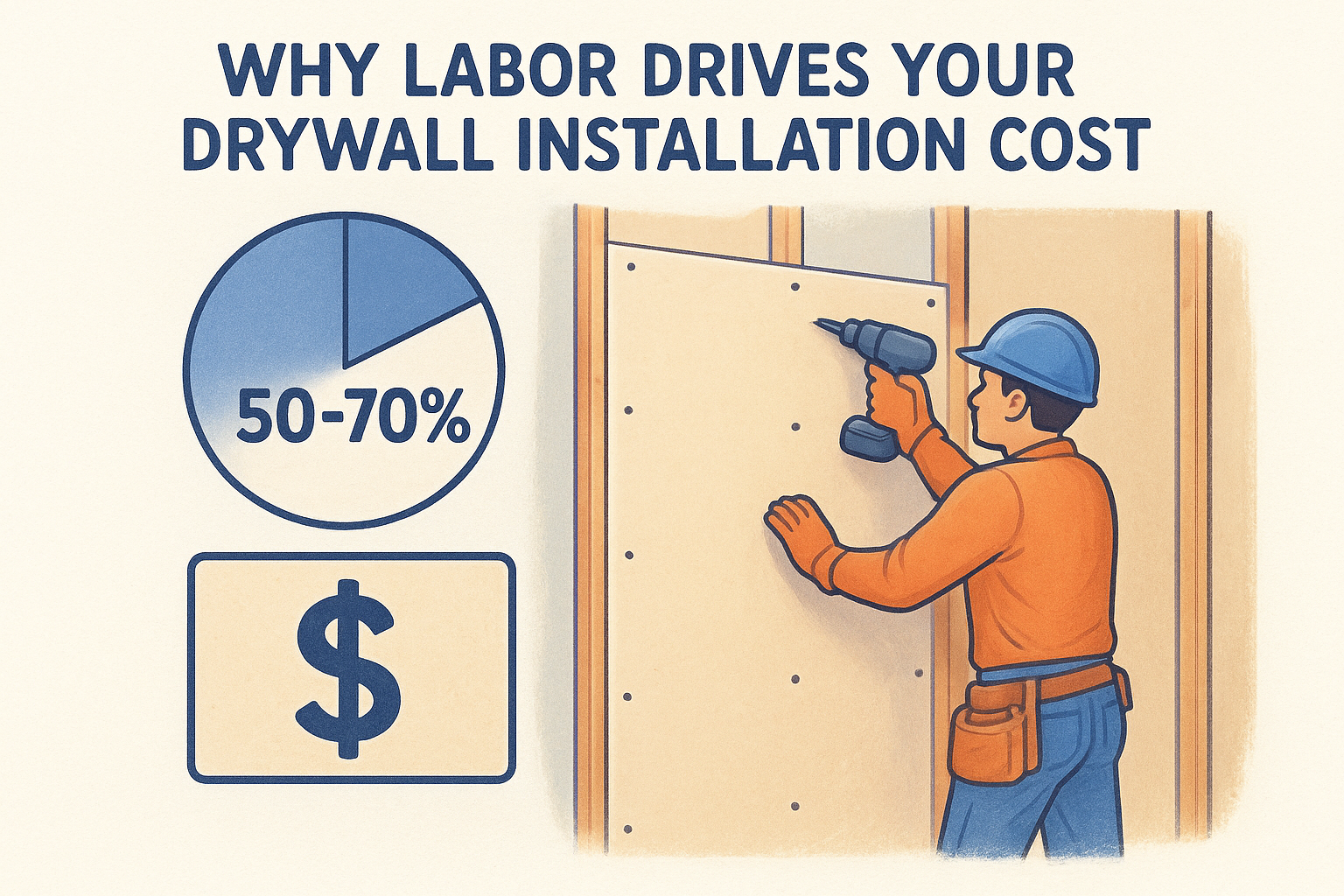
Labor is the biggest line on most drywall bills, commonly 50 to 70 percent of the total project cost . The labor rate decides whether your budget holds. Materials are cheap by comparison, since a ½-inch 4x8 sheet runs about $10 to $14.

What the labor price covers

Drywall labor is three separate jobs sold under one price, and each one has its own pace and skill level.

  • Hanging: measuring, cutting, lifting, and screwing board to studs and joists. Ceilings need at least two people, and anything above 9 feet needs a panel lift.
  • Taping and mudding: tape over every seam, then three coats of joint compound (tape coat, block coat, finish coat). Each coat needs about 24 hours to dry.
  • Sanding and prep: smoothing the last coat so paint or texture goes on cleanly.

Finishing is the slow part. A crew can hang a bedroom in a day, but the drying cycles stretch tape-and-mud work across several visits. Some estimators put finishing at 60 to 70 percent of the labor cost . A bid with a suspiciously low per-foot rate often covers hanging only.

Why board area matters more than floor area

Rates apply to the surface of the board , not the footprint of the house. As a working rule, walls plus ceilings add up to about three times the floor area, so a 1,500 square foot house has roughly 4,500 square feet of board.

Here is what that does to a budget. The $1.60 to $3.75 range applied to 1,500 square feet of floor gives $2,400 to $5,625. Applied to 4,500 square feet of board, it gives $7,200 to $16,875. When you see a very low whole-house number online, this mix-up is usually the reason, and it is why two quotes can look so far apart .

Always ask whether a per-square-foot drywall rate is applied to floor area or to board surface.

Labor cost per square foot by phase and finish level

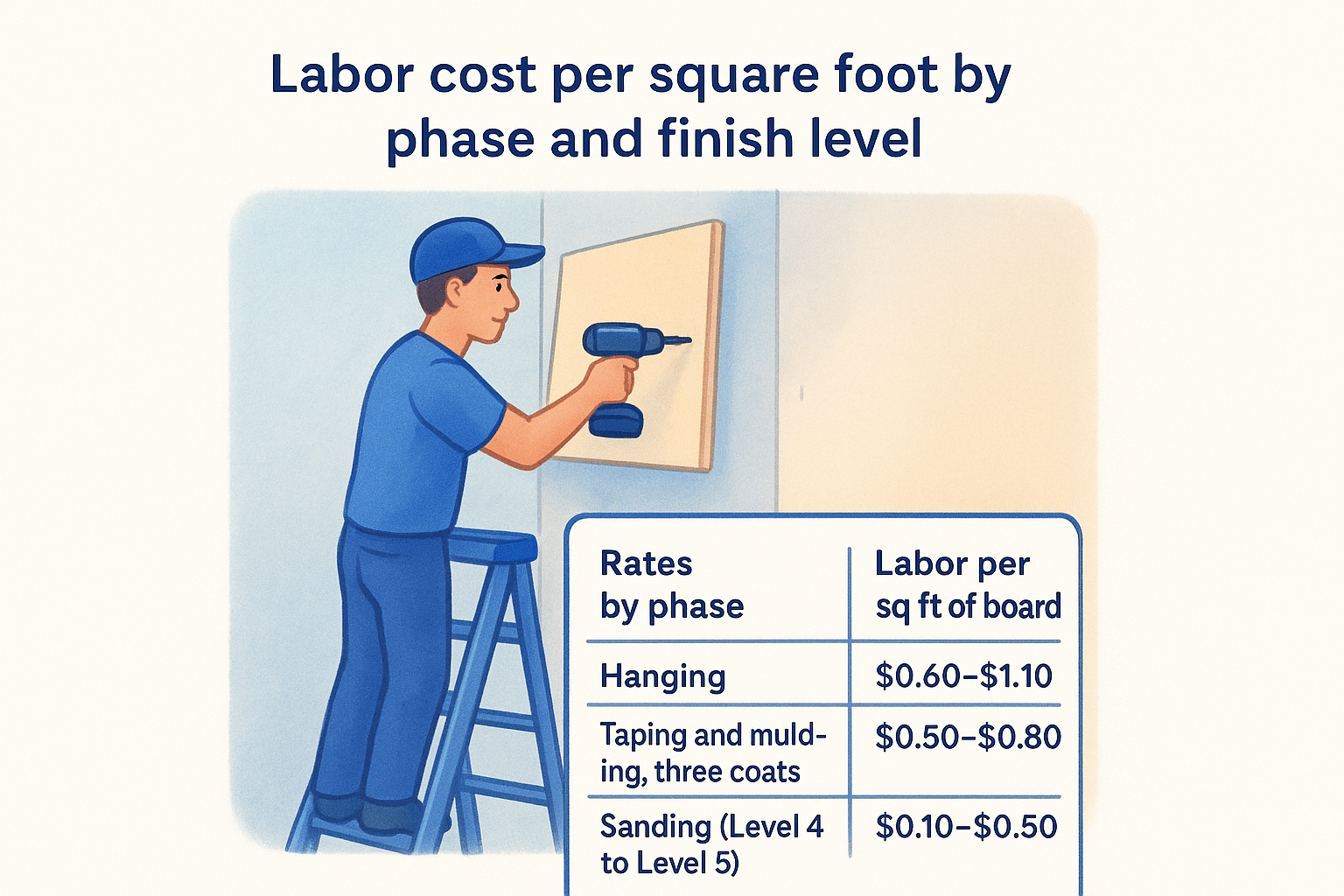
Hanging costs about $0.60 to $1.10 per square foot, and finishing to Level 4 brings the labor total to $1.60 to $2.75. A Level 5 finish pushes it to $2.10 to $3.75.

Rates by phase

Sources break the work into phases like this. Use the phase rates to cross-check a bid, not to add up your own total.

Work Labor per sq ft of board
Hanging $0.60–$1.10
Taping and mudding, three coats $0.50–$0.80
Sanding (Level 4 to Level 5) $0.10–$0.50

Bundled rates usually land a bit above the sum of the phases because they carry setup, cleanup, and crew overhead. Complex layouts with angles, curves, and many cutouts can push hanging alone toward $1.25.

Rates by finish level

The finish level is the biggest single price lever after square footage. The Gypsum Association defines five levels in its GA-214 standard. Level 3 is texture-ready and costs less than the levels below.

Finish and scope Hang + finish labor per sq ft
Level 4 (standard smooth painted walls) $1.60–$2.75
Level 5 (full skim coat) $2.10–$3.75
Hang, tape, and texture $2.25–$3.95

Level 4 is the default for smooth painted residential walls. Level 5 belongs where gloss or semi-gloss paint, or strong light raking across the wall, would show flaws. By these rates, Level 5 costs roughly a third more than Level 4, and some estimators put the jump at 30 to 60 percent.

Ask whether a rate covers hanging only or hanging through the finish level, because the two differ by more than double.

Cross-checking with per-sheet and all-in averages

Some crews quote labor per sheet. A 4x8 sheet is 32 square feet, so the rates above translate to about $12 to $25 per sheet on walls and $20 to $40 on ceilings or awkward layouts.

All-in averages that include materials sit around $2.26 to $2.75 per square foot. Home-services marketplace data shows a typical national job around $2,200, with most between $1,235 and $3,992. Those totals look low next to whole-house math because most jobs are single rooms or partial work, not entire homes.

How to calculate labor for your own project

To estimate labor, measure the board area, pick a finish level, and multiply by that level's rate. Then add the extras that bids list separately.

Step by step

  1. Multiply your room's perimeter by the ceiling height to get wall area.
  2. Multiply length by width to get ceiling area, if the ceiling is getting board.
  3. Add the two for total board area. Subtract only large openings, since small doors and windows barely move the total.
  4. Multiply by the labor rate for your finish level.
  5. Add texture, demolition, haul-away, and any repairs.

For ordering board, use (board area × 1.10) ÷ 32 , rounded up, which includes a 10 percent waste allowance.

Worked examples

Take a 12x12 bedroom with 8-foot ceilings. Walls are 48 feet × 8 feet = 384 square feet, and the ceiling adds 144, for 528 square feet of board . At Level 4, labor is 528 × $1.60 to $2.75, or about $845 to $1,450 . You would need 19 sheets, and materials add roughly $270 to $385, so the all-in range is about $1,100 to $1,840. Single-room jobs often hit a crew's minimum charge, so expect the low end to be a floor.

If you were quoted for 1,000 square feet of board, Level 4 labor is $1,600 to $2,750. Whole houses scale the same way:

Floor area Board area (about 3×) Level 4 labor
1,000 sq ft 3,000 sq ft $4,800–$8,250
1,500 sq ft 4,500 sq ft $7,200–$12,375
2,000 sq ft 6,000 sq ft $9,600–$16,500
2,500 sq ft 7,500 sq ft $12,000–$20,625

A 2,000 square foot house at Level 5 uses $2.10 to $3.75 instead, which is $12,600 to $22,500. Vaulted ceilings add roughly 15 to 25 percent. Expect about 10 to 14 days on site for a Level 4 whole house and 14 to 21 days for Level 5, mostly because of drying time.

Multiply the rate by board surface, not floor area, and your estimate will land close to what a contractor quotes.

What raises or lowers drywall labor prices

Ceiling height, layout, texture, scope, schedule, and local wages move the labor cost the most. Each one can shift your quote by tens of percent.

Job conditions that change the rate

Condition Effect on labor
Ceilings above 9 feet Lift or scaffolding; hanging moves toward $1.00 or more
Angles, curves, many cutouts Hanging up to about $1.25
Vaulted or cathedral ceilings About 15–25% more
Orange peel texture Adds $0.30–$0.50
Knockdown texture Adds $0.40–$0.65
Skip trowel texture Adds $0.50–$0.80
Tear-out of old board $0.50–$1.00

Repairs price differently from new work. Small jobs carry setup and travel time, so a repair costs more per square foot than new installation. Texture matching on a patch is usually its own line item.

Timing, location, and older homes

Rush schedules add about 15 to 50 percent depending on the source, because crews bring extra people or work overtime. Local wages matter too. High-cost metros run 20 to 50 percent above the national baseline, and mid-tier markets 5 to 15 percent. Wages differ between metro areas even inside one state. If you live in the Sacramento Valley, treat the national figures here as a starting point and compare two or three local quotes.

In a home built before 1978, old paint and texture may need testing before demolition. Old popcorn ceilings can contain asbestos. Testing and any required abatement are billed on top of the drywall labor.

How to read a drywall labor quote

A good quote names the scope in enough detail that you could hand it to another contractor and get a comparable price. Vague quotes hide the differences that matter.

What a quote should spell out

  • The square footage and whether it is board area or floor area.
  • Board type and thickness, such as ½-inch standard, ⅝-inch fire-rated, or moisture-resistant.
  • The finish level by number, and the texture type if any.
  • Demolition, haul-away, and disposal as separate lines.
  • Whether priming and paint are included.
  • Payment terms and any warranty.

The finish level is the line most often left verbal, and it causes the most disputes mid-job. Get it in writing.

Red flags and ways to save

Watch for a single floor-area rate with no detail, a large deposit demanded up front, or no license number. In California, ask for the license number and check it with the state contractor board. Our license is No. 1077675, and we collect payment only after the job is complete.

You can cut cost in a few ways. Keep the finish at Level 4 unless your lighting or paint demands Level 5. Avoid rush scheduling, and bundle repairs and new work into one visit. Hanging the board yourself saves the cheapest phase, but finishing is the skilled one, and it is the one that shows.

A quote that names the finish level, the board, and the square footage basis is a quote you can compare.

Setting your drywall labor budget

Labor makes up most of a drywall bill, and it is priced on board surface, not floor space. Expect about $0.60 to $1.10 per square foot to hang, $1.60 to $2.75 to hang and finish to Level 4, and $2.10 to $3.75 for Level 5. Measure your walls and ceilings, apply the rate for your finish level, then add texture, demolition, and any local adjustment for your area.

Once you have your number, compare it with real bids. If you are in Sacramento or the surrounding Sacramento Valley, you can get a free drywall installation quote and see how your own estimate holds up against an in-home measurement.

Recent Posts

By cinchweb • October 22, 2026
Learn patching painted drywall in 4 steps: prep, fill, sand and prime, then match texture and repaint so the repair blends in and won't flash.
By cinchweb • October 22, 2026
Compare 6 types of residential drywall contractors near me in the Sacramento Valley, with typical costs and how to vet each one before you hire.
By cinchweb • October 20, 2026
A popcorn ceiling removal tool with bag catches much of the mess. Learn what to test first, how to scrape, and how to finish the ceiling smooth.
By cinchweb • October 20, 2026
Painted popcorn ceiling removal in 4 steps: test for asbestos, break the paint seal, scrape without gouging, then skim coat and repaint.
By cinchweb • October 19, 2026
Fire rated drywall installation in 4 steps: pick Type X or C, count layers for 1- and 2-hour walls, seal joints and penetrations, and pass inspection.
By cinchweb • October 19, 2026
A step-by-step guide to patching plaster wall with drywall: match the thickness, tape the seams, and finish with joint compound so the repair disappears.
By cinchweb • October 19, 2026
Compare drywall repair companies near me in Sacramento: five provider types, license checks, cost factors, and which one fits your repair.
By cinchweb • October 19, 2026
Learn how asbestos ceiling removal works in California: test first, weigh DIY against a licensed pro, vet contractors, and budget the job.
By cinchweb • October 15, 2026
Learn how to pick a drywall patching panel, match its thickness, and install it in five steps, from marking the cut to priming the finished patch.

Show More