October 19, 2026
Asbestos Ceiling Removal: How to Do It Safely in California
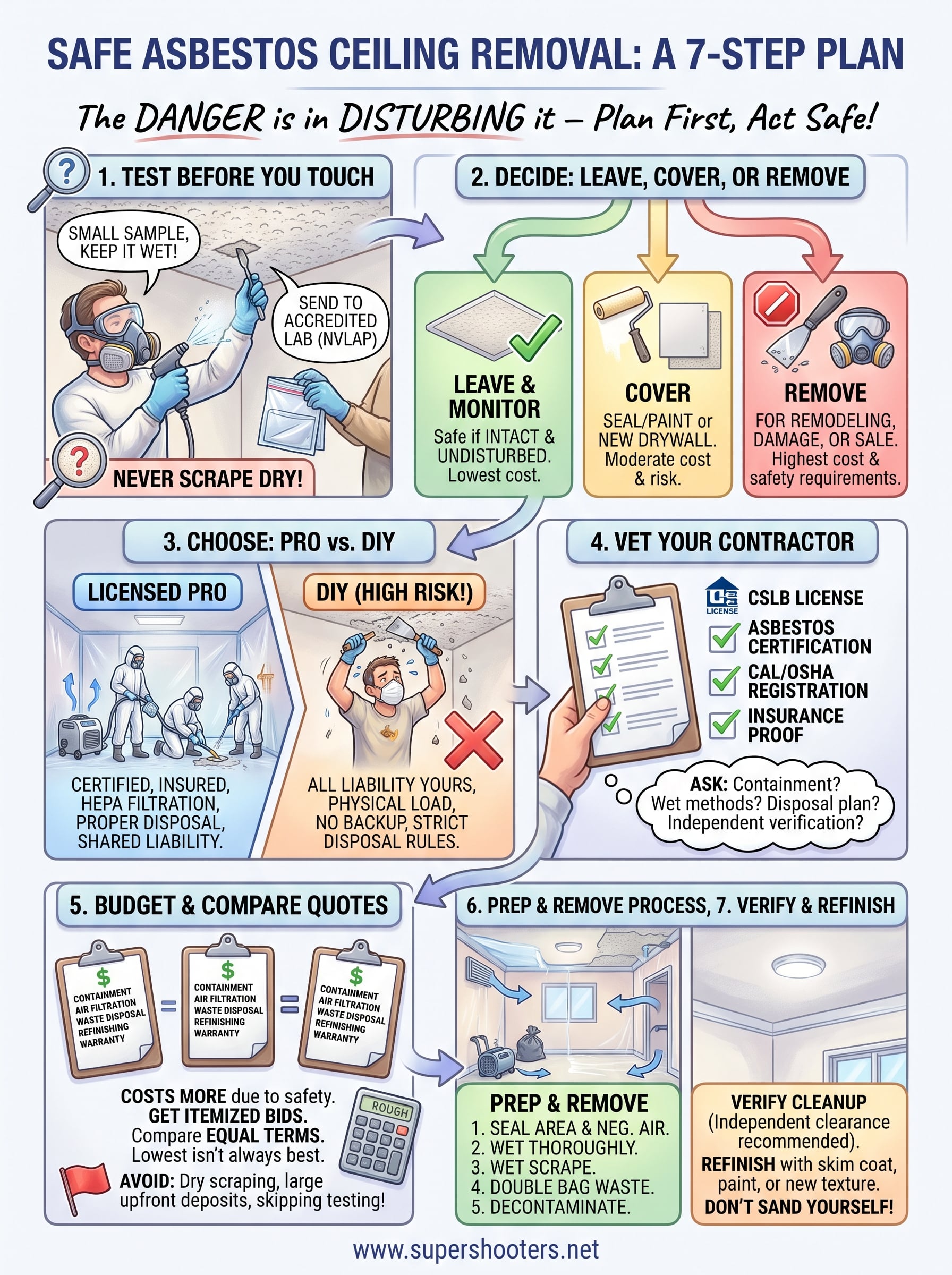
The safe way to handle asbestos ceiling removal is to test the ceiling first, decide whether to leave it, cover it, or remove it, and in most cases hand the removal to a licensed abatement contractor. Never scrape a suspect ceiling dry. Thorough wetting, sealed containment, and approved disposal are what keep fibers out of your lungs and out of the rest of your house.
The problem is that an asbestos ceiling looks exactly like any other popcorn or acoustic ceiling. Nothing warns you. Most homeowners find out in the middle of a remodel, after a corner has already been scraped or a recessed light has already been cut in. Then come the questions. Is it safe to stay in the house? Can I do this myself? What will it cost? The DIY guides that rank online are written for other states, so their legal advice often does not apply here.
This guide walks you through seven steps, from testing the ceiling to refinishing it. We have worked on ceilings across the Sacramento Valley for over 30 years, so the advice below comes from the questions homeowners actually ask us.
Why asbestos ceilings need a plan first
Asbestos ceiling removal needs a plan because the danger comes from disturbing the material, not from living under it. An intact ceiling is a managed risk . A scraped, sanded, or water-damaged one is a contamination problem that can spread fibers through every room.
Which ceilings contain asbestos
Sprayed popcorn, acoustic, and "cottage cheese" textures were standard in homes for decades, and many of them used asbestos as a binder and fireproofing filler. Federal bans on asbestos in spray-applied textures and patching compounds arrived in the late 1970s, but builders kept using up existing stock into the 1980s. That makes the year your home was built your first clue and a lab test your only proof. Many Sacramento Valley homes from the 1960s through the 1980s sit right in the zone where testing matters.
| Home built | Asbestos likelihood | What to do |
|---|---|---|
| Before 1980 | High | Assume asbestos until a lab says otherwise |
| 1980 to mid-1980s | Possible | Test before any work |
| Later | Low | Test anyway if you plan to remodel |
Popcorn is not the only suspect. Smooth ceilings, plaster, and joint compound on older drywall can also contain asbestos, so any ceiling in an older home deserves a test before you cut, drill, or scrape it.
Can you live in a house with an asbestos ceiling
Yes, you can. When the ceiling is intact, dry, and not crumbling, the fibers stay locked in the material and do not circulate in your air. Trouble starts when something disturbs it. Typical triggers are scraping, sanding, drilling for recessed lights, installing a ceiling fan, a roof leak that soaks the texture, or a remodel that opens a wall.
The health stakes explain why people take this seriously. Inhaled asbestos fibers can cause lung cancer, mesothelioma, and asbestosis, and the diseases often appear decades after exposure . The EPA states there is no known safe level of exposure, which is why the goal is always to keep fibers from getting airborne. You can read the agency's overview on its asbestos page.
An undisturbed asbestos ceiling is a manageable risk, and a disturbed one is a problem you have to clean up.
Step 1. Test the ceiling before you touch it
Test the ceiling by sending a small sample to an accredited lab, or by hiring a certified asbestos consultant to take it for you. This is the cheapest step in the whole project, and it decides every step after it. Without a result, you are guessing, and asbestos ceiling removal done on a guess is how contamination happens.
Take a sample the safe way
The sampling itself disturbs the ceiling a little, so keep it small and keep it wet. Many homeowners test a ceiling for asbestos by taking their own samples. If you would rather not, a certified consultant will do it and give you a written report.
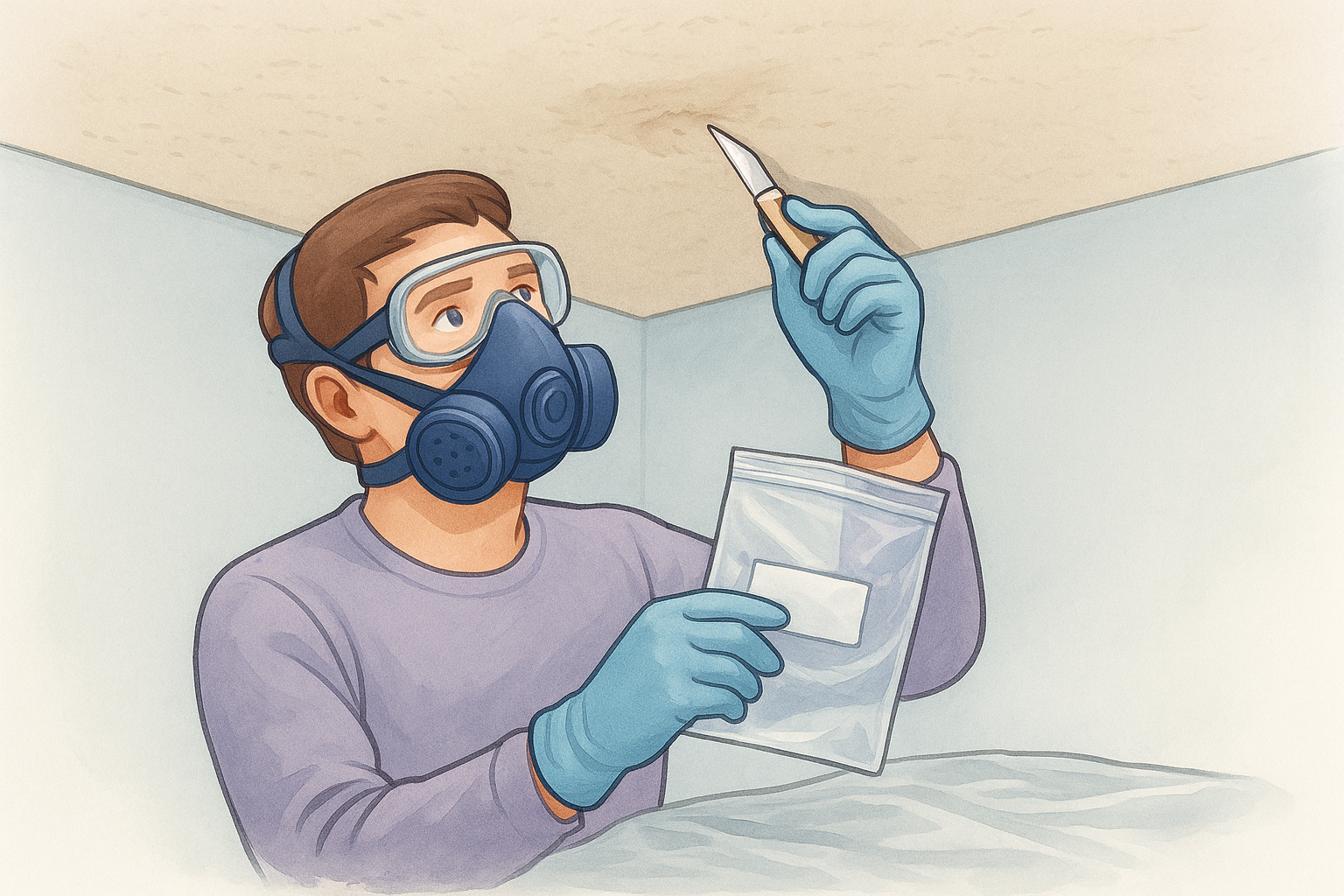
- Turn off the HVAC system, and keep children and pets out of the room.
- Wear a half-face respirator with P100 filters, disposable gloves, and goggles.
- Lay plastic sheeting on the floor under the sample spot.
- Mist a small area with water and a drop of dish soap so fibers stay down.
- Cut or scrape a piece about one square inch, all the way through to the drywall.
- Seal it in a zip bag, then place that bag inside a second bag, and label it with the room and spot.
- Wipe the area with a damp rag, bag the rag, and seal the hole with a dab of sealant or tape.
Take samples from three different spots on each ceiling, and ask the lab whether it wants them bagged separately. Texture applied at different times can contain different materials.
Choose a lab and read the result
Use a lab accredited for asbestos analysis. Look for NVLAP accreditation. Most labs use polarized light microscopy, charge a modest fee per sample, and return results in a few days, with rush service available at a higher price.
"None detected" is a clear answer. A result of "trace" or "less than 1%" is not. The federal line sits at 1% asbestos, but California's rules for construction materials are stricter, so a low result still calls for a conversation with a certified consultant before you start scraping. If you decide not to test, treat the ceiling as asbestos-containing and follow every precaution in this guide.
No lab result means you treat the ceiling as asbestos, with no exceptions.
Step 2. Decide whether to leave, cover, or remove
Once the test comes back positive, you have three real options: leave the ceiling alone, seal or cover it, or remove it. The right choice depends on the ceiling's condition and your plans for the room. Removal is not automatically the best move, and a good contractor will tell you so.
Compare your options
| Option | Relative cost | Risk | Best when |
|---|---|---|---|
| Leave and monitor | Lowest | Low while intact | The ceiling is sound and you plan no work |
| Encapsulate with sealant or paint | Low | Low to moderate | The ceiling is intact and needs a refresh |
| Cover with new drywall | Moderate | Moderate, because fasteners pierce the texture | You want a smooth ceiling without full removal |
| Remove | Highest | Highest during the work, lowest afterward | Remodeling, damage, or a sale is coming |
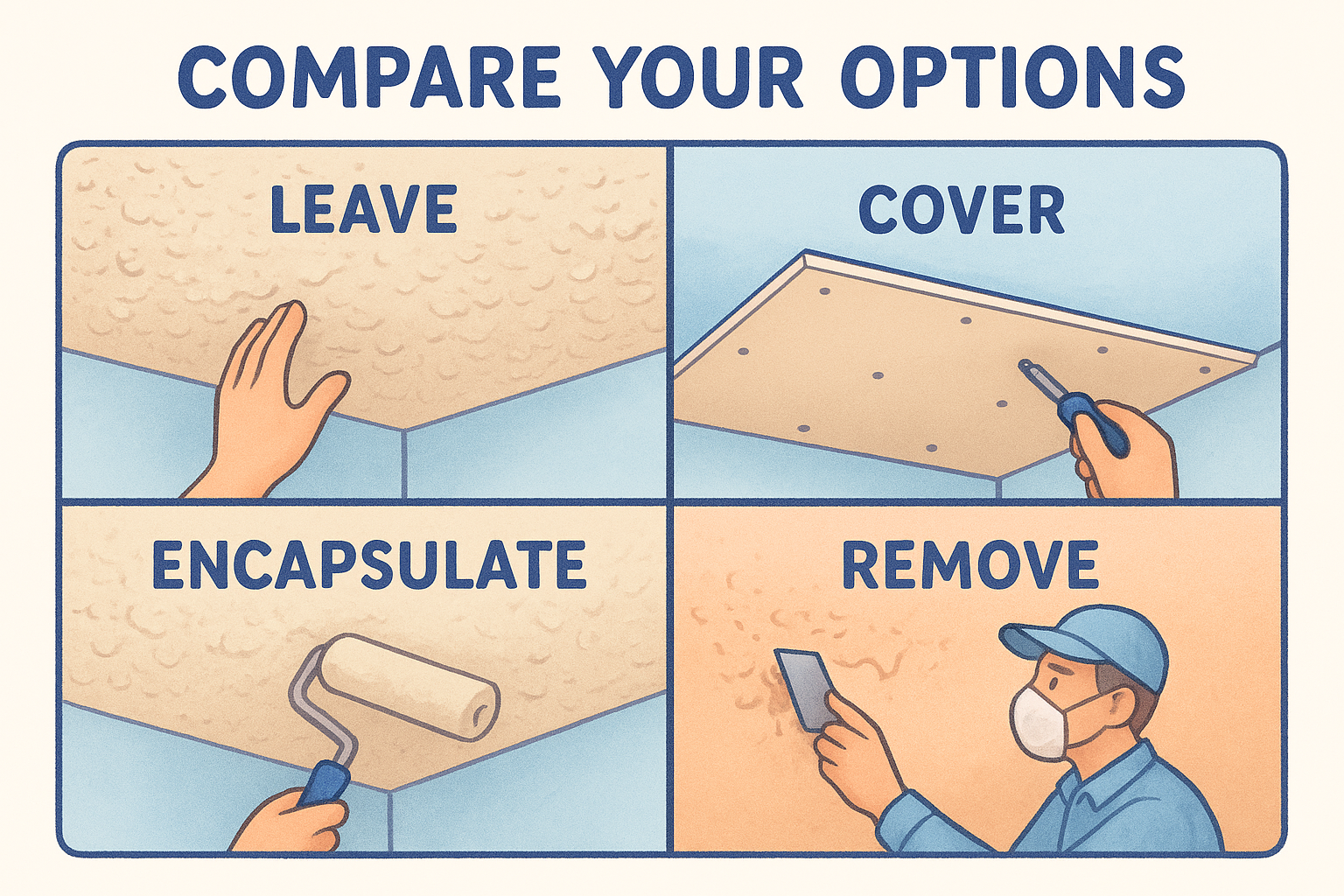
Painting deserves a warning. If you ever want to scrape later, thick paint can seal the texture so water cannot soak in, and an unwettable ceiling is a ceiling nobody can remove safely. A sprayed application is preferred over rolling, since a roller presses on the texture. Covering a popcorn ceiling with new drywall is also a real option, but screws going through the texture disturb it, so only an asbestos-aware contractor should do it.
Know when removal is the right call
Remove the ceiling when the material is crumbling, water-stained, or already damaged. Remove it when your remodel will disturb it anyway, such as relocating lights, opening walls, or adding a room. Removal also makes sense when you plan to sell and want a clean disclosure, since California sellers must disclose known environmental hazards, asbestos included.
If none of those apply and the ceiling is intact, leaving it alone is a legitimate and often cheapest answer. Asbestos ceiling removal is a project you choose for a reason, not an obligation the day the lab report arrives.
Remove an asbestos ceiling when it is damaged or about to be disturbed, not just because it is dated.
Step 3. Choose between DIY and a licensed pro
Hire a licensed pro. In California the rules, the equipment, and the physical demands all push in that direction. DIY is possible in limited situations, but it saves less money than people expect and carries risk you cannot undo.
What the two paths really look like
| Factor | DIY | Licensed contractor |
|---|---|---|
| Equipment | Respirator, coveralls, plastic, sprayers, waste bags | Negative air machines, HEPA filtration, decontamination setup |
| Safety backup | Almost none | Trained crew, air controls, standard procedures |
| Disposal | You find and use an approved site | Handled as part of the job |
| Physical load | Overhead work in a respirator and coveralls | Handled by a crew |
| Liability | All yours | Shared through license, insurance, and warranty |
Overhead work makes asbestos ceiling removal harder than floors or siding. You are scraping wet debris down onto yourself while wearing a respirator, goggles, and a sealed suit in a humid, plastic-lined room. Beards also prevent a proper respirator seal.
What California requires of contractors
California treats asbestos work for pay seriously. Contractors who handle more than 100 square feet of asbestos-containing material must be registered with Cal/OSHA and hold the proper certification from the Contractors State License Board. You can learn about worker safety rules on the Cal/OSHA site. Those rules apply to people working for pay, so never hire a handyman or a friend of a friend to scrape an asbestos ceiling.
Homeowners working on their own house are in a different legal position, but disposal rules and local air district rules still apply. Call your air quality district before you start. Sacramento County homeowners deal with the Sacramento Metropolitan Air Quality Management District, and nearby counties have their own.
If you still plan to do it yourself
Keep a DIY asbestos popcorn ceiling removal job to a small area, and do not proceed if any of these fail:
- The ceiling has been painted and water will not soak through to the substrate after repeated sprays over 15 to 20 minutes.
- You cannot get a respirator fit test or the right protective gear.
- You have no approved disposal site confirmed in advance.
- You would have to sand, vacuum, or sweep at any point. Never do any of those.
Everything in Step 6 is the minimum, and you perform all of it yourself, including the cleanup.
DIY asbestos removal does not save money if one dry scrape contaminates the house.
Step 4. Hire and vet an abatement contractor
Vet a contractor by checking three things yourself: an active CSLB license, the right asbestos certification and Cal/OSHA registration, and written proof of insurance. A good bid does not substitute for any of them. The right contractor makes asbestos ceiling removal an ordinary, well-run job.
Verify the paperwork
Start with the Contractors State License Board, where you can look up any license number and confirm it is active and in good standing. Then ask directly for the contractor's asbestos certification and Cal/OSHA registration. Ask for a certificate of liability insurance and proof of workers' compensation coverage, and call the insurer if you want to be sure.
A contractor who dodges these requests has answered your question. Ours is License No. 1077675, and you are welcome to check any contractor, us included, against the same standard.
Ask the right questions
Bring this list to every estimate. A free in-home consultation is the right setting for it.
- How will you contain the work area, and will you use negative air machines with HEPA filtration?
- How do you wet the material, and what do you do if a painted ceiling will not absorb water?
- Where does the waste go, and will I receive disposal paperwork?
- Will an independent consultant verify the cleanup, and is that cost in your bid?
- Does the price include repairing and refinishing the ceiling afterward?
- What warranty covers the finished work?
Spot the red flags
Walk away from anyone who offers to skip testing, scrape dry to save time, or leave the debris for you to haul. A request for a large deposit before any work starts is another warning, since California limits down payments on home improvement contracts. Our own approach is no upfront payment until the project is complete, which keeps the incentives where they belong.
A legitimate contractor shows you the license, the insurance, and the disposal plan before you sign anything.
Step 5. Budget for the job and compare quotes
Asbestos ceiling removal costs more than ordinary popcorn removal because of the containment, protective gear, air filtration, regulated disposal, and extra labor. Plan on a quote above the standard texture removal price, and get at least two written estimates so you can see what is driving the difference.
What drives the price
| Cost driver | Why it raises the price |
|---|---|
| Ceiling square footage | More material means more labor and more waste |
| Ceiling height and access | High or vaulted ceilings need scaffolding or lifts |
| Containment setup | Sealing rooms, vents, and doorways takes crew time |
| Air filtration and decontamination | Negative air machines and decon stations are rented or owned equipment |
| Disposal | Asbestos waste needs special bagging and an approved site |
| Testing and clearance | Lab fees and independent verification add cost |
| Refinishing | A new texture or skim coat is a separate trade step |
Texture thickness also matters. Heavily built-up or painted ceilings take longer to saturate and scrape.
Build a rough budget before you call
Published national estimates put popcorn ceiling removal at roughly $1.25 to $3.50 per square foot. The low end reflects ordinary texture, and asbestos abatement pricing per square foot belongs above that range. For a 500 square foot ceiling, that baseline is about $625 to $1,750 before containment, disposal, and testing push the total higher.
Add the lab test, which is small next to the removal itself, and the cost of refinishing the ceiling. Local prices vary across Sacramento, Roseville, Folsom, Elk Grove, and the surrounding communities, so a written estimate from someone who has seen your ceiling beats any online average.
Compare quotes on equal terms
A cheap bid that excludes disposal, testing, or refinishing is not cheap. Line up each quote against the same list: containment, air filtration, waste handling, independent clearance, refinishing, and warranty. Ask each contractor to itemize those lines in writing. Super Shooters provides a free in-home estimate, so you can see the full scope before you spend anything.
Compare what each quote includes, because the lowest number often leaves out the expensive parts.
Step 6. Prepare your home and know the removal process
Prepare by clearing the rooms, planning to be out of the house, and knowing what a correct removal looks like. A proper asbestos ceiling removal follows a set sequence, and you can hold your contractor to it, or follow it yourself if you go the DIY route.
What you do before the crew arrives
Your part is simple, but it matters. Do it a day or two ahead.
- Move furniture, rugs, and wall hangings out of the work area, or leave them for the crew to cover.
- Arrange for people and pets to stay elsewhere during the work.
- Do not turn on the HVAC system, and ask the crew whether vents need to be sealed.
- Have an electrician remove or disconnect ceiling light fixtures and fans if the contractor does not handle them.
- Keep the area clear of foot traffic until the crew gives the all-clear.
What a proper removal looks like
Every competent crew follows roughly this order. If yours skips a step, ask why.
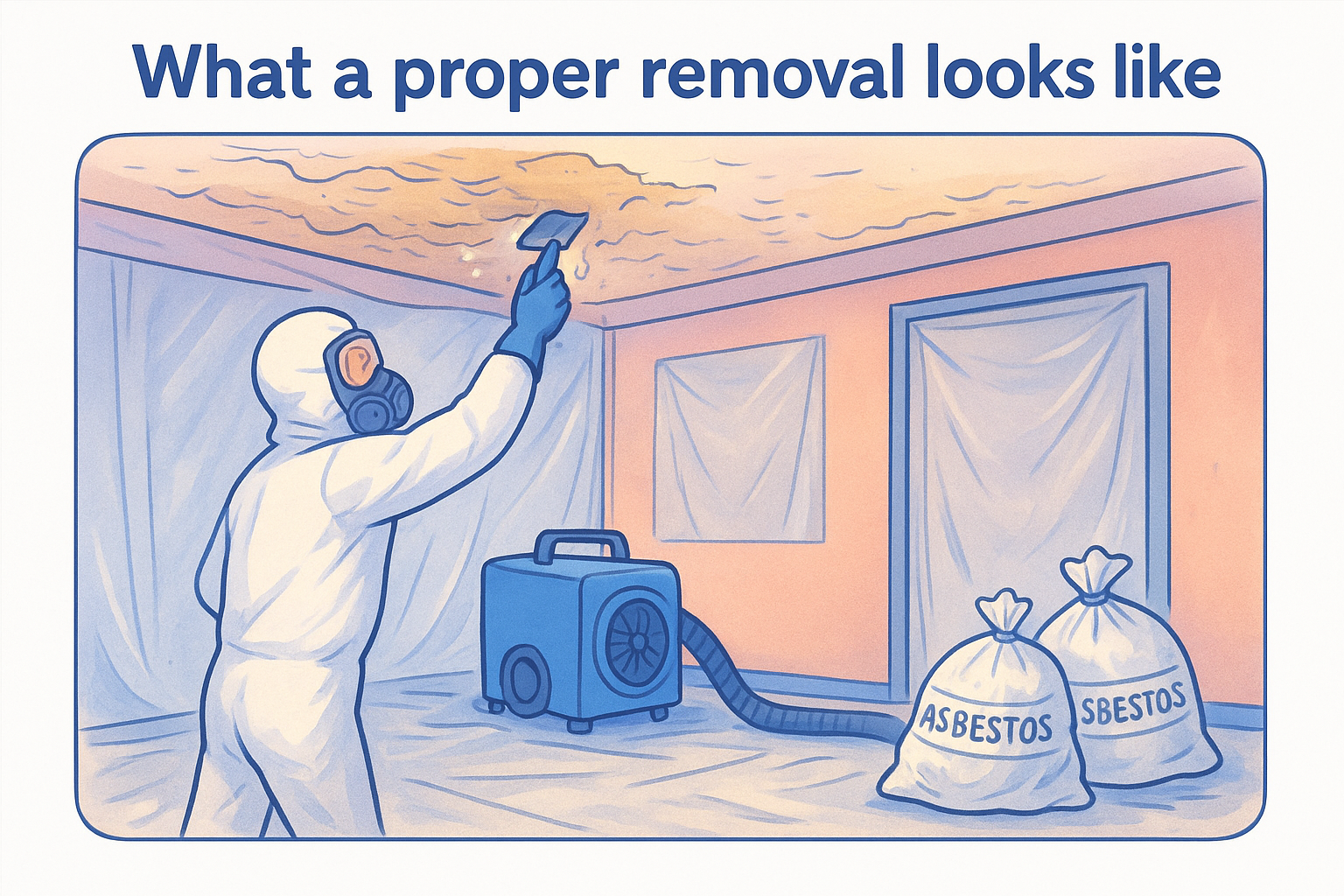
- Seal the work area with plastic sheeting on floors, walls, vents, and doorways, with a controlled entry and exit.
- Run negative air machines with HEPA filters so air flows into the work area and out through the filters.
- Wet the ceiling thoroughly with water and a wetting agent, and let it soak in until the texture is saturated.
- Scrape the wet material onto plastic below, keeping everything damp the whole time.
- Wet-wipe the ceiling and exposed wall edges, and never sand, sweep, or dry vacuum.
- Double bag debris and used plastic in labeled 6-mil asbestos waste bags.
- Apply a sealant or primer to the stripped surface to lock down any residue.
- Decontaminate gear and workers, then take down the containment.
- Transport the waste to a landfill approved for asbestos, with paperwork.
How long it takes
Setup and cleanup take as long as the scraping itself. A single room can be a one-day job, while a whole house usually takes several days once you add containment, removal, and cleanup. Ask for a schedule in writing, and expect the crew to resist rushing, since speed is the enemy of wet removal.
Wet, contained, and filtered removal is what separates a safe job from a contamination event.
Step 7. Verify the cleanup and refinish the ceiling
Finish by confirming the work area is clean and then restoring the ceiling, which is rough and often damaged after the texture comes off. Do not sand it yourself. This last step turns a safe removal into a finished room.
Verify the cleanup
Walk the space with your contractor before the containment comes down, and look at ceilings, wall tops, and floors for any residue. For extra assurance, hire an independent consultant to do a visual inspection or air sampling after the work. It costs more, but it gives you a result from someone with no stake in the job. Keep the disposal paperwork and the lab report. They protect you when you sell.
Refinish the ceiling
A scraped ceiling usually shows torn paper, gouges, and uneven areas. A skim coat over a sealed surface, new texture, or new drywall hung over the old ceiling brings it back to a clean finish. Our popcorn ceiling removal and drywall repair crews handle that step, and for a heavily damaged ceiling, drywall installation is often the cleaner route. Having one team do both stages avoids gaps between trades.
If you already scraped it dry
If you scraped a ceiling that might contain asbestos without wetting it, stop and act. Leave the room, close the door, and turn off the HVAC so air does not carry dust through the house. Keep everyone out, including pets. Do not vacuum, sweep, or wipe up the debris, because that spreads fibers.
Send a sample for testing, and call a certified asbestos consultant and an abatement contractor to assess and clean the space. Acting quickly limits how far the dust travels.
Never sand, sweep, or vacuum asbestos debris, because each of those puts the fibers in the air.
Your next move
Asbestos ceiling removal comes down to a short sequence. Test the ceiling, choose whether to leave, cover, or remove it, hire a licensed contractor you have checked yourself, and insist on wet, contained, filtered work with proper disposal. Each step protects your family and your home's value.
If your lab result came back positive, or you are planning a remodel in an older Sacramento Valley home, the next step is a conversation, not a scraper. Our team can look at your ceiling, explain your options, and give you a clear written price. Request a free estimate for asbestos acoustic ceiling removal and get the job planned the right way.
Recent Posts