
Share this article

October 15, 2026

Ceiling Water Damage Repair Cost: What You'll Really Pay

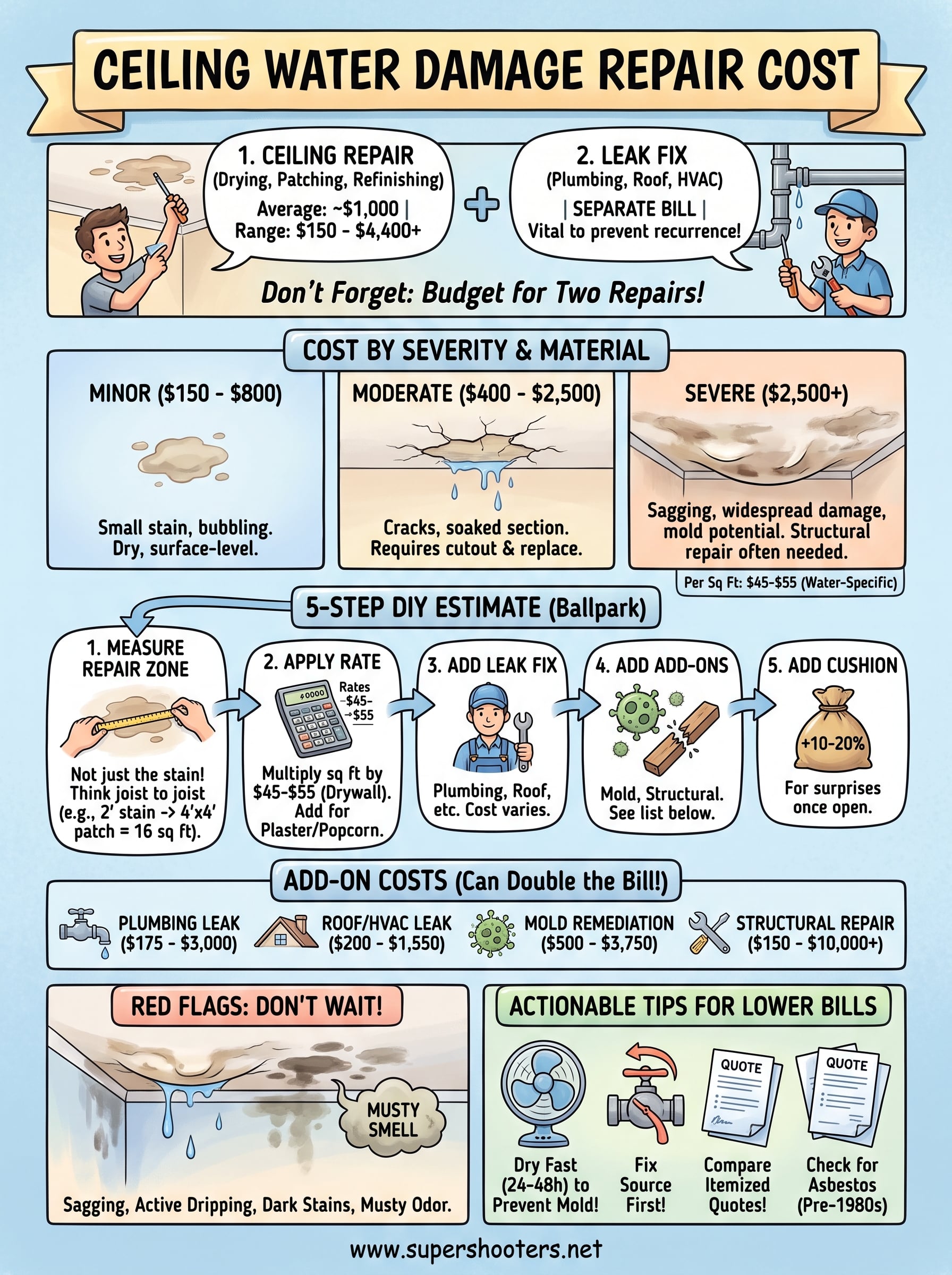
Ceiling water damage repair cost is the total price of drying, patching, and refinishing a ceiling that a leak has stained, softened, or cracked. Nationally, most jobs land between $150 and $4,400, with an average near $1,000. Water-specific repairs run about $45 to $55 per square foot. That figure covers the ceiling only. Fixing the leak that caused the damage is a separate bill.

Your final number depends on how far the water spread, what your ceiling is made of, and whether mold or structural damage is hiding above the drywall. This article gives you price tables by severity, a simple method to estimate your own cost, a checklist for reading contractor quotes, and the signs that separate a cosmetic stain from a real problem.

Super Shooters has repaired drywall and ceilings across the Sacramento Valley for more than 30 years, so we know how these jobs get quoted and where the surprises hide. Use the numbers below as a starting point, then confirm them with a local, itemized estimate.

Why ceiling water damage repair cost varies so much

Ceiling water damage repair cost varies because the same brown stain can hide very different problems. A dry, surface-level stain needs primer and paint. A soaked, sagging ceiling needs demolition, drying, new drywall, and finishing. National averages put the typical job near $1,000, but the range runs from $150 to well past $4,000.

Typical cost by damage severity

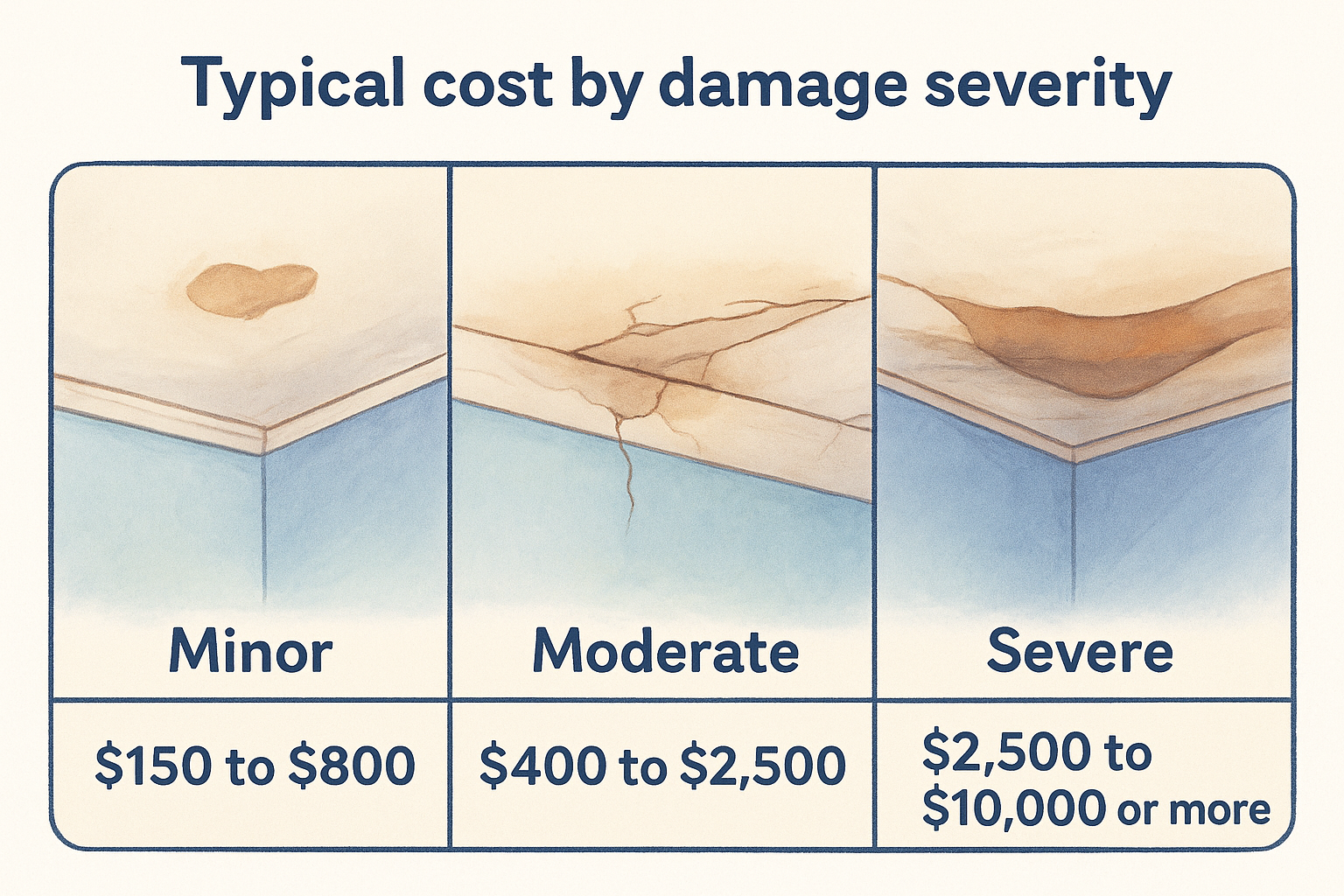
Severity is the biggest single driver, so start there. The table combines national averages for repair work alone , with no leak repair included.

Damage level What it looks like Typical cost
Minor Small stain, bubbling paint, or a small hole in a ceiling that dried fast $150 to $800
Moderate Cracks along seams, or a soaked section of drywall that must be cut out and replaced $400 to $2,500
Severe Sagging ceiling, damage across several rooms, rotted joists $2,500 to $10,000 or more

These ranges describe national averages, and local labor rates in the Sacramento Valley can sit above or below them. Treat the table as a sanity check for the quotes you receive, not a promise.

Per square foot and hourly pricing

Most contractors price water-damaged ceiling work at $45 to $55 per square foot . General ceiling repair, which includes textured ceilings and other materials, spans $45 to $90 per square foot. Small jobs are often billed by the hour instead, at roughly $60 to $90 an hour , or as a flat patch price.

Per-square-foot pricing works well for mid-size repairs and poorly for tiny ones. Joint compound needs several coats with drying time between them, so even a 2-square-foot patch takes more than one visit. That is why small repairs often carry a minimum charge. If a quote for a small hole looks steep per foot, ask about the minimum before you object.

Two bills, not one

Every figure above covers the ceiling only. The leak behind it is a second job, and it is the one people forget to budget for. Plumbing, roofing, and HVAC repairs each add their own cost, which you will see in the next section. Repairing a ceiling without fixing the source wastes the money, because the stain comes back.

Budget for two repairs: the ceiling and the leak that caused it.

How to estimate your ceiling water damage repair cost

You can build a realistic estimate in five steps: measure the true repair area, apply the rate for your ceiling type, add the leak fix, add any mold or structural work, and keep a cushion. Doing this before you call anyone lets you spot a quote that is far outside the normal range.

Build a ballpark in five steps

Work through these in order and write each number down.

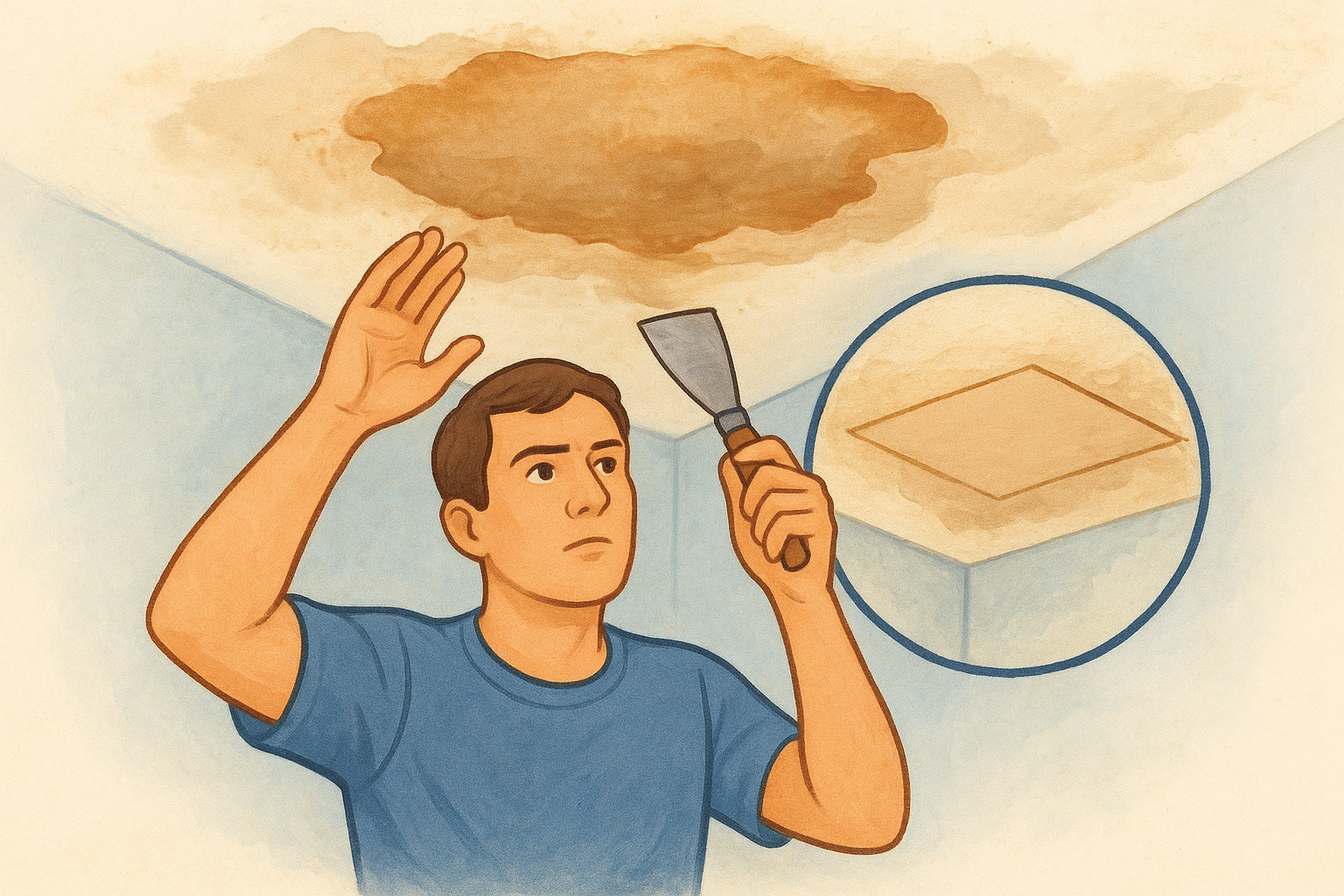
  1. Measure the repair zone, not the stain. Drywall is cut back to the nearest joists, which sit 16 or 24 inches apart. A 2-foot stain often becomes a 4 by 4 foot patch, or 16 square feet.
  2. Multiply by the rate for your ceiling material. The table in the next subsection gives the ranges.
  3. Add the leak repair if the source is not fixed yet.
  4. Add mold or structural work if you smell mold, see dark stains, or notice sagging.
  5. Add a 10 to 20 percent cushion. This is a rule of thumb for surprises found once the ceiling is open.

Here is how it plays out. A 16-square-foot drywall repair at $45 to $55 per square foot comes to $720 to $880 . If a plumber still has to fix the supply line, add that bill on top. The leak fix alone can fall anywhere in the $175 to $3,000 range.

Adjust for ceiling material and location

Your ceiling type changes the rate more than most homeowners expect. The 16-square-foot column shows the same patch priced on each material.

Ceiling type Cost per square foot 16 sq ft repair
Drywall $45 to $55 $720 to $880
Plaster and lath $65 to $80 $1,040 to $1,280
Popcorn texture $75 to $90 $1,200 to $1,440

Texture is the expensive part of a popcorn repair. The patch has to blend with the surrounding ceiling, and matching a sprayed finish takes skill. Some homeowners decide to remove the popcorn texture instead of matching it, which gives a smooth, uniform result.

Location and water type matter too. A basement ceiling may hide plumbing lines that complicate the work, a garage ceiling needs insulation put back, and attic or upper-floor ceilings take longer to reach. Clean supply-line water costs far less to clean up than sewage or flood water, which require extra protocols.

Add-ons that can double the bill

Add-ons are where a $900 estimate turns into a $3,000 invoice. Price them separately so you can see what you are paying for.

Add-on Typical cost
Plumbing leak repair $175 to $3,000
Roof leak repair $360 to $1,550
HVAC leak repair $200 to $1,500
Mold remediation $500 to $3,750
Joist repair $150 to $750
Main support beam repair $1,500 to $10,000

Mold is the add-on you can most easily prevent. Moisture that sits for more than a day or two invites growth, and the EPA recommends drying water-damaged materials within 24 to 48 hours. Fast drying often decides whether your ceiling water damage repair cost stays in the minor range.

Price the add-ons separately, because they, not the patch, decide whether the bill doubles.

How to read a contractor quote for ceiling repair

A fair quote breaks the job into stages, states what is and is not included, and tells you when you pay. If a quote is a single lump sum with no detail, you cannot compare it with anything, and that is the first problem to fix.

What a complete quote lists

Ask for a written, itemized estimate. A quote for ceiling water damage repair should name each of these stages:

  • Confirmation that the leak is fixed, or a clear note that it is excluded
  • Moisture readings and drying time
  • Demolition and disposal of wet drywall and insulation
  • Replacement insulation, if needed
  • New drywall, taping, and finishing coats
  • Texture matching
  • Stain-blocking primer and paint
  • Mold or structural work, listed as included or excluded
  • Timeline and payment schedule

Get at least three quotes and compare them line by line, not by total. A low total that skips drying or primer is not cheaper. It just moves the cost to a future repair. Our own estimates are free and happen in your home, so you can see exactly what the contractor is proposing.

Red flags that signal a bad quote

Watch for a quote that ignores the leak source, pressure to sign the same day, and no license number. Check any contractor's license with the California Contractors State License Board. Large deposits are another warning sign. California limits the down payment on a home improvement contract to the lesser of 10 percent of the price or $1,000. We do not ask for payment until the project is complete.

Be careful with quotes far above the ranges in this article for a small area. A $5,000 bid for two small ceiling bubbles needs a clear explanation, such as hidden structural damage or a whole-ceiling refinish. Without one, get another opinion.

Questions to ask before you sign

A few direct questions reveal how a contractor works. Ask what happens to the price if they find more damage once the ceiling is open, and whether they will get your approval first. Ask whether texture matching is included. Ask what warranty covers the repair and how long it lasts. Clear answers in writing protect you far better than a handshake price.

Compare quotes line by line, because a low total that skips drying or primer is not a bargain.

When ceiling water damage is serious and when to replace

Water damage to a ceiling is serious when the drywall sags, drips actively, smells musty, or has dark brown or black stains. A small, dry, pale stain is usually cosmetic. Repair or replace depends on how much material stayed wet and for how long, and that choice drives your ceiling water damage repair cost more than any other.

Signs you should not wait

Some symptoms mean you should call a professional now:

  • A sagging or bulging ceiling, which means water has pooled above the drywall
  • Active dripping or streaming water
  • Dark brown or black stains, which suggest long exposure and possible mold
  • A musty smell near the stain
  • Water collecting in a light fixture

Stay out from under a bulge , and leave draining it to a professional. If water reaches a fixture, shut off power at the breaker before anything else. A leak that has run for weeks will cost more than one caught in days.

Repair or replace

A patch is enough when the damage is small, the drywall is firm, and everything has dried completely. After the leak is fixed, stain-blocking primer and paint handle a dry stain. Cut out and replace a section when the drywall is soft, sagging, or stayed wet beyond 48 hours.

Replace the whole ceiling when damage is widespread, leaks keep returning, or the ceiling is near the end of its life. At that point, new drywall installation often beats a series of patches. For smaller jobs, professional drywall repair and patching restores the surface without touching the rest of the room.

Check for asbestos before you cut

If your home was built before the 1980s, the textured ceiling may contain asbestos. Sanding, scraping, or cutting into it can release fibers. Have the material tested before any repair begins, and use a licensed professional for asbestos acoustic ceiling removal if the test is positive. Testing adds a small cost up front, and it prevents a much larger problem later.

How insurance and quick action lower your bill

Homeowners insurance often covers sudden, accidental water damage, and quick action keeps ceiling water damage repair cost low whether or not you file a claim. Policies differ, so confirm the details with your insurer before you assume anything is covered.

Does homeowners insurance pay

Most policies cover damage from a pipe that bursts overnight or an appliance line that fails suddenly. They usually exclude gradual leaks, poor maintenance, and neglect. Flood damage is typically excluded from standard policies and needs a separate flood policy.

Your deductible decides how much help you actually get. If the repair costs $1,500 and your deductible is $1,000, the policy pays about $500. For small repairs, paying out of pocket may make more sense than filing a claim. For damage in the thousands, a claim usually pays off. Either way, photograph the damage right away and keep every estimate and receipt.

Ways to keep the bill down

You cannot undo the leak, but you can limit what it costs you. These steps matter most:

  • Shut off the water at the source if you can reach the valve safely.
  • Dry the area fast. Fans and dehumidifiers within the first 24 to 48 hours prevent mold.
  • Fix the source first. Repairs on top of an active leak are wasted.
  • Skip the paint-over. Painting over a wet or unrepaired stain hides the problem while it grows.
  • Bundle the finishing work. Ask for patching, texture, and paint in the same visit.
  • Compare itemized quotes from several contractors.

The cheapest ceiling repair is the one you start within a day or two of the leak.

Budget with ranges, then get it priced

Ceiling water damage repair cost comes down to severity, material, and the leak behind it. Expect $150 to $800 for minor damage, $400 to $2,500 for moderate damage, and $2,500 or more when joists or sagging are involved. Water-specific repairs run about $45 to $55 per square foot, and the leak fix is an extra bill.

Use the five-step estimate to set your range, then check each quote line by line. Fast drying and a fixed leak protect your budget better than any discount. When you are ready for a firm number on your own ceiling, book a free in-home drywall repair estimate with Super Shooters. You pay nothing until the work is done.

Recent Posts

By cinchweb • October 15, 2026
Learn how to pick a drywall patching panel, match its thickness, and install it in five steps, from marking the cut to priming the finished patch.
By cinchweb • October 13, 2026
Compare five kinds of drywall repair contractors near me, see who each suits, and learn how to check licenses, reviews, and estimates before you hire.

By cinchweb • October 12, 2026
How long does asbestos testing take? See timelines for sampling, PLM, PCM, and TEM results, plus what speeds up or delays your report. Plan your project.
By cinchweb • October 10, 2026
Learn how to sand drywall without dust using 5 clean methods: seal the room, thin coats, wet sanding, and HEPA vacuums. Plus when to call a pro.
By cinchweb • October 9, 2026
Learn how to patch a large hole in drywall with mesh. Get the tools list, three-coat mud method, sanding and paint tips for a 2–6 inch repair.

By cinchweb • October 7, 2026
See 2026 California asbestos abatement cost per square foot by material, plus a 1,000 sq ft example, removal vs. encapsulation, and how to read a quote.

By cinchweb • October 6, 2026
How to use drywall patching clips on 4-12 inch holes: pick the right thickness, set the patch, finish in three coats, and know when to call a pro.

By cinchweb • October 5, 2026
Find the best joint compound for skim coating: compare lightweight, all-purpose, Plus 3, Easy Sand and Durabond, plus how to mix, apply and sand.
By cinchweb • October 5, 2026
Is vertical drywall installation okay? Learn when it works, how to hang sheets step by step, common mistakes, and when to hire a pro.

Show More