October 7, 2026
Asbestos Abatement Cost per Square Foot: 2026 Price Ranges
If you are planning to remove an old ceiling or wall finish, the first question is usually what it will cost. The asbestos abatement cost per square foot typically runs from about $3 to $20 for most home materials, depending on what is being removed and how it is handled. Those numbers shift fast once you add testing, containment, and disposal, so a single average rarely tells you much.
Here is the short answer. Asbestos-containing popcorn ceilings usually fall at the lower end, often $5 to $10 per square foot in California, while pipe insulation, flooring, and siding can cost more. Small jobs cost more per square foot because setup and lab fees stay the same no matter how little you remove. Sacramento Valley pricing also tends to run above national averages.
Below, we break down 2026 price ranges by material, location, and project size, and explain what drives each line item. We have removed acoustic ceilings in the Sacramento Valley for over 30 years, so these figures come from real jobs, not guesswork.
Why asbestos abatement cost per square foot matters
Every bid you receive eventually gets reduced to one figure, dollars per square foot. That number is how you compare contractors , check a quote against market ranges, and decide whether a project fits your budget before anyone touches your ceiling. It only helps if you understand what sits behind it.
A budgeting tool you can use before the first call
Square footage is the one measurement you already have. Multiply your ceiling or wall area by a price range and you get a ballpark budget in about two minutes. The table below uses the $5 to $10 range we see for asbestos popcorn ceiling removal in California. It is an illustration, not a quote.
| Ceiling area | Low estimate ($5/sq ft) | High estimate ($10/sq ft) |
|---|---|---|
| 400 sq ft (two bedrooms) | $2,000 | $4,000 |
| 1,000 sq ft (typical single story) | $5,000 | $10,000 |
| 1,500 sq ft (larger home) | $7,500 | $15,000 |
The spread grows with the size of the job. On a 1,500 square foot ceiling, a $5 difference per square foot is $7,500. Pinning down where you land in the range early keeps you from being surprised later.
What a low number can hide
Two bids at $4 and $9 per square foot look like a $5 gap. Often they do not cover the same work. One may leave out lab testing, air monitoring, floor and wall protection, or disposal . Another may skip the retexture and paint that follow removal. Scope differences explain most of the price gaps we see when homeowners show us competing quotes.
A very low figure can also point to a crew that is not qualified. In California, asbestos work involving 100 square feet or more of material must be done by a registered, properly certified contractor . Uncertified crews cut costs by skipping containment, and that is exactly where the savings turn into risk.
Why the stakes are higher than a normal remodel
Scraping a non-asbestos ceiling is a messy weekend. Scraping an asbestos ceiling sends microscopic fibers into the air, and the EPA links inhaled asbestos to lung cancer, mesothelioma, and asbestosis. Material that is intact and left alone is generally low risk. The danger starts when it is disturbed without containment .
That changes the math. If fibers spread through a house, you may pay for professional cleanup of every room, the HVAC system, and the contents, on top of the original removal. Those costs routinely exceed what proper abatement would have run in the first place.
The cheapest asbestos bid is the most expensive one if it spreads fibers through your home.
So use the per-square-foot figure the right way. It is a good yardstick for budgeting and comparing bids, but only after you confirm that every bid covers the same testing, containment, and cleanup.
How to estimate your abatement cost per square foot
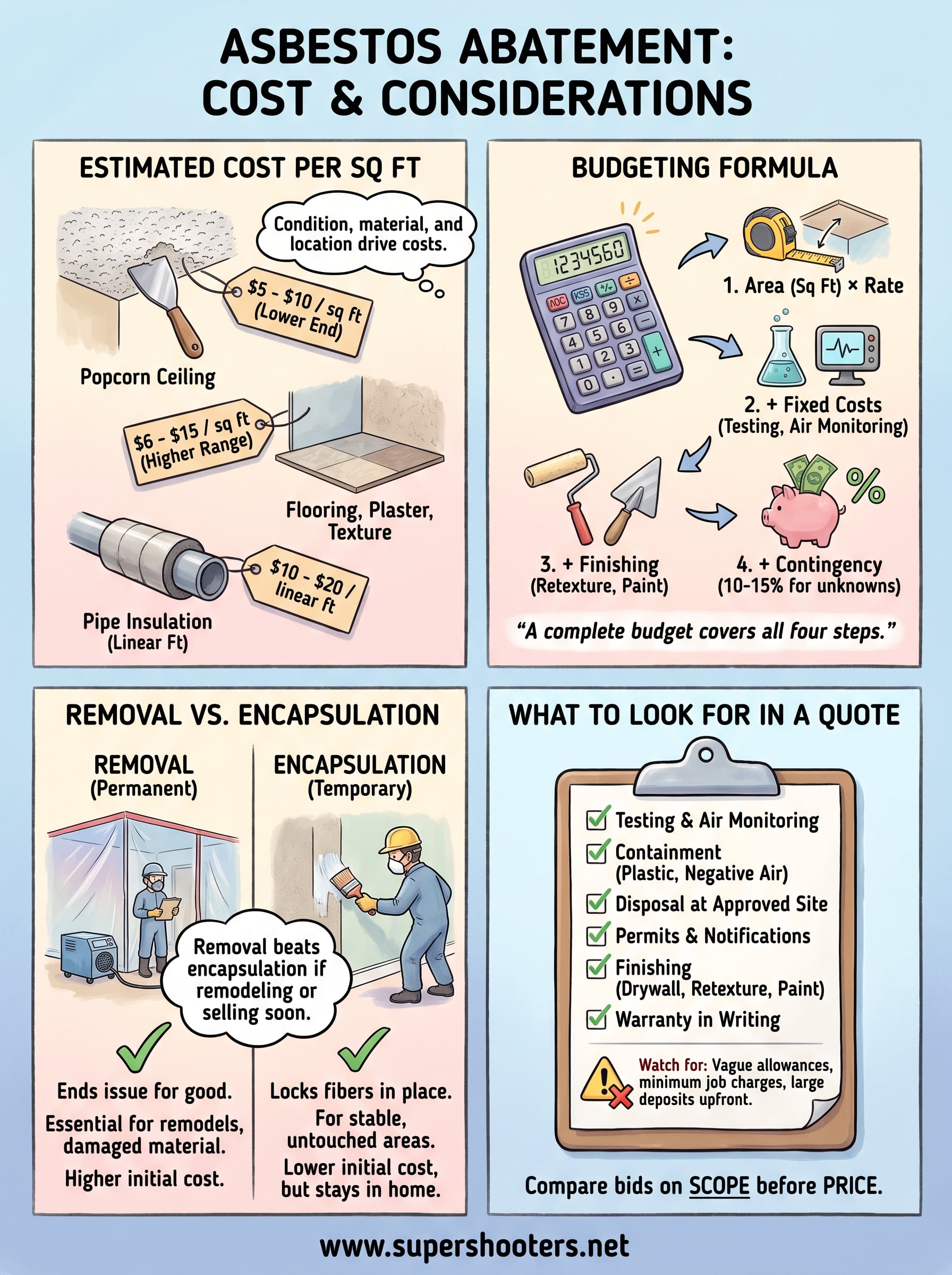
A reliable estimate starts with your own measurements, not a contractor's average. You need four inputs : area, material, testing, and finishing. With those, you can build a realistic budget range before anyone visits your home.
The four-step formula
Ceiling area is length times width for each room, added together. Wall area is perimeter times height , minus doors and windows. Measure in square feet, because that is how every bid is priced.
- Measure the total area you plan to remove.
- Confirm the material by testing the ceiling for asbestos in a lab. Analysis usually runs $30 to $100 per sample, and each material needs its own sample.
- Apply the per-square-foot range for that material (the next section lists them).
- Add the fixed costs: air monitoring, permits, any minimum job charge, and the retexture and paint that follow.
A worked example
Take a 1,000 square foot asbestos popcorn ceiling in a single-story home. The table uses the $5 to $10 removal range from earlier, plus rough figures for testing and finishing.
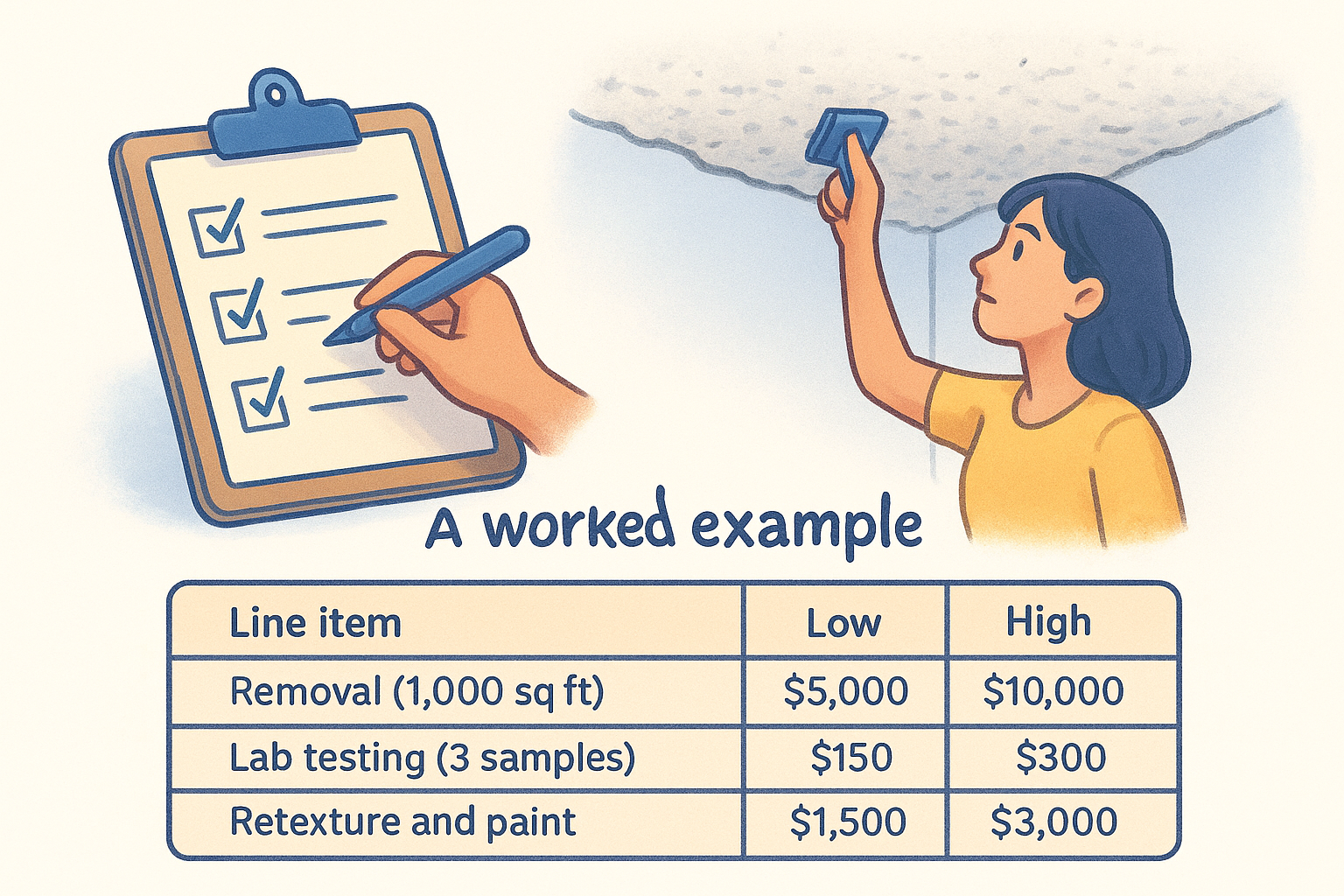
| Line item | Low | High |
|---|---|---|
| Removal (1,000 sq ft) | $5,000 | $10,000 |
| Lab testing (3 samples) | $150 | $300 |
| Retexture and paint | $1,500 | $3,000 |
| Subtotal | $6,650 | $13,300 |
| Contingency (10% to 15%) | $665 | $1,995 |
| Estimated total | $7,315 | $15,295 |
Notice that removal is only about three quarters of the total. Hold back a 10 to 15 percent contingency , because water stains, old patches, or damaged drywall often show up only after the ceiling comes down. Once you have your range, a free in-home estimate replaces it with a firm number.
Budget the whole project, not just the removal line.
Asbestos abatement cost by material and location
Material sets the base price. The same containment, labor, and disposal charges look very different on a ceiling than on a floor or a pipe wrap. These are the 2026 working ranges we use for California homes, and they show how asbestos abatement cost per square foot changes from one surface to the next.
Price ranges by material
| Material | Typical cost | What affects it |
|---|---|---|
| Popcorn or acoustic ceiling | $5 to $10 per sq ft | Most common home job, repeatable work |
| Wall texture and joint compound | $4 to $9 per sq ft | Drywall replacement adds cost |
| Plaster walls | $6 to $12 per sq ft | Heavy debris, slower demolition |
| Vinyl floor tile and mastic | $5 to $15 per sq ft | Glued adhesive layer drives labor |
| Cement siding or roofing | $6 to $15 per sq ft | Exterior access and weather |
| Pipe insulation | $10 to $20 per linear foot | Priced by length, not area |
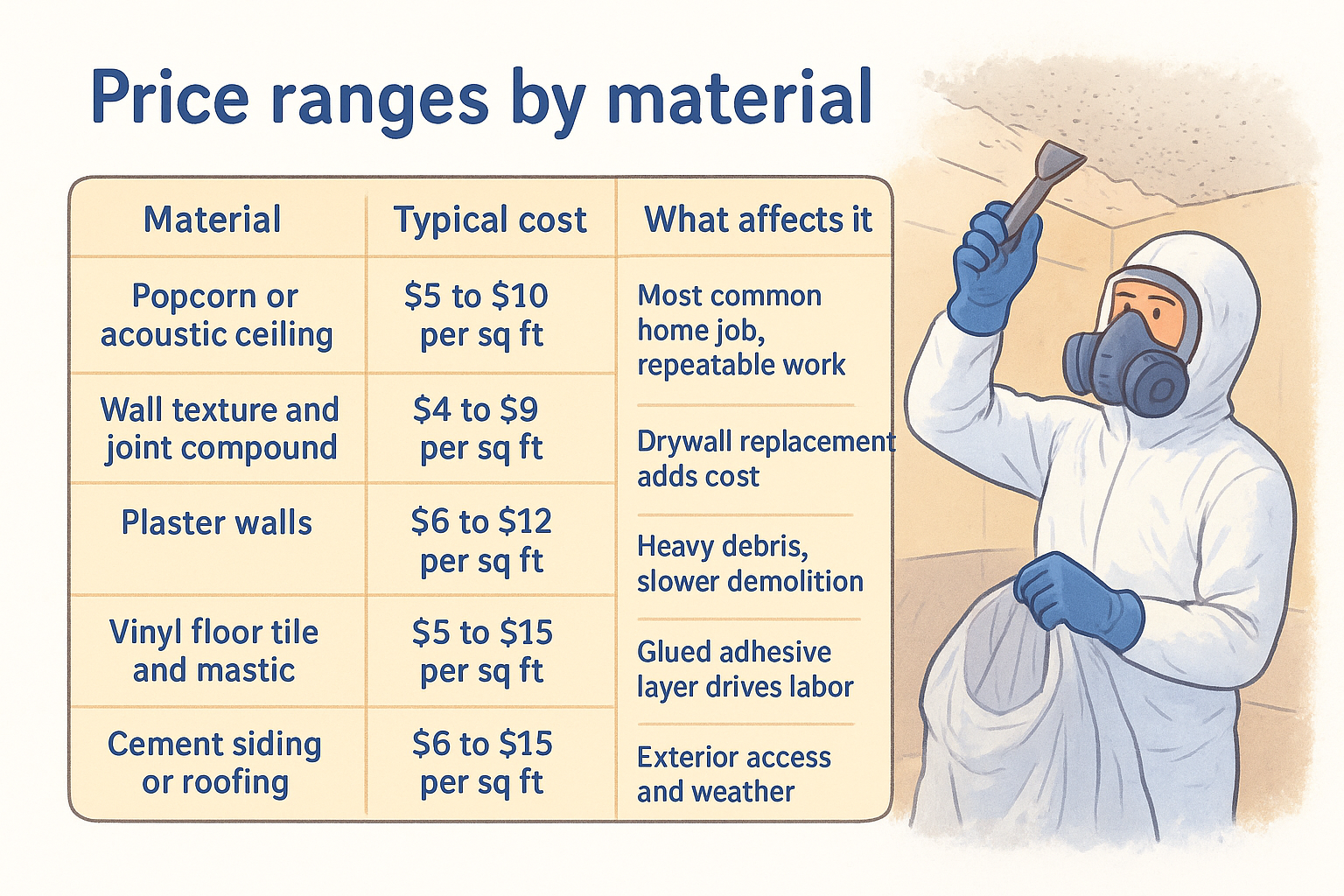
Ceilings land at the bottom of the scale because the work is predictable . Crews wet the material, scrape it, and bag it in one controlled pass. Floors and plaster take longer to break up, and pipe wrap is priced by length because it is hard to reach and easy to disturb. Always confirm which unit of measure a bid uses before you compare it with another.
How location moves the number
Geography matters almost as much as material. Sacramento Valley pricing usually runs above national averages because of California's certification rules, labor rates, and the cost of hauling waste to approved disposal sites. The Bay Area and coastal metro areas run higher still. Farther out, expect a travel or mobilization charge that city homeowners do not see.
Material sets the base rate, and location and job size adjust it up or down.
Small jobs deserve a special note. A 150 square foot bedroom ceiling can price at the top of its range, or hit a minimum job charge, because lab fees, containment setup, and permits cost the same on a small job as on a large one. A whole-house ceiling spreads those fixed costs across more square feet, so the per-foot rate drops.
Finally, ask each contractor whether the figure covers removal only or removal plus finishing . A $6 bid that ends with bare drywall is not comparable to an $8 bid that includes new texture and paint.
What drives the price up or down
Beyond material and location, a handful of site conditions can move your asbestos abatement cost per square foot by several dollars in either direction. Most of them you can see, or control, before a crew arrives. Knowing them also helps you read why two similar homes get different bids .
What pushes the price up
Condition matters more than most homeowners expect. Material that is crumbling, water-damaged, or loosely bonded releases fibers easily, so the crew needs tighter containment and more air filtration . Ceiling height and surface history add labor too. The table shows the adjustments we see most often. These are rough figures from our own jobs, not fixed rates.
| Condition | Typical effect | Why it costs more |
|---|---|---|
| Friable or damaged material | Higher rate | Stricter containment, more air filtration |
| Several layers of paint | About $1 to $2 more per sq ft | Material wets and scrapes slowly |
| Vaulted or high ceilings (10 ft or more) | About 10% to 25% more | Scaffolding and slower work |
| Furnished, occupied rooms | Added labor | Moving and sealing contents |
| Damaged drywall underneath | Extra line item | Patching or panel replacement |
Condition and access often change your price more than the material name on the lab report.
Hidden problems deserve their own mention. A ceiling that was patched after a leak, or sprayed over a bad repair, can turn a simple scrape into a repair job. That is why we recommend the 10 to 15 percent contingency from earlier.
What brings the price down
Clear the work area before the crew arrives. Empty rooms save setup hours , and setup is billed like any other labor. Grouping work also helps. Removing every asbestos ceiling in one visit means you pay for containment and mobilization once, not three times.
You can also trim the finishing side of the bill. A contractor who handles removal, drywall repair, and retexture avoids the handoff gaps and duplicate setup that come with hiring separate trades. A few other habits help:
- Test early , so the bid reflects a confirmed material instead of a worst-case guess.
- Ask for line-item pricing to spot where you can trim scope.
- Schedule in the slower months, when crews often have open dates.
- Skip rush timelines unless you truly need them.
None of these should come at the expense of containment or disposal. Those are the lines to protect, and they are the same ones the next section helps you check on a quote.
Removal vs. encapsulation: cost comparison and when each fits
Removal is not your only option. If the material is in good shape, sealing it in place can cost far less up front. The right choice depends on the condition of the surface, your remodeling plans, and how long you will own the home.
Cost side by side
Encapsulation locks fibers in place with a sealant or a new layer over the old one. The asbestos abatement cost per square foot is lower here, but the problem stays in your house. These are rough ranges from our own jobs, so treat them as ballpark figures.
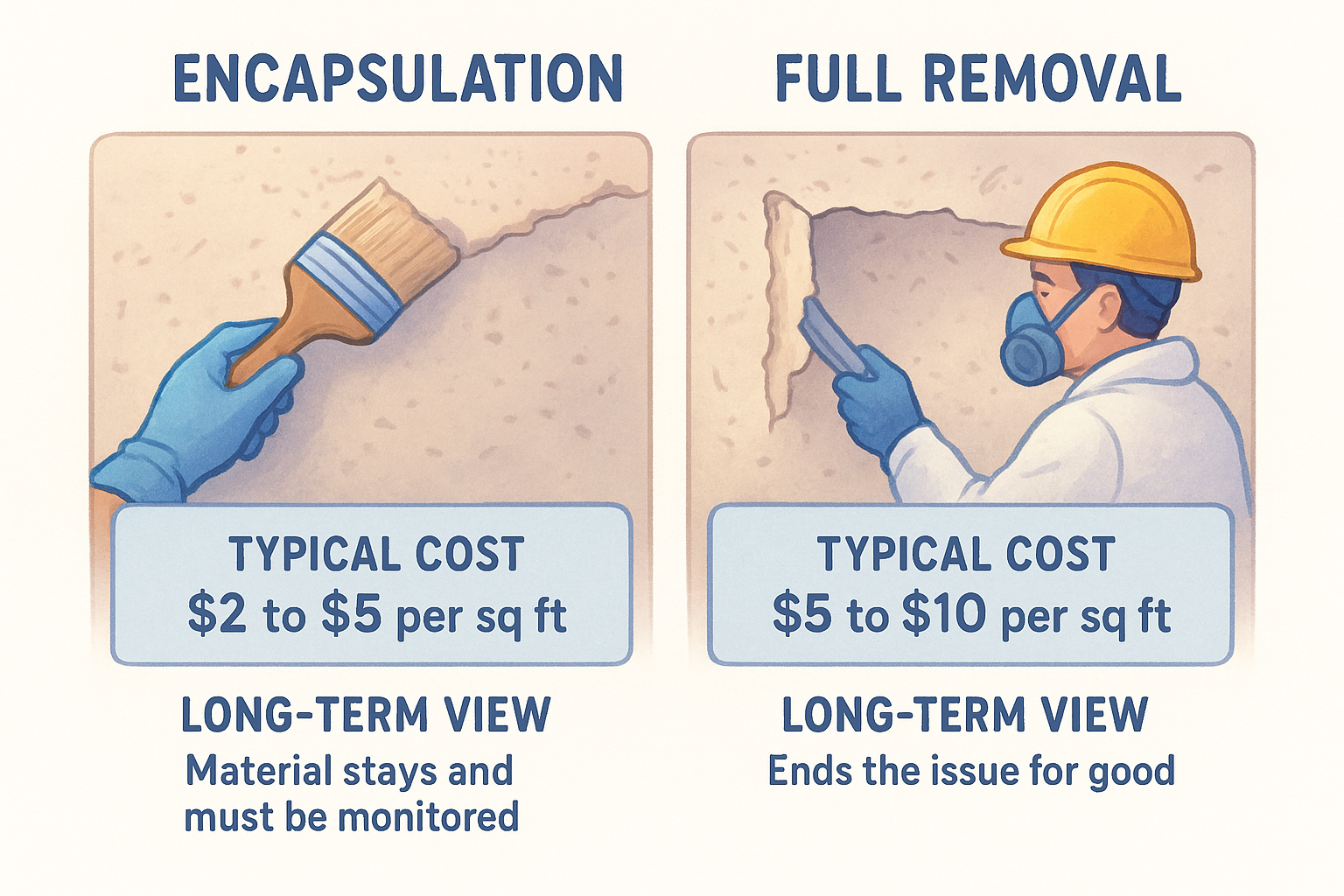
| Option | Typical cost | Long-term view |
|---|---|---|
| Sealant coating | $2 to $5 per sq ft | Material stays and must be monitored |
| Drywall overlay | $3 to $6 per sq ft | Hides it, and later removal costs more |
| Full removal | $5 to $10 per sq ft | Ends the issue for good |
When encapsulation fits
Sealing works when the material is intact, firmly bonded, and out of reach . A stable ceiling in a home where you plan no changes is the classic case. You pay less now and avoid a week of containment.
Any later project can undo that savings. Recessed lighting, a removed wall, or a roof leak can disturb the material , and known asbestos generally has to be disclosed when you sell. Some buyers walk away from it, and others negotiate the price down.
When removal is the better call
Pick removal when the surface is crumbling, water stained, or flaking, because damaged material cannot be sealed reliably . It also makes sense if you plan to remodel, add an ADU, or sell within a few years.
Encapsulation postpones the bill, it does not cancel it.
Do the math on a 1,000 square foot ceiling. A $4,000 overlay now, followed by $8,000 to $10,000 of removal after a remodel, costs more than removing it once at $5,000 to $10,000. If you will never touch the ceiling, sealing can win. If there is a real chance you will, paying once is usually cheaper.
How to read a quote and avoid hidden costs
A quote is only useful if you can compare it line by line. The asbestos abatement cost per square foot on page one tells you little until you see what it covers. Ask every contractor for an itemized written bid , not a lump sum.
What a complete quote lists
Look for each item below. If one is missing, ask whether it is included, priced separately, or left out.
- Lab testing and who pays for it
- Air monitoring during and after the work
- Containment, such as plastic sheeting, negative air machines, and floor protection
- Permits and required notifications
- Bagging, hauling, and disposal at an approved site
- Drywall repair, retexture, and paint
- Warranty terms, in writing
Then vet the ceiling removal contractor. Confirm the license on the California Contractors State License Board website and ask for proof of insurance. Ours is License No. 1077675, and you should expect any contractor to give you the same details.
A quote you cannot compare line by line is a quote you cannot trust.
Hidden costs and red flags
Extra charges usually surface after the work starts. Watch for vague allowances , change-order clauses with no stated rates, and minimum job charges buried in the fine print. Ask what happens if the crew finds damaged drywall above or behind the material, and get the per-square-foot rate for that extra work before you sign.
Payment terms say a lot too. A contractor who wants a large deposit before any work begins is a risk, and California limits home improvement down payments for exactly that reason. With Super Shooters, you pay nothing upfront and settle at project completion, and the Super Shield warranty is included. Whoever you hire, compare the bids on scope first and price second.
Budgeting for your project
Plan around a range, not a single figure. The asbestos abatement cost per square foot usually lands at $5 to $10 for ceilings and higher for floors, plaster, and pipe wrap. Add testing, finishing, and a 10 to 15 percent contingency , and you have a budget you can trust.
Compare bids on scope before price. Every quote should list testing, air monitoring, containment, and disposal , because those lines protect your family. If your material is damaged or a remodel is coming, removal beats encapsulation over the long run.
Ready for a firm number? Our team has completed over 10,000 projects across the Sacramento Valley, and you can book a free in-home estimate for asbestos ceiling removal in Sacramento. You pay nothing upfront , and the Super Shield warranty is included.
Recent Posts