
October 12, 2026
How Long Does Asbestos Testing Take? Timeline by Test Type
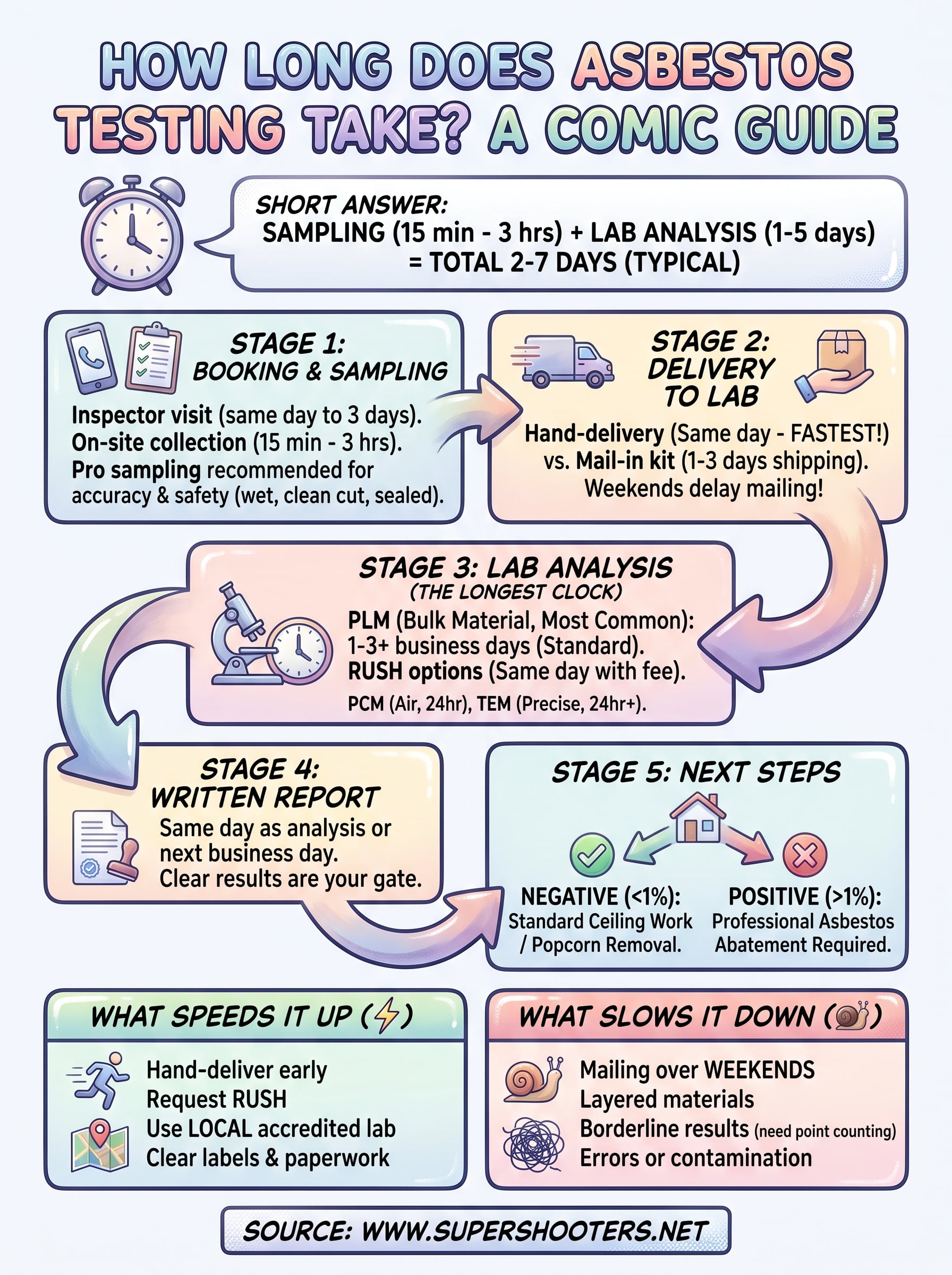
The short answer: how long does asbestos testing take depends on two separate clocks. Sampling on site takes 15 minutes to about 3 hours, and lab analysis usually takes 1 to 5 business days. Most homeowners have a written result 2 to 7 days after the first phone call. Asbestos testing means collecting a small piece of suspect material, such as popcorn ceiling texture, and having an accredited lab examine it under a microscope to learn whether asbestos fibers are present and in what percentage.
At Super Shooters, we remove acoustic and popcorn ceilings across the Sacramento Valley, and many of the homes we visit were built when asbestos in ceiling texture was common. The question we hear most often at a free consultation is how long the test will hold up the project. We have planned enough remodels around lab results to know where the days go.
This article breaks the timeline into its parts: why the wait matters, what happens at each stage, how long each lab method takes, what speeds results up or slows them down, and what to do once the report arrives.
Why the testing timeline matters before you start work
You cannot safely scrape, sand, or cut into a suspect ceiling until results are in, so the test timeline sets your whole project schedule. Knowing how long asbestos testing takes lets you book painters, flooring crews, and drywall work in the right order.
A two-to-seven day wait is the cheapest insurance in any ceiling project.
Test first, then schedule the work
Homes in the Sacramento Valley built before roughly 1980 often have textured ceilings, and some of that texture contains asbestos. You cannot tell by looking at it. Color, age, and sparkle prove nothing, so only a lab result settles the question . Testing is the gate for popcorn ceiling removal, drywall cuts, and even a quick scrape to "see what's under there."
Every trade after the gate depends on it. If you book a painter or floor installer before results arrive, you may pay for an idle crew or push the whole job back. Build the wait into your calendar first , then schedule everything else behind it.
Why guessing costs more than waiting
Asbestos-related disease typically appears decades after exposure, and health agencies have not identified an exposure level considered safe. The EPA's asbestos guidance says the safest move is to leave suspect material alone until it is tested. One brief, accidental disturbance carries low odds of harm by itself. Still, it is an avoidable risk, because fibers are light and can spread through a house on air currents and foot traffic.
If you have already disturbed a ceiling, stop work and keep people out of the room . Do not vacuum or sweep the debris, since that lifts fibers back into the air. Then arrange testing and wait for the result.
How asbestos testing works, step by step
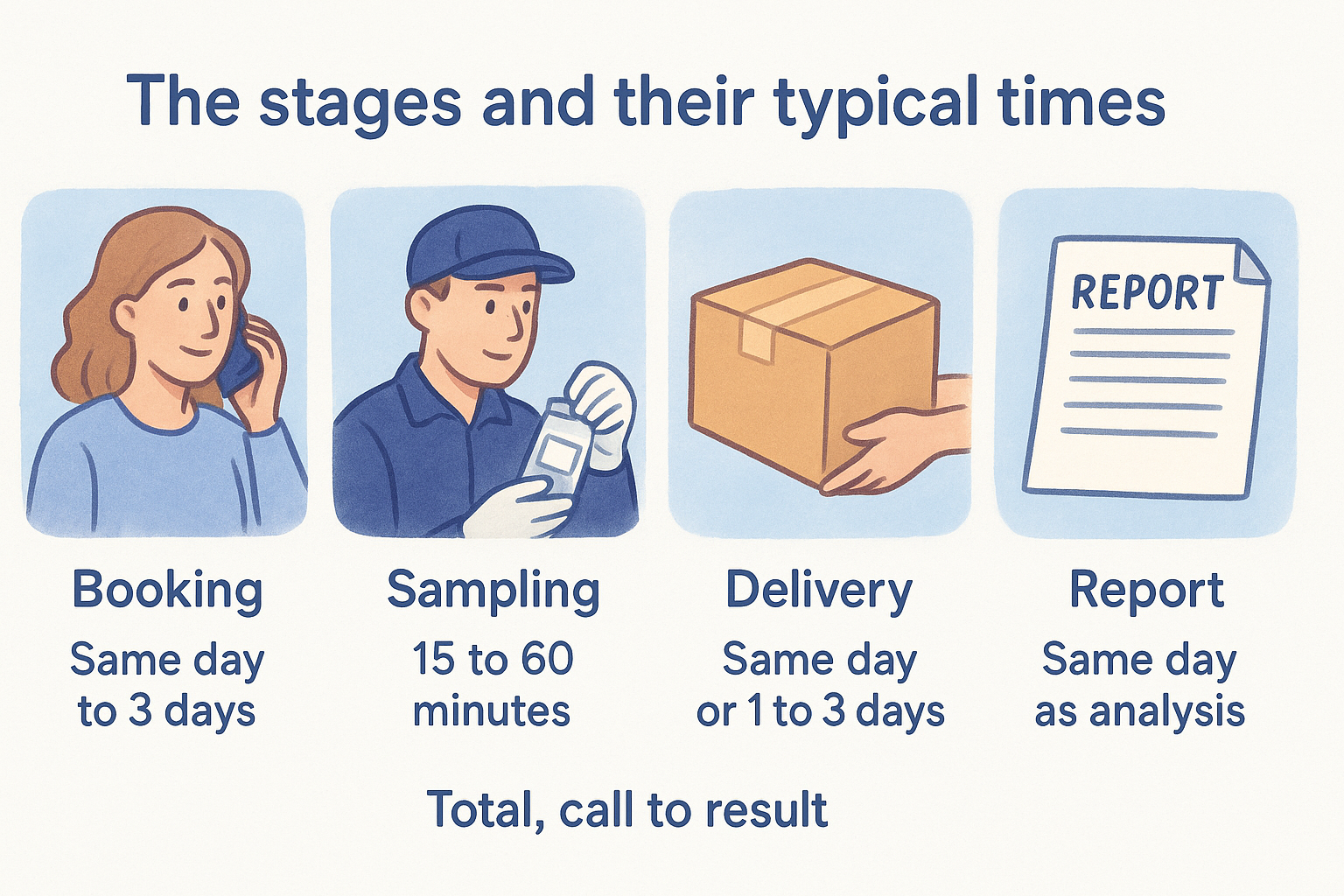
A full test runs in five stages: booking, sampling, delivery, lab analysis, and the report. For a typical house the whole sequence takes 2 to 7 days, and the lab stage is the longest piece.
The stages and their typical times
| Stage | Typical time |
|---|---|
| Booking an inspector or ordering a kit | Same day to 3 days, depending on availability |
| On-site sampling, single ceiling | 15 to 60 minutes |
| On-site sampling, whole house | 1 to 3 hours |
| Delivery to the lab | Same day if hand-delivered, 1 to 3 days if mailed |
| Lab analysis (PLM, bulk material) | 1 to 3 business days standard, same day with rush |
| Written report | Same day as analysis, or the next business day |
| Total, call to result | About 2 to 7 days |
Larger homes, several different materials, and limited access push sampling toward the longer end. A single popcorn ceiling in one room is the fastest scenario.
How many samples to expect
A common rule of thumb comes from federal school rules for surfacing materials. Inspectors take 3 samples for a uniform area under 1,000 square feet, 5 for 1,000 to 5,000 square feet, and 7 above that. Sampling extra spots barely adds time on site. It matters because every sample is a separate analysis , and a careful inspector samples each distinct material, such as ceiling texture, joint compound, and wall texture, separately.
Professional sampling versus a mail-in kit
A test kit is cheaper up front, but you collect the sample yourself and mail it, which typically adds 1 to 3 days of shipping. You also handle the material that you are trying to avoid disturbing. A professional wets the surface, takes a clean cut, and seals the sample, which keeps fibers down and keeps the lab from rejecting a poor sample. If you choose a kit, wear a respirator rated for fine particles, mist the spot first, and follow the lab's instructions exactly, as in our safe DIY sampling guide.
Hand-delivering a properly collected sample to a local lab is the fastest route to a result.
Lab turnaround by test method
The method sets the clock. Bulk samples like ceiling texture use polarized light microscopy(PLM) and come back fastest, while air tests and electron microscopy take longer.
What each method checks and how long it takes
| Method | What it checks | Typical turnaround |
|---|---|---|
| PLM | Asbestos in bulk materials like popcorn ceiling, tile, joint compound | 1 to 3 business days, up to 5 at some labs, same day with rush |
| PCM | Total airborne fiber count, cannot tell asbestos from other fibers | Same day to 24 hours |
| TEM | Identifies asbestos fibers in air or bulk with high precision | 24 hours to several business days |
| Point counting | Follow-up on low or borderline PLM results | Adds time on top of the PLM result |
For a homeowner asking how long asbestos testing takes for a house, PLM is almost always the test that matters . You will only meet PCM or TEM if air monitoring is needed during or after abatement.
Rush service and what it changes
Many accredited labs offer 24-hour or same-day PLM for a surcharge. Same-day service usually requires samples to arrive early in the day, often before noon. Asbestos testing prices vary by lab, so ask for the rush fee before you commit. Rush makes sense when a contractor, closing date, or move-in date is waiting on the result.
Standard turnaround is not always short
Some labs and inspectors report on a slower schedule, up to 10 days, particularly during busy periods or for small clients without a rush request. Ask for the turnaround in writing when you book. Also confirm the lab holds NVLAP accreditation, which you can verify through NIST's NVLAP program, because an unaccredited result can be rejected by contractors.
The lab method and the rush option decide your wait far more than the sampling visit does.
What speeds up or delays your results
Results arrive fastest when samples are collected correctly, hand-delivered early in the day, and sent to a local accredited lab. Almost every delay comes from shipping, paperwork, or a sample that needs extra analysis.
What speeds results up
- Book the inspector for a morning visit so samples reach the lab before the same-day cutoff.
- Hand-deliver samples instead of mailing them.
- Request rush service when a date is firm, and not by default.
- Label each sample clearly and fill out the chain-of-custody form completely.
- Use a lab in or near Sacramento to skip shipping altogether.
What slows results down
- Mailing samples, especially over a weekend.
- Layered materials, such as texture over paint over joint compound, which need extra prep to separate.
- A low or borderline PLM result that triggers point counting.
- A sample too small or contaminated to analyze, which forces a resample.
- Missing or illegible paperwork.
- Samples that arrive after the lab's daily cutoff, which are usually logged the next working day.
Weekends and holidays are the most overlooked delay. A sample dropped off Friday afternoon may not be analyzed until Monday, so a "1-day" turnaround can quietly become four days on the calendar. Book sampling early in the week when you can.
Most delays are shipping and paperwork problems, not lab problems.
What happens after the results come back
Once you have a report, you either proceed with normal ceiling work or plan a professional removal. Either way, the next step takes days rather than weeks to schedule.
Reading your results
A negative result means the sampled material did not show asbestos, so standard ceiling work can proceed. A positive result lists the asbestos type and its percentage. Most rules treat material above 1% asbestos as asbestos-containing, and California generally requires a certified contractor to remove more than 100 square feet of it.
Do not read a negative as a blanket clearance for the whole house. Each distinct material needs its own result , so a clean ceiling texture says nothing about the wall texture or flooring in the next room.
Planning removal or a clean ceiling
If your ceiling tests negative, a standard popcorn ceiling removal can usually be scheduled as soon as your calendar allows. If it tests positive, you need a contractor set up for asbestos abatement, with containment and cleanup procedures. Removal for a typical house is measured in days, not weeks, though square footage and access set the exact length.
A report in hand turns a worry into a schedule you can plan around.
Planning around the wait
Plan for about a week from first call to written result, and treat anything faster as a bonus. Share the result with your contractor before they quote, so the scope and schedule fit what the lab found.
If you are not sure whether your ceiling needs testing, book a free in-home consultation with Super Shooters. We will look at the age of the home and the texture, tell you what we would test, and help you line up the timing so your project does not stall. When you are ready to move forward, learn more about our asbestos acoustic ceiling removal service.