Share this article

May 16, 2026

How Many Drywall Sheets Do I Need? Easy Room Formula Guide

Buying too much drywall means wasted money sitting in your garage. Buying too little means a second trip to the hardware store and a stalled project. Either way, figuring out how many drywall sheets do I need is the first real step before any wall or ceiling job, and getting it right saves you time, money, and frustration .

The math itself isn't complicated, but there are details that trip people up, door and window cutouts, choosing between 4x8 and 4x12 sheets, and knowing how much joint compound and tape to buy alongside the panels. After completing over 10,000 drywall and ceiling projects across the Sacramento Valley, our team at Super Shooters has dialed in these calculations to the sheet. We use the same formulas and rules of thumb every day on jobs ranging from single-room repairs to full ADU build-outs .

In this guide, we'll walk you through a straightforward room-by-room formula, show you how to account for waste, and help you build an accurate materials list before you spend a dime. Whether you're tackling the project yourself or just want to understand what a contractor is quoting you, you'll have the numbers you need by the end.

What you need before you calculate

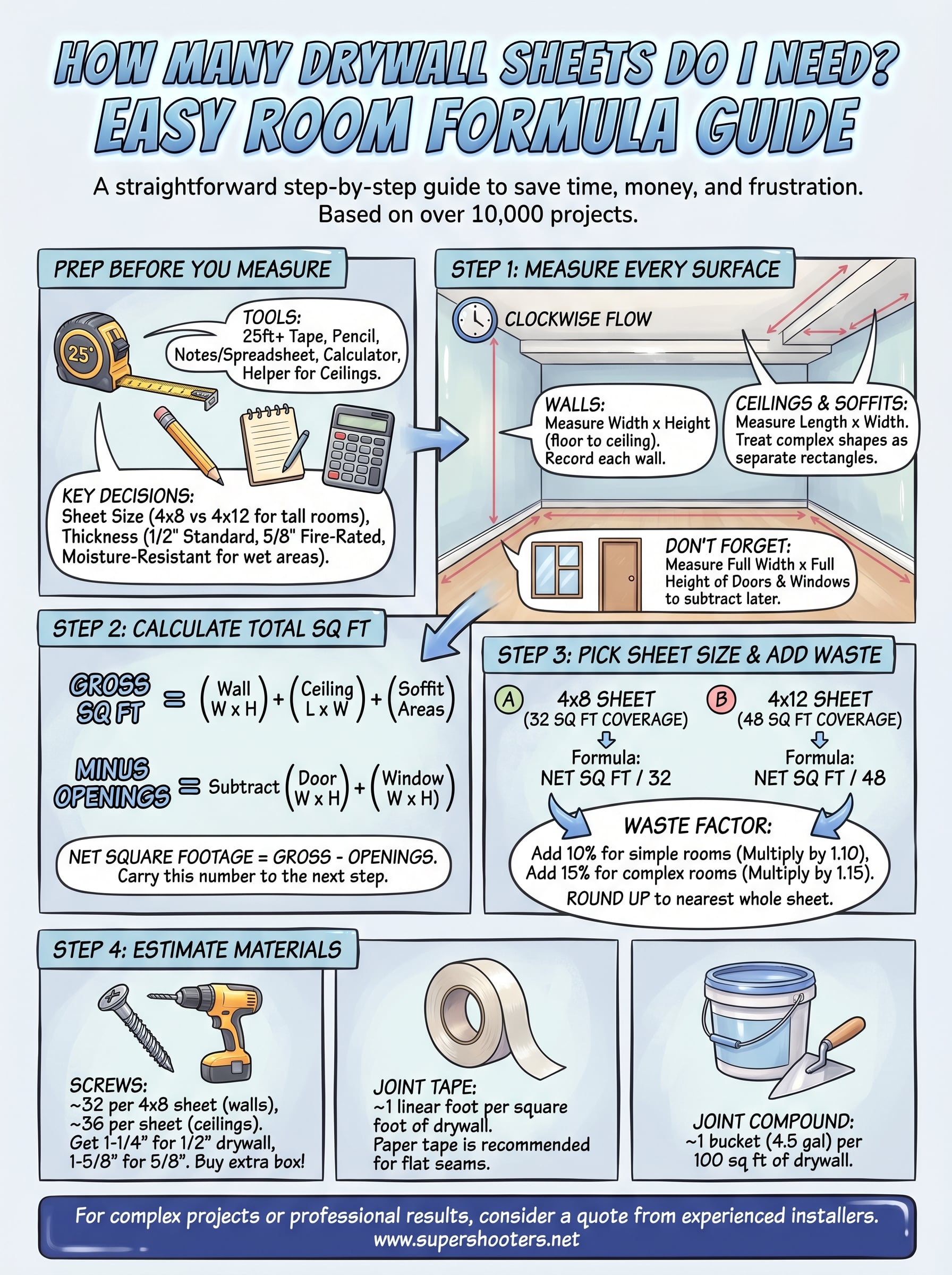
Before you pull out a tape measure, gathering the right tools and making a couple of decisions upfront will save you from redoing your numbers halfway through a job. Figuring out how many drywall sheets do I need starts with preparation, not math. The calculations only work accurately when you know what you're measuring and which sheet format you're buying before you write down a single number.

Tools and materials to gather first

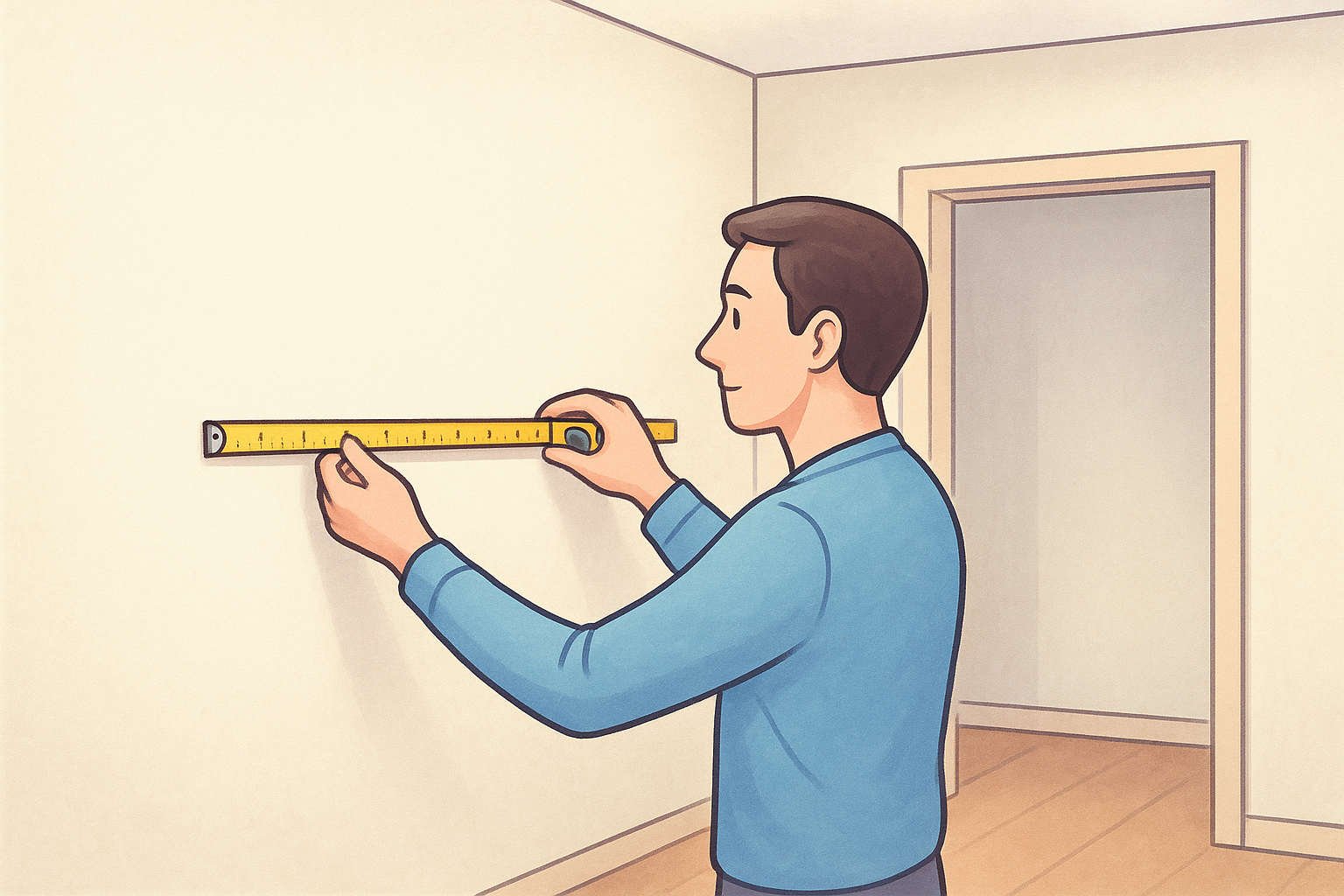
You don't need anything complicated, but having the right items on hand keeps the process clean and accurate. Grab a tape measure that's at least 25 feet long , a pencil, and either a notepad or a simple spreadsheet on your phone or computer. You'll record every wall, ceiling section, door, and window opening as a separate measurement, so organized notes matter more than you might expect. Skipping this step and trying to hold numbers in your head is where most DIYers end up short on sheets.

Here's what to have ready before you start measuring:

  • 25-foot tape measure (a 16-foot tape won't reach most room diagonals comfortably)
  • Pencil and graph paper, or a spreadsheet app on your phone
  • A basic calculator or calculator app
  • Architectural drawings or a floor plan, if your project has one
  • A helper for ceiling measurements , since solo measuring overhead causes errors

Ceiling measurements taken alone almost always come out wrong. A second set of hands holds the tape flat while you record the number accurately.

Key decisions to make before you measure

Two choices directly affect your final sheet count before you touch a tape measure: sheet size and drywall thickness . Standard sheets come in 4x8 feet, but 4x12 sheets work better for rooms with 9-foot ceilings or higher because they cut the number of horizontal seams significantly. Knowing which size you'll use changes how you divide your total square footage into individual panels, so commit to this early.

Thickness is the other variable you need to lock in. Half-inch drywall (1/2") covers the vast majority of interior walls and ceilings in residential homes. Five-eighths-inch panels are required by building code in many garages and between shared walls because of their fire resistance rating. Bathrooms, laundry rooms, and kitchens often call for moisture-resistant drywall , which you'll want to count and price separately since it costs more per sheet than standard panels.

The table below lays out the most common drywall types and where each one belongs:

Drywall Type Thickness Typical Application
Standard 1/2" Interior walls and ceilings
Fire-rated 5/8" Garages, shared/party walls
Moisture-resistant 1/2" Bathrooms, kitchens, laundry
Ultralight 1/2" Overhead ceiling installs

Making these decisions now means you build one accurate materials list from the start rather than going back to recalculate after you've already started buying.

Step 1. Measure walls, ceilings, and soffits

Accurate measurements are the foundation of figuring out how many drywall sheets do I need for any project. Record every surface separately in your notes, including walls, the ceiling, and any soffits or bump-outs that need coverage. Missing even one surface creates a gap between your material order and what actually shows up on job day.

How to measure walls

Start at one corner of the room and work clockwise so you don't skip a wall. Measure the width of each wall at floor level, then record the ceiling height straight up from the floor. Write both numbers down as a pair before moving to the next wall. For walls with angled sections or knee walls, break each one into simple rectangles and record them as separate measurements.

Record door and window openings as you go, because you'll subtract them in the next step. Measure the full width and full height of each opening and note which wall it belongs to. Don't skip small windows; every opening reduces your sheet count , and skipping them throws off your total.

Always measure every wall in the room even if two opposite walls look identical. Rooms are rarely perfectly square, and even a 2-inch difference can shift your sheet count.

How to measure ceilings and soffits

Ceiling measurements follow the same logic as walls. Measure the length and width of the ceiling from wall to wall, then write that number down before moving on. For L-shaped or non-rectangular ceilings, divide the area into separate rectangles and measure each section individually.

Soffits need the same careful treatment. Measure each flat face and each bottom face of a soffit as its own separate rectangle. A standard kitchen soffit above cabinets has a vertical face and a horizontal bottom, which gives you two distinct measurements for a single soffit. Record both before moving to your next surface.

Step 2. Convert measurements to square footage

With all your measurements recorded, the next step is converting those numbers into total square footage so you can start figuring out how many drywall sheets do I need. The formula is straightforward: multiply width by height for every surface you recorded, then combine the results into a single running total. Keep each calculation on a separate line in your notes so you can catch any mistakes before they carry through to your final sheet count.

Calculate gross square footage for each surface

For every wall, multiply its width in feet by its ceiling height in feet . A wall that measures 12 feet wide and 9 feet tall gives you 108 square feet. Repeat this for every wall, the ceiling, and each soffit face you recorded in Step 1. Add all of those individual results together to get your gross square footage , which is your starting number before any deductions.

Here's a simple example for a single room:

Surface Width (ft) Height (ft) Square Footage
Wall A 12 9 108
Wall B 10 9 90
Wall C 12 9 108
Wall D 10 9 90
Ceiling 12 10 120
Gross Total 516 sq ft

Subtract door and window openings

Once you have your gross total, subtract each door and window opening using the same width-times-height formula. A standard interior door at 32 inches wide by 80 inches tall equals roughly 17.8 square feet to deduct. A 36x48-inch window removes about 12 square feet. Work through every opening you noted in Step 1 and subtract each one from your gross total individually.

Small openings add up faster than most people expect; four standard windows in one room can reduce your total by nearly 50 square feet.

Subtracting all openings gives you your net square footage , which is the number you carry into Step 3. Write your gross and net totals separately so you can verify the math at a glance before you start pricing sheets.

Step 3. Pick sheet size, layout, and waste factor

Your net square footage from Step 2 becomes the input for this step, where you convert raw square footage into an actual sheet count. Two variables control that conversion: the sheet size you select and the waste factor you build in to cover cuts, damaged panels, and odd-shaped corners.

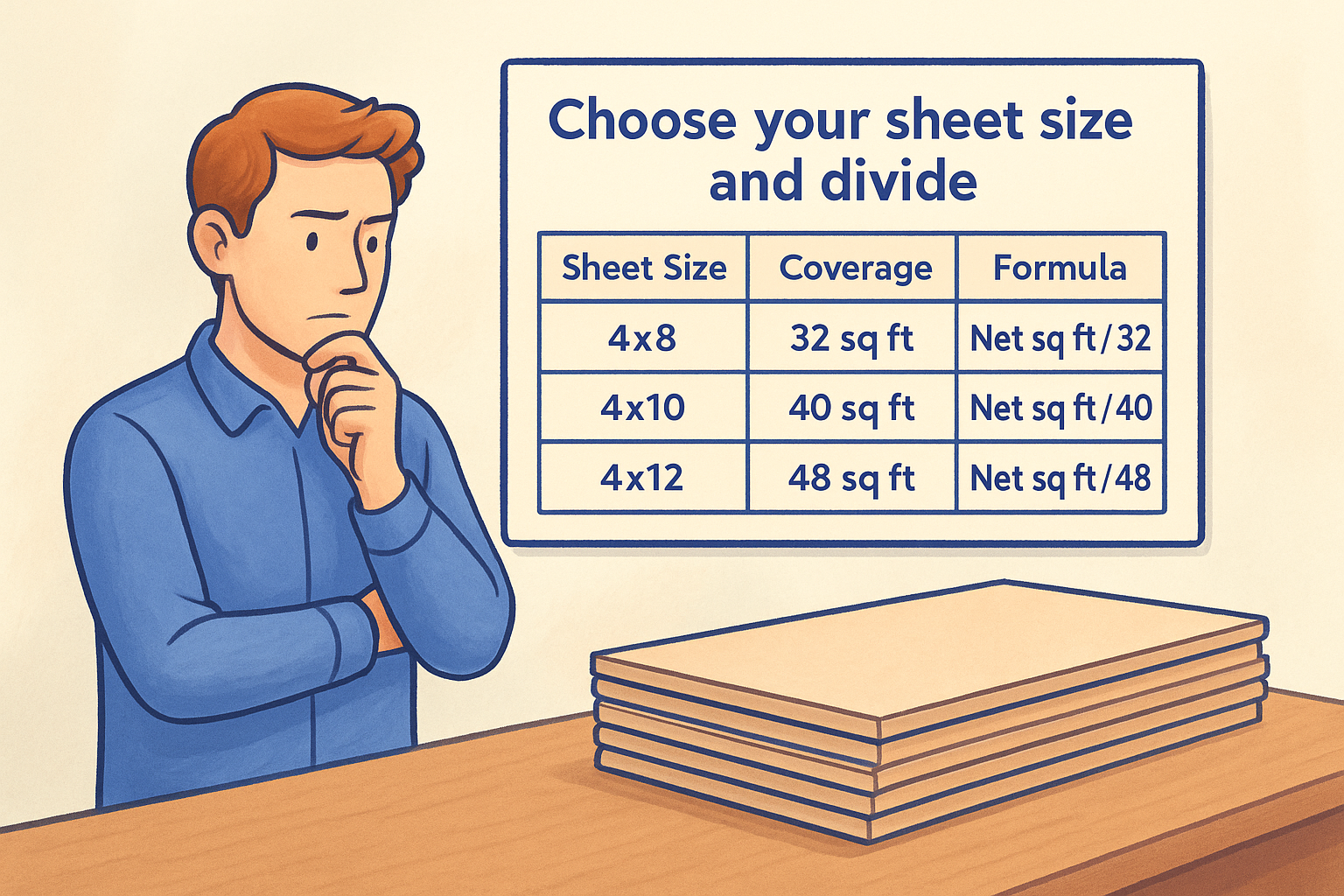
Choose your sheet size and divide

Standard 4x8 sheets cover 32 square feet each, while 4x12 sheets cover 48 square feet. Dividing your net square footage by the coverage per sheet gives you a baseline sheet count. For a room with gross measurements bringing it to 450 net square feet , a 4x8 layout requires 450 divided by 32, which equals roughly 15 sheets before waste.

Use the table below as a quick reference:

Sheet Size Coverage Formula
4x8 32 sq ft Net sq ft / 32
4x10 40 sq ft Net sq ft / 40
4x12 48 sq ft Net sq ft / 48

Rooms with 9-foot or taller ceilings almost always benefit from 4x12 sheets because running a single panel floor-to-ceiling eliminates the horizontal butt joint at mid-wall.

Apply the waste factor

Every drywall job produces offcuts, and some panels crack during handling. Adding a 10% waste factor is the standard approach for straightforward rectangular rooms. Multiply your baseline sheet count by 1.10 and round up to the next whole number. For rooms with lots of corners, angled walls, or complex soffits, bump that figure to 15% and round up again.

Here's how that looks using the 15-sheet baseline example:

  • Baseline sheets: 15
  • 10% waste (simple room): 15 x 1.10 = 16.5, rounded up to 17 sheets
  • 15% waste (complex room): 15 x 1.15 = 17.25, rounded up to 18 sheets

Answering how many drywall sheets do I need comes down to this final rounded number, which is what you bring to the lumber yard or put into your materials order.

Step 4. Estimate screws, tape, and joint compound

Once you have your final sheet count, the rest of your materials list follows directly from that number . Screws, joint tape, and joint compound all calculate off the same square footage you used to figure out how many drywall sheets do I need, so you can build a complete order in one pass without guessing at the lumber yard.

Drywall screws

Drywall screws follow a simple ratio : plan on 32 screws per 4x8 sheet for walls and 36 screws per sheet for ceilings, where panels need tighter spacing to hold against gravity. For a 17-sheet wall job, that works out to roughly 544 screws. Screws come in 1-pound and 5-pound boxes, and a 5-pound box holds approximately 150 to 200 screws depending on length, so two 5-pound boxes cover most single-room projects with a small buffer left over.

Always buy one extra box of screws; running short mid-installation costs more in lost time than the box is worth.

Screw length depends on your panel thickness : use 1-1/4-inch screws for 1/2-inch drywall going into wood framing and 1-5/8-inch screws for 5/8-inch panels. Coarse-thread screws work for wood studs, while fine-thread screws are the correct choice for metal framing.

Tape and joint compound

Joint tape runs at roughly 1 linear foot per square foot of drywall , so a 450-square-foot room needs about 450 feet of tape. Standard rolls come in 75-foot and 250-foot lengths, which makes your roll count easy to calculate. Paper tape outperforms mesh on flat seams because it produces a stronger joint that resists cracking over time.

Mud sizing is just as predictable. Plan on one 4.5-gallon bucket of joint compound per 100 square feet of drywall coverage. Use the table below to size your order before you head to the store:

Net Square Footage Joint Compound Needed
Up to 100 sq ft 1 bucket (4.5 gal)
101-200 sq ft 2 buckets
201-400 sq ft 4 buckets
401-600 sq ft 6 buckets

Next steps for your drywall project

Now that you know how many drywall sheets do I need for your specific room, you have everything required to build a complete materials list before you spend any money. Pull your net square footage , apply the waste factor, and use the screw, tape, and compound ratios from Step 4 to finish the order in one pass. Write out every item with a quantity and bring that list to the lumber yard so you buy once and buy right.

Some projects are straightforward enough to tackle yourself, while others, including ceilings, fire-rated assemblies, or rooms with complex angles , benefit from a professional installation to avoid costly mistakes. If your project falls into that category, or if you just want the job done cleanly the first time, the team at Super Shooters has completed over 10,000 residential drywall projects across the Sacramento Valley. Get a free in-home estimate and find out exactly what your project needs.

Recent Posts

By cinchweb May 16, 2026
Learn how much does drywall cost in 2026. Get current rates per square foot, material prices, and labor estimates to budget your project with confidence.
By cinchweb May 14, 2026
Explore 7 professional drywall texturing techniques to upgrade your home. Learn how to apply knockdown, orange peel, and skip trowel finishes with ease.
By cinchweb May 14, 2026
Learn how to remove wallpaper from drywall without damage. Our guide covers safe peeling, glue removal, and prepping your walls for a fresh coat of paint.
By cinchweb May 12, 2026
Learn what to do after popcorn ceiling removal. Fix drywall damage, apply a smooth skim coat, and get a professional paint finish with these easy steps.
By cinchweb May 12, 2026
Learn how to drywall a garage with our complete guide. Discover essential tools, fire-rated panels, insulation, and costs for a professional, durable result.
By cinchweb May 10, 2026
Identify and repair 6 common types of drywall damage. From water stains to cracks, learn how to fix your walls fast and get professional, lasting results.
By cinchweb May 9, 2026
Learn how to fix cracks in plaster walls. Assess the damage, secure loose areas with plaster washers, and apply compound for a seamless, lasting repair.
By cinchweb May 9, 2026
Learn how to texture drywall walls with our guide to orange peel and knockdown finishes. Master mud consistency, tool selection, and expert techniques.
By cinchweb May 7, 2026
Learn how to repair water damaged drywall with our guide. Fix leaks, dry framing, and follow steps to patch and finish walls or ceilings for a seamless look.
Show More