May 14, 2026
7 Drywall Texturing Techniques And Tools You Can Use Today
Flat drywall is clean, but it shows every imperfection, every seam, every patch, every slight wave in the surface. That's exactly why drywall texturing techniques exist. Texture hides flaws, adds visual depth, and gives your walls and ceilings a finished look that flat surfaces simply can't match. Whether you're wrapping up a remodel or refreshing a room that feels outdated, knowing which texture to use, and how to apply it , makes all the difference.
At Super Shooters, we've applied texture to walls and ceilings across more than 10,000 homes in the Sacramento Valley over the past 30+ years. Our crews work with every method on this list, day in and day out. That hands-on experience is exactly what shaped this guide, we're breaking down seven proven techniques so you can understand your options and decide what's right for your project.
Below, you'll find each technique explained with the tools you'll need and practical steps to get the job done. Some are beginner-friendly, others take a steadier hand. We'll be straight with you about which ones to DIY and which ones to leave to a pro .
1. Professional texture matching and application
When you have a patched wall or a newly drywalled room that needs to blend with the rest of your home, professional texture matching is the most reliable option. A skilled applicator reads the existing surface, mixes compound to the right consistency, and applies it so the repair disappears into the surrounding wall . This is the foundation that every other drywall texturing technique builds on.
What you get
Professional texture matching gives you a seamless, consistent finish across your entire wall or ceiling. Instead of a visible patch or a mismatched pattern , the repaired area looks like it was always part of the original surface, which matters most in high-visibility rooms.
Best places to use it
This technique works best on walls and ceilings where texture already exists and you need a repair or addition to blend in. Common situations include:
- After drywall patches or water damage repairs
- When extending a room into a new addition
- After popcorn ceiling removal , where you want a clean replacement texture
Tools and materials
You'll need joint compound (pre-mixed or dry powder), a texture sprayer or hopper gun for spray-style textures, a selection of trowels and knives, sandpaper, primer, and paint. The exact tools always depend on the original texture style you're matching.
How the process works
First, you identify the original texture pattern by examining the surface closely. Then you mix compound to the right consistency, apply a test patch on scrap drywall , adjust your technique, and apply to the actual surface once the test matches.
Getting the compound consistency right before you touch the wall saves you from scraping off wet texture and starting over.
Tips to match existing texture
- Photograph the existing texture under raking light before you start
- Always test on scrap drywall board first , not the wall itself
- Let the test patch dry fully before you compare it to the original
Time and cost expectations
A small repair patch typically takes two to four hours including dry time. Full rooms or ceilings run one to two days. Professional services in the Sacramento Valley generally fall between $1 and $3 per square foot , depending on texture complexity and ceiling height.
2. Orange peel spray with a hopper gun
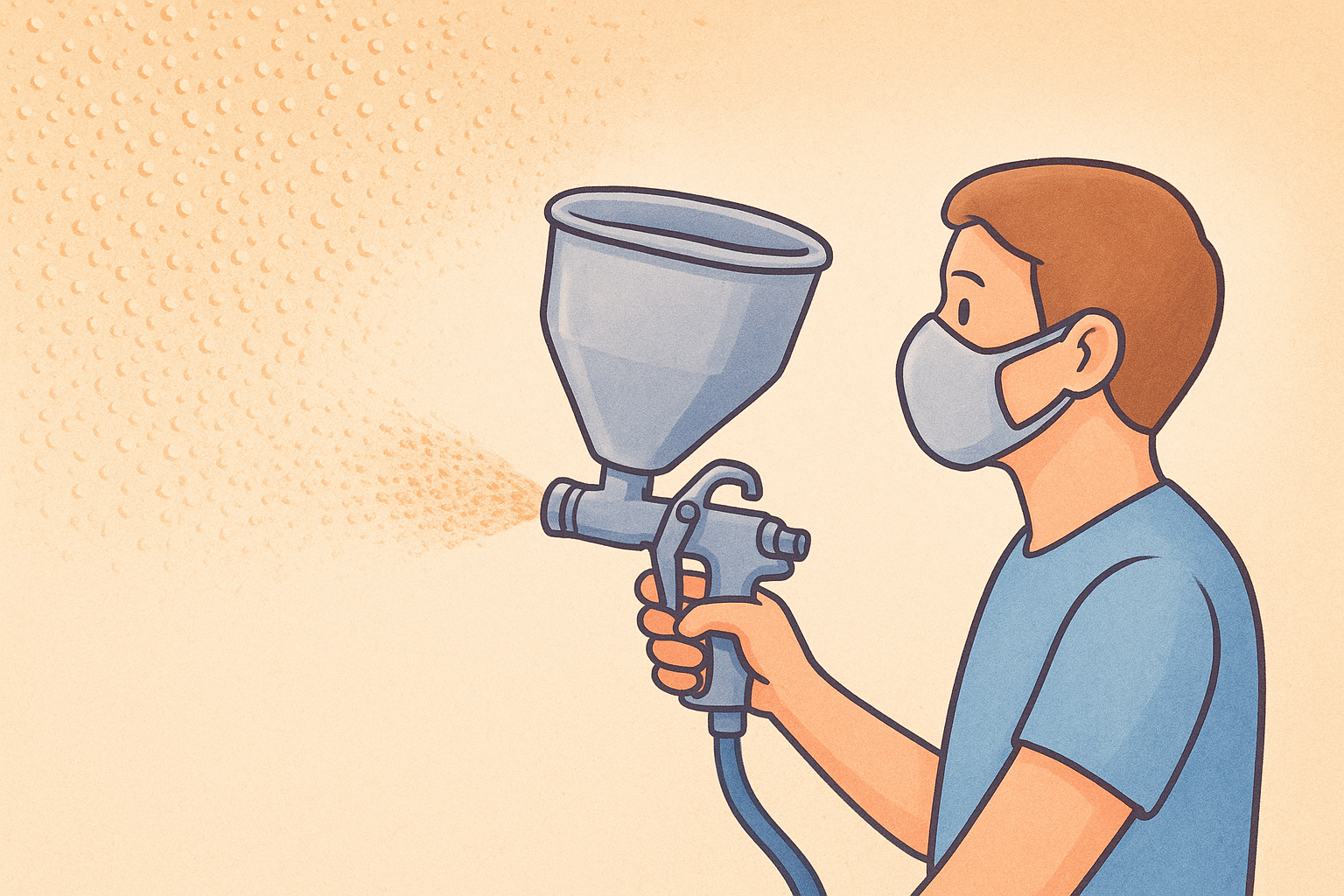
Orange peel is one of the most common drywall texturing techniques used in residential construction today. It gets its name from the small, rounded bumps that mimic the skin of an orange, and it applies quickly once you have the right equipment set up.
What you get
You get a subtle, uniform bump pattern spread evenly across your wall or ceiling. The texture hides minor surface flaws without drawing attention to itself, which makes it a practical choice for everyday living spaces.
Best places to use it
This technique works well in bedrooms, hallways, and living rooms where you want a clean, consistent look. It also holds up well on garage walls since the surface is easy to wipe down.
Tools and materials
You'll need a hopper gun and air compressor , pre-mixed joint compound thinned to a runny consistency, primer, and paint. A fine-tip nozzle gives you the tightest, most consistent bead size.
How to apply it
Thin your compound to roughly the consistency of pancake batter , load the hopper, then hold the gun 8 to 12 inches from the wall and spray in steady, overlapping passes. Let everything dry completely before you prime.
Test your spray pattern on scrap drywall first. Bead size shifts with air pressure and compound thickness, so dial it in before touching the actual wall.
Tips to match existing texture
Compare your test patch under the same lighting as the existing surface. Adjust air pressure until the bead size looks identical to what surrounds it.
Time and cost expectations
A single room takes three to five hours including dry time. Materials typically run $50 to $150 for a standard bedroom.
3. Knockdown texture with spray and knife
Knockdown texture builds on the orange peel method by adding one extra step: you spray compound onto the surface, then drag a wide drywall knife across the wet peaks to flatten them. The result is an irregular, layered pattern with more visual depth than a standard spray finish.
What you get
You get a random, flattened surface where each peak catches light at a slightly different angle. The variation gives your walls more character than smoother options without looking busy.
Best places to use it
Knockdown works well in living rooms, dining rooms, and on ceilings where you want a finish that draws the eye. It also hides uneven seams better than most other drywall texturing techniques .
Tools and materials
You need a hopper gun and air compressor , pre-mixed joint compound thinned slightly, and a 12 to 18-inch knockdown knife with a flexible blade.
How to apply it
Spray the compound in light, random passes , then wait three to five minutes until the peaks lose their shine. Drag your knife at a low angle across the surface with minimal pressure to flatten the tops.
If you wait too long, the compound stiffens and tears instead of flattening cleanly, so keep a close eye on the surface after spraying.
Tips to match existing texture
Match the knife angle and pressure from your test patch before moving to the wall. Pay close attention to how tightly spaced the flattened areas are on the original surface.
Time and cost expectations
One room takes four to six hours including dry time. Materials typically run $60 to $180 for a standard space.
4. Skip trowel finish with a trowel
Skip trowel is a hand-applied drywall texturing technique that creates a natural, irregular look by dragging a curved trowel across wet compound in loose, overlapping strokes. Unlike spray methods, every pass is controlled by hand, which means no two walls ever look exactly the same .
What you get
You get a soft, organic pattern with shallow, rounded ridges and open areas where the base coat shows through. The finish reads as earthy and artisan without being heavy or overpowering.
Best places to use it
Skip trowel suits living rooms, bedrooms, and dining rooms where you want texture that feels intentional. It also works well on accent walls where the handmade quality adds visual interest.
Tools and materials
You need pre-mixed joint compound , a flexible 18-inch trowel, a mud pan, a hawk, and a primer rated for textured surfaces. Thin the compound slightly so it spreads without tearing.
How to apply it
Load a small amount of compound onto your hawk , scoop it onto the trowel, and apply it in short, angled strokes at a low angle. Skip across the surface randomly and let some base show through between each pass.
Keeping your trowel angle consistent at roughly 15 to 20 degrees gives you clean edges without gouging the surface underneath.
Tips to match existing texture
Study the stroke length and density on the original wall before you test. Adjust how much compound you load per pass until the coverage percentage matches closely.
Time and cost expectations
A standard room takes five to seven hours including dry time. Materials typically run $40 to $120 for a bedroom-sized space.
5. Stomp brush texture and knockdown
Stomp brush texture is one of the more physical drywall texturing techniques on this list. You press a stiff-bristled brush into wet compound, pull it straight back, and repeat across the entire surface. Once the peaks dry slightly, you can flatten them with a knife for a softer knockdown version, or leave them as sharp spikes for a more dramatic finish.
What you get
You get a bold, spiked pattern with peaks that radiate outward from each brush impression. The result has more texture depth than spray methods, which makes it a strong choice when you want walls that stand out rather than blend in.
Best places to use it
This technique works best on ceilings and accent walls in family rooms or entryways where heavy visual texture fits the space. Avoid it in tight rooms where the pattern can feel overwhelming at close range .
Tools and materials
You need pre-mixed joint compound , a stomp brush or a standard masonry brush, a roller to apply the base coat, a mud pan, and a wide knockdown knife if you want the flattened variation.
How to apply it
Roll compound onto the surface in a thick, even coat , then press the stomp brush firmly into the wet mud and pull it straight back. Repeat in a random, overlapping pattern across the whole area.
Work quickly because compound that dries too much before stamping produces uneven peaks that are difficult to fix without scraping the wall clean.
Tips to match existing texture
Pay close attention to the spacing between each brush impression on the original surface. Too much overlap tightens the pattern; too little spacing makes it look scattered and uneven .
Time and cost expectations
A standard room takes four to six hours including dry time. Materials typically run $50 to $140 for a bedroom-sized space.
6. Roll-on texture with a thick nap roller
Roll-on texture is one of the most accessible drywall texturing techniques available to homeowners. You apply thinned compound directly with a roller, and the thick nap fibers pull the material into a random, stippled pattern as they lift off the surface.
What you get
You get a low-profile, random stipple across the entire wall or ceiling. The pattern is subtle enough to hide minor surface flaws without dominating the room visually.
Best places to use it
This technique fits well in utility rooms, bathrooms, and hallways where you want a finished look without heavy texture. It also works on garage interiors where a clean, easy-to-apply finish is the priority.
Tools and materials
You need pre-mixed joint compound thinned to a loose consistency, a thick nap roller (¾-inch or 1-inch), a standard roller frame, a paint tray, and primer.
How to apply it
Thin your compound until it spreads easily without dragging , load your roller fully, and apply it in overlapping passes. Work in manageable sections so the compound stays wet and consistent throughout.
Roll in one direction on your first pass, then lightly roll perpendicular to even out any thick buildup before the compound sets.
Tips to match existing texture
Check the nap size on the original surface before you buy your roller. A finer nap produces tighter stippling, while a coarser nap creates more pronounced peaks .
Time and cost expectations
A standard room takes three to five hours including dry time. Materials typically run $30 to $90 for a bedroom-sized space.
7. Comb texture with a notched trowel
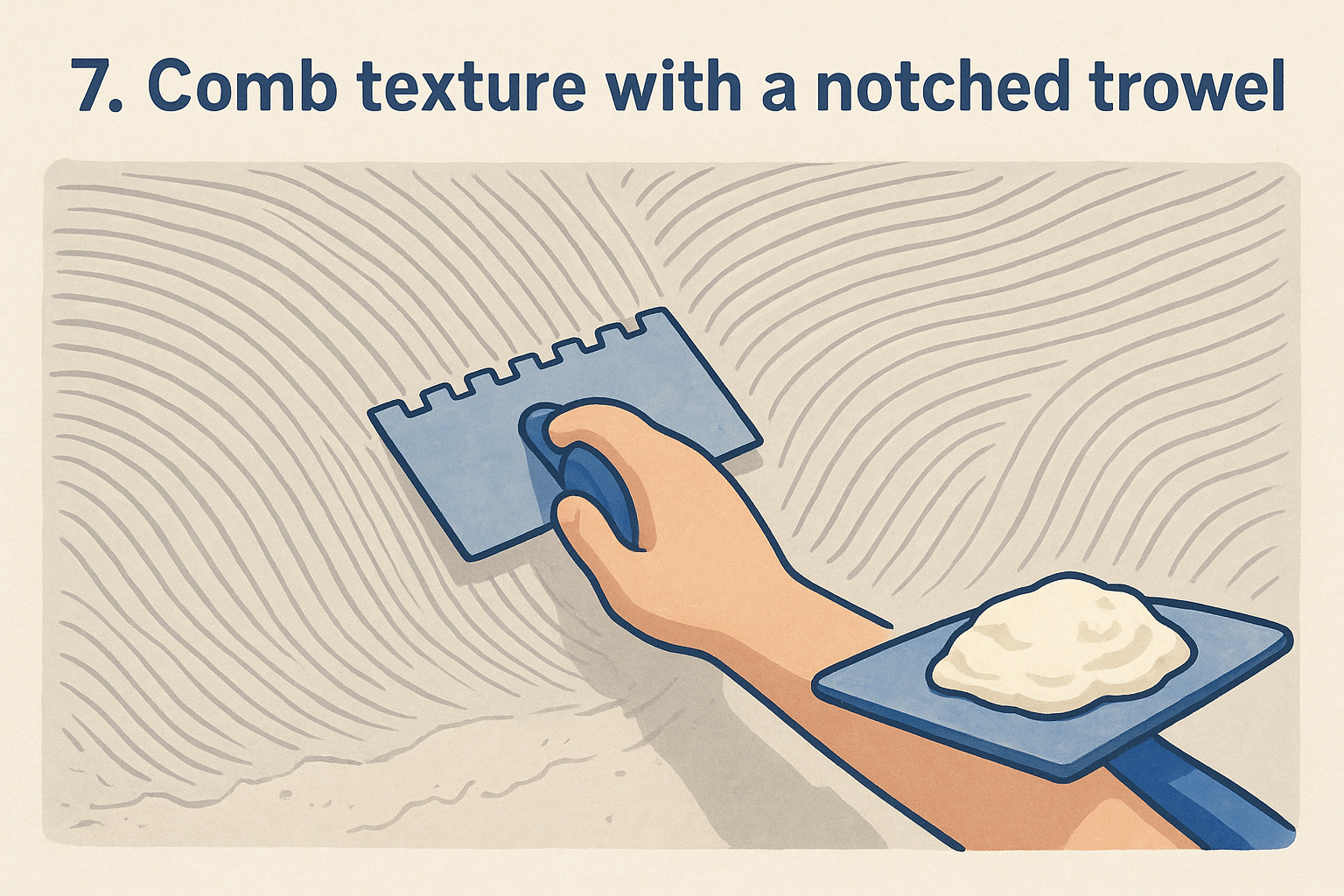
Comb texture is one of the most distinctive drywall texturing techniques you can apply by hand. You drag a notched trowel through wet compound to pull parallel lines or curved patterns across the surface. The result is geometric and deliberate, unlike any spray-based finish on this list.
What you get
You get clean, repeating grooves cut directly into the compound. The lines can run straight, curved, or in arcs depending on how you move your wrist, giving you more creative control over the final look than most other texture methods.
Best places to use it
This technique works best on accent walls and feature ceilings in dining rooms or entryways where a bold, graphic pattern fits the design. Avoid it in rooms where you want a subtle or understated finish .
Tools and materials
For this technique, gather pre-mixed joint compound , a notched trowel, a hawk, a mud pan, and primer. The notch size on your trowel determines groove width, so wider notches produce bolder lines and tighter notches create finer detail.
How to apply it
Apply a smooth, even base coat of compound first, then drag your notched trowel through it in consistent strokes before it sets. Keep each pass moving in the same direction to maintain a clean, uniform pattern throughout the surface.
Keeping your trowel pressure steady prevents the grooves from varying in depth, which would make the whole pattern look uneven.
Tips to match existing texture
Match the notch size and stroke direction on a test patch before you touch the actual wall. Pay close attention to whether the original lines run straight or in curves , since even a small mismatch breaks the pattern noticeably.
Time and cost expectations
A standard room takes three to five hours including dry time. Materials typically run $40 to $100 for a bedroom-sized space.
Pick the texture that fits your home
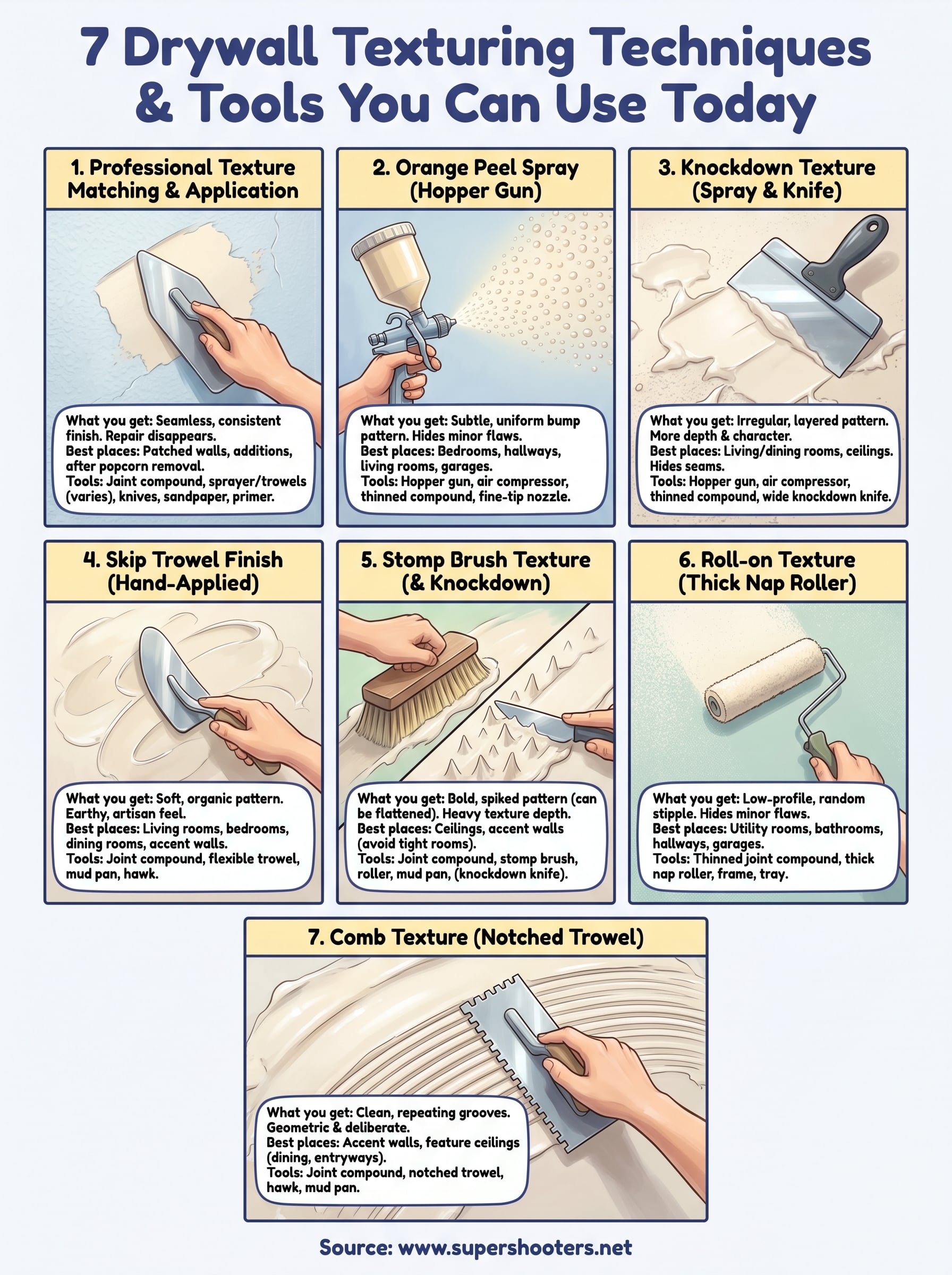
Seven drywall texturing techniques are on this list, and each one suits a different goal. If you want something subtle that hides imperfections, roll-on or orange peel keeps the wall quiet. If you want depth and character, skip trowel and knockdown give your surfaces something worth looking at. Bold geometric spaces call for comb texture, while stomp brush earns its place on ceilings and feature walls where heavy pattern works in your favor.
Your biggest decision comes down to skill level and available tools . Spray methods need a compressor and hopper gun, and hand techniques require practice to stay consistent. Matching an existing texture is always harder than starting fresh, and a bad patch stands out far more than a blank wall ever would.
When the result matters, bring in a pro. The team at Super Shooters has handled every texture style across thousands of Sacramento Valley homes. Get a free estimate today and see what the right finish looks like done right.
Recent Posts